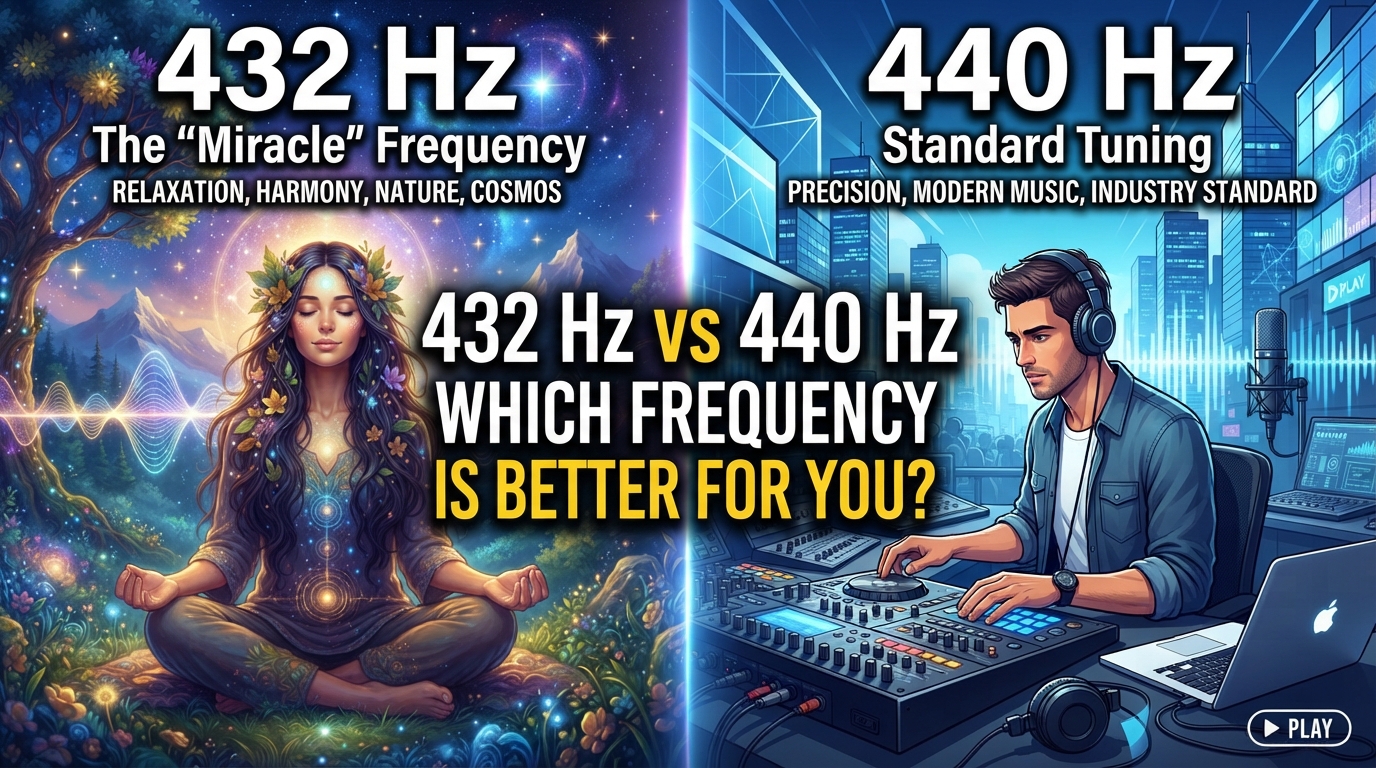
432Hz vs. 440Hz: The Fascinating Debate Over Sound, Music, and Well-Being
Introduction: Why Are 432Hz and 440Hz So Different?
Few debates in the world of music and sound are as intriguing as the discussion surrounding 432Hz and 440Hz.
Today, most Western music is tuned so that the note A above middle C corresponds to 440Hz. This tuning standard makes it possible for musicians, orchestras, and instruments from around the world to perform together with greater consistency.
Yet in recent years, 432Hz tuning has attracted growing attention among musicians, meditation practitioners, sound-healing enthusiasts, and people interested in spirituality. Supporters often describe 432Hz music as warmer, softer, or more relaxing, while some believe that it has a special connection with nature and the human body.

But how much of this is supported by science, and how much comes from tradition, symbolism, or personal experience?
The answer is more nuanced than simply saying that one frequency is “good” and the other is “bad.”
In this guide, we will explore what 432Hz and 440Hz actually mean, why 440Hz became the modern tuning standard, what research suggests about their possible effects, and how you can experience the difference for yourself.
1. 432Hz and 440Hz Explained: What Is the Actual Difference?
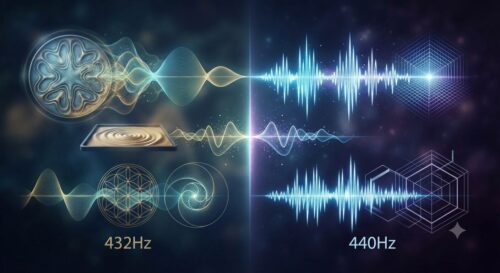
Before discussing the spiritual or emotional qualities associated with these tunings, it is important to understand what the numbers actually represent.
Hertz (Hz) is a unit used to describe frequency, meaning the number of cycles or vibrations occurring each second.
When musicians say that an instrument is tuned to A=440Hz, they mean that the note A above middle C has a fundamental frequency of 440 cycles per second.
With A=432Hz, that same reference note is tuned slightly lower.
This difference affects the pitch of the entire musical system, not just a single note.
432Hz: A Lower Tuning With a Softer Character
Music tuned to A=432Hz is approximately 32 cents lower than music tuned to A=440Hz.
That difference is small, but it is large enough to be audible when the two versions are compared directly.
Many listeners describe 432Hz music as:
- warmer
- softer
- more spacious
- calmer
- less bright
These descriptions are subjective, however. The experience can depend on the listener, the instrument, the arrangement, the recording, and even the volume at which the music is played.
The idea that 432Hz is inherently a “natural frequency” is common in spiritual and wellness communities, but this is not an established scientific fact.
440Hz: The Modern Reference Standard
A=440Hz is the most widely used modern reference pitch in Western music.
It provides musicians with a consistent point of reference when tuning instruments and performing together. This consistency is especially important for orchestras, concert halls, recordings, instrument manufacturers, and international musical collaboration.
It is sometimes described by 432Hz advocates as harsh or overly bright, but there is no scientific basis for the idea that 440Hz is inherently harmful or that it automatically produces anxiety.
Millions of people listen to music based on A=440Hz every day without experiencing any particular negative effect from the tuning itself.
The Important Difference
The simplest way to understand the distinction is this:
432Hz and 440Hz are two different tuning references.
They are not two completely different kinds of sound, nor are they opposites in terms of health.
A song played at 432Hz and the same song played at 440Hz will have the same basic musical structure, but the 432Hz version will sound slightly lower in pitch.
| Feature | 432Hz Tuning | 440Hz Tuning |
| Status | Popular in wellness, meditation, and alternative music scenes | The modern international reference standard (ISO 16) |
| Perceived Sound | Described as warmer, softer, and less bright | The standard brightness used in worldwide music |
| Scientific Evidence | Limited research; subjective relaxation effects depend on expectation | No evidence of harm; practical standard for global musical collaboration |
| Primary Use Case | Meditation, sound healing, and personal relaxation | Orchestras, live concerts, recordings, and global collaboration |
2. The Spiritual Meaning of 432Hz: Nature, Resonance, and Inner Harmony
The fascination with 432Hz extends far beyond music theory.
For many people, the frequency has become part of a broader spiritual philosophy centered on harmony, natural rhythms, and the idea that sound can influence consciousness.

Why Is 432Hz Associated With Nature?
The number 432 has been given special significance in various spiritual and numerological traditions. Some proponents argue that it appears in mathematical relationships connected with nature, astronomy, geometry, and ancient civilizations.
These connections are often presented as evidence that 432Hz is somehow built into the structure of the universe.
However, many of these claims involve selective interpretations of numbers rather than established scientific relationships.
That does not mean that 432Hz has no value. It simply means that its spiritual meaning should be understood as symbolic or philosophical rather than scientifically proven.
432Hz and the Schumann Resonance
One particularly common claim is that 432Hz is connected to the Schumann resonances, natural electromagnetic resonances of the Earth-ionosphere system.
The primary Schumann resonance is approximately 7.83Hz, not 432Hz.
Some people attempt to connect 432Hz to this value through mathematical harmonics or multiplication, but this does not establish a scientifically recognized special relationship between 432Hz music and the Earth’s electromagnetic field.
This distinction is important because the idea sounds scientific while often relying on a much looser interpretation of resonance.
Music as a Spiritual Practice
Even without a special cosmic frequency, music can have a profound role in spiritual and contemplative traditions.
Across cultures, music and rhythm have been used for:
- meditation
- prayer
- ritual
- emotional expression
- communal bonding
- relaxation
- altered states of consciousness
From this perspective, the appeal of 432Hz may be less about possessing a unique supernatural property and more about the way people use it.
If a particular tuning helps someone slow down, breathe more deeply, meditate, or become more emotionally present, that subjective experience can still be meaningful.
3. What Does Science Say About 432Hz vs. 440Hz?
This is where the discussion becomes especially interesting.
There have been studies examining whether music tuned to 432Hz may influence physiological or psychological measures differently from music tuned to 440Hz.
Some small studies have reported differences in measures such as heart rate, blood pressure, anxiety, or subjective relaxation when participants listened to music tuned to different reference pitches.
However, the existing research is still limited.
Sample sizes are often small, experimental designs vary, and it is difficult to determine whether any observed effect comes specifically from the tuning frequency itself or from other aspects of the musical experience.
The Role of Expectation
Expectation can also influence how people experience music.
If someone strongly believes that 432Hz music is calming or spiritually meaningful, that belief may shape their subjective response. This does not make the experience meaningless. It simply means that psychological expectations can be part of the experience.
The same principle applies in reverse.
Someone who expects 440Hz music to feel harsh may be more likely to notice qualities that confirm that expectation.
Does 432Hz “Heal” the Body?
There is currently not enough scientific evidence to conclude that 432Hz directly heals physical illnesses or produces unique medical benefits.
Music itself, however, has been widely studied as a way to influence mood, stress, relaxation, and emotional well-being.
Therefore, it is reasonable to use 432Hz music as part of a relaxation or meditation routine if you enjoy it, while avoiding claims that it can replace medical treatment.
Is 440Hz Harmful?
There is also no solid scientific evidence that standard A=440Hz tuning is inherently harmful, toxic, or responsible for anxiety.
The idea that 440Hz was deliberately introduced to negatively influence human consciousness is a popular claim online, but it is not supported by reliable historical evidence.
The adoption of 440Hz was primarily connected to the practical need for standardized musical tuning.
4. Why Did 440Hz Become the Standard?
The history of musical tuning is much more complicated than a simple switch from “natural” 432Hz to “modern” 440Hz.
For centuries, musicians used different reference pitches. The exact pitch of A could vary significantly depending on the country, city, ensemble, instrument, and historical period.
This created practical problems.
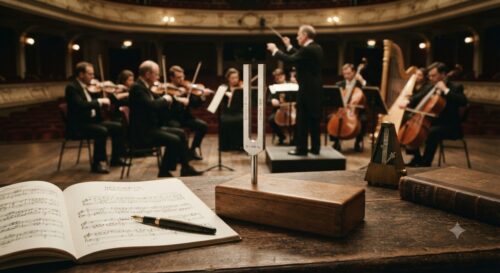
The Need for Standardization
As international musical collaboration increased, having a common reference pitch became increasingly useful.
An orchestra traveling from one city to another needed instruments and musicians to work together without constantly adapting to dramatically different tuning systems.
In the 20th century, A=440Hz gradually became the dominant international reference.
The International Organization for Standardization (ISO) published ISO 16 in 1955, establishing 440Hz as the standard frequency for A above middle C.
This was fundamentally a matter of musical consistency.
Why Didn’t Everyone Use 432Hz?
There is an important misconception here.
The world did not simply use 432Hz for thousands of years and then suddenly replace it with 440Hz.
Historical tuning practices were diverse, and there was no single universal standard throughout history.
The pitch of A varied considerably across different periods and locations.
Some composers and musicians did use tuning systems close to A=432Hz, while others used considerably higher or lower reference pitches.
Therefore, describing 432Hz as the universal “original tuning” of ancient music would be historically misleading.
Why 432Hz Remains Popular
Despite the lack of evidence for a universal ancient standard, 432Hz has developed a powerful modern identity.
For some listeners, it represents:
- simplicity
- natural harmony
- meditation
- spiritual awareness
- relaxation
- a connection with nature
Those associations can make 432Hz music especially attractive for wellness and contemplative practices.
5. 432Hz vs. 440Hz: Which One Should You Listen To?
There is no universal answer.
The best choice depends on what you are trying to achieve and, importantly, which sound you personally prefer.

Try the Same Music in Both Tunings
One of the easiest ways to explore the difference is to listen to the same piece in both versions.
Find a recording available in both A=432Hz and A=440Hz.
Listen to one version for several minutes without switching back and forth too quickly.
Then try the other.
Pay attention to:
- your breathing
- your sense of relaxation
- emotional responses
- perceived brightness or warmth
- concentration
- overall enjoyment
You may notice a difference immediately—or you may barely notice one at all.
Both reactions are perfectly reasonable.
Using 432Hz for Meditation
If you enjoy the sound of 432Hz, it can work beautifully as part of a meditation routine.
Find a quiet environment, sit comfortably, and allow the music to become the focus of your attention.
Instead of trying to force a particular physical or spiritual response, simply observe what happens.
Does your breathing become slower?
Does your mind feel less busy?
Do you find it easier to stay present?
These personal observations are more useful than trying to make your experience fit a predetermined theory.
When 440Hz May Be the Better Choice
There is no reason to avoid 440Hz if you enjoy it.
Most contemporary music is based on this tuning, so choosing 440Hz gives you access to an enormous range of recordings and live performances.
For musicians, staying with the standard tuning can also make collaboration with other performers much easier.
The goal should not be to find a frequency that is supposedly “better for everyone.”
The goal is to discover what works for you.
Frequently Asked Questions
Q: Is 432Hz scientifically proven to heal the body?
A: There is currently not enough scientific evidence to conclude that 432Hz directly heals physical illnesses. However, people often find it helpful for relaxation and meditation because of its softer acoustic character and personal preference.
Q: Was 440Hz introduced to negatively affect human consciousness?
A: No. The claim that 440Hz was deliberately introduced to cause harm is a popular internet myth without reliable historical evidence. Its adoption was driven by the practical need for global musical consistency.
Q: Can I use 432Hz music if I am not a spiritual person?
A: Absolutely. Anyone can listen to 432Hz music purely for enjoyment, relaxation, or to experience a slightly lower pitch and different sonic texture.
Conclusion: The Real Power of 432Hz and 440Hz May Be Personal
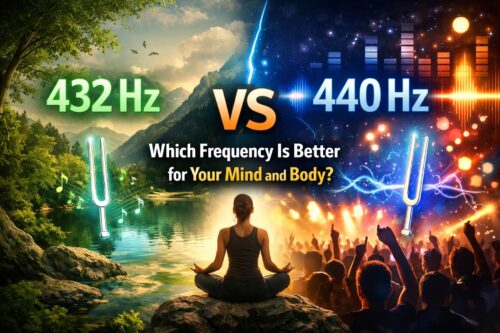
The debate between 432Hz and 440Hz brings together music history, acoustics, psychology, spirituality, and personal experience.
A=440Hz became the modern standard largely because musicians needed a consistent reference pitch. A=432Hz, meanwhile, has gained a strong following because many people associate it with warmth, relaxation, nature, meditation, and spiritual harmony.
Some research suggests that different tunings may produce measurable differences under certain experimental conditions, but the evidence is not yet strong enough to conclude that 432Hz possesses unique healing powers or that 440Hz is harmful.
Perhaps the most balanced approach is to remain curious without turning preference into absolute fact.
If 432Hz helps you relax, meditate, or enjoy music more deeply, there is nothing wrong with incorporating it into your routine.
If you prefer the sound of 440Hz, that is equally valid.
Ultimately, the most meaningful question may not be:
“Which frequency is objectively better?”
It may be:
“What does this music help me feel, notice, and experience?”
Sound does not need a mystical explanation to have an emotional impact.
Sometimes, simply listening carefully is enough to discover something new about yourself.
432 Hz frequencies tool
432 Hz Resonance Tone
A single sustained tone, tuned to the frequency many call "nature's pitch" — often described as warmer and more grounding than the standard 440 Hz reference.
How to use this tool
- 01Put on headphones or sit near your speakers, in a quiet space.
- 02Press Play Tone to start the 432 Hz sine wave.
- 03Set a timer if you'd like the tone to stop automatically — useful for meditation, study, or sleep sessions.
- 04Adjust the volume to a soft, comfortable level. This is a background tone, not something to play loudly.
What are Solfeggio frequencies?
Solfeggio frequencies are a set of tones — traditionally cited as 396, 417, 528, 639, 741 and 852 Hz — said to have originated in ancient sacred music and later been revived in modern sound-healing and meditation practice. Each tone is popularly associated with a different emotional or energetic theme, such as releasing stress, restoring balance, or supporting focus.
It's worth noting these claims are rooted in alternative-wellness tradition rather than established clinical science. Many people still find that sitting with a single steady tone is a simple, low-effort way to slow down and settle attention — regardless of the specific frequency.
Why 432 Hz specifically?
432 Hz sits just below the modern concert-pitch standard of 440 Hz. Advocates call it "natural tuning" or "Verdi's A," pointing to mathematical relationships with numbers found in nature and to a subjectively warmer, rounder character compared with 440 Hz. It's commonly used in ambient, meditation, and relaxation music as an alternative to standard tuning.
- Often paired with slow breathing or seated meditation
- Used as a calm background layer during study or focused work
- Played at low volume during wind-down routines before sleep
This tool generates a plain sine wave for ambient listening. It is not a medical device and makes no therapeutic claims.