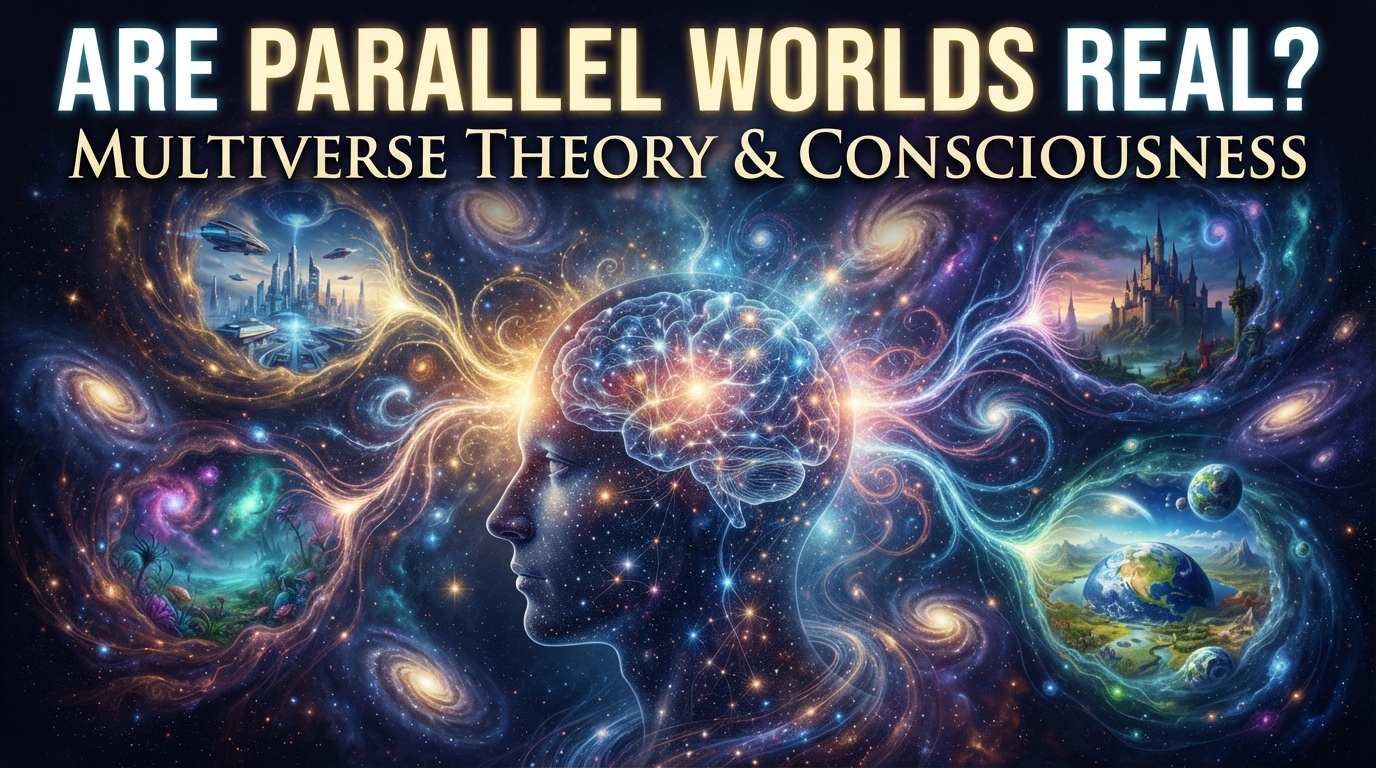
Parallel Worlds and the Power of Consciousness: A Guide to Shifting Your Reality and Manifesting Your Dreams
Introduction: Could Your Consciousness Influence the Reality You Experience?
Have you ever experienced a powerful sense of déjà vu, had an unusually vivid dream, or suddenly felt as though your life could have taken a completely different direction?
Experiences like these have inspired people to question what reality really is. The idea of parallel worlds and shifting realities was once mainly associated with science fiction, but today it is also discussed in theoretical physics, philosophy, psychology, and spiritual traditions.
One important distinction, however, is worth making from the beginning: the existence of parallel universes has not been proven, and there is no scientific evidence that human consciousness can literally move from one universe to another. The many-worlds interpretation of quantum mechanics is a serious interpretation of quantum theory, but it should not be confused with the spiritual idea of “reality shifting.”

Even so, the metaphor of shifting realities can be surprisingly useful.
Our thoughts influence what we notice. Our beliefs affect how we interpret events. Our expectations shape our decisions, habits, and behavior. In this sense, changing consciousness can genuinely change the reality we experience.
This guide explores the fascinating relationship between consciousness, perception, parallel-world theories, and manifestation—and shows how you can use these ideas in a practical way.
1. Consciousness and Reality: More Than the Physical Body
One of the oldest philosophical questions is surprisingly simple:
Who are you?
Are you only your physical body, or is your sense of self something more?
From a scientific perspective, consciousness remains one of the most complex and unresolved subjects in neuroscience. The brain clearly plays a central role in producing our experiences, yet researchers continue to investigate exactly how subjective awareness emerges from neural activity.

Spiritual traditions often approach the question differently. Rather than viewing consciousness as merely a product of the body, they describe consciousness as something fundamental to human existence.
These perspectives should not automatically be treated as scientific equivalents. However, they offer an interesting framework for reflecting on identity and perception.
The Ever-Changing Self
Your physical body is constantly changing. Cells are replaced, tissues repair themselves, and your body continuously adapts to its environment.
Yet despite these physical changes, you maintain a relatively stable sense of identity.
You still recognize yourself as “you.”
This continuity raises an interesting question: what creates our sense of self when the physical components of the body are constantly changing?
Memory, personality, emotions, relationships, and consciousness all contribute to our identity. Rather than being a fixed object, the self may be better understood as an ongoing process.
The Illusion of Separation
Human beings naturally divide the world into “me” and “everything else.”
This distinction is useful for everyday life, but it can also become psychologically limiting.
When we constantly perceive ourselves as isolated from other people or from the world around us, fear, anxiety, and defensiveness can become stronger. By contrast, feelings of connection and belonging can change how we interpret difficult experiences.
Many spiritual traditions describe this sense of connection as unity or universal consciousness.
Whether you interpret that idea spiritually, philosophically, or simply as a psychological experience of interconnectedness, it can encourage a broader perspective on life.
Consciousness as a Director of Attention
Your consciousness may not control everything that happens to you, but it strongly influences what you pay attention to and how you interpret what happens.
Imagine two people experiencing the same setback.
One sees it as proof that nothing will work out.
The other sees it as information, feedback, or an opportunity to try a different approach.
The external event is the same. Their internal realities are completely different.
This is where conscious awareness becomes powerful. When you learn to observe your thoughts rather than automatically believe every thought that appears, you gain more freedom in choosing how you respond.
2. Quantum Theory and Parallel Worlds: What Does Science Actually Say?
The idea of parallel universes is not purely fictional. Some interpretations of modern physics do allow for the possibility of multiple worlds or universes.
One of the best-known examples is the many-worlds interpretation of quantum mechanics, associated with physicist Hugh Everett III.

In simplified terms, the interpretation suggests that different possible outcomes of quantum events may correspond to different branches of reality.
However, this is where it is important to separate physics from spiritual interpretation.
Infinite Possibilities?
Popular discussions often describe the many-worlds interpretation as saying that every decision you make creates a new universe.
That description is an oversimplification.
The theory concerns quantum states and their evolution, not everyday choices such as deciding whether to drink coffee or tea. Scientists also do not have evidence that a person’s consciousness can consciously select or jump between these hypothetical branches.
Nevertheless, the concept provides a fascinating philosophical image:
What if reality contains far more possibilities than the one we currently experience?
As a metaphor, this can encourage us to think beyond our present circumstances.
The Version of You Who Lives Differently
Imagine another version of yourself who made different choices.
Perhaps that person moved to another country, started a business, pursued a creative career, or developed completely different relationships.
You do not need to believe that this version literally exists in another universe to benefit from the thought experiment.
The exercise can reveal something important about your own life: your future is influenced by the choices you make today.
Instead of asking, “How can I magically become that person?” you can ask:
“What would the version of me I admire do differently today?”
That question turns an abstract idea about parallel realities into something practical.
The Law of Attraction as a Psychological Framework
The Law of Attraction is often described as the idea that your thoughts and emotions attract corresponding experiences.
There is no established scientific evidence that thoughts emit a frequency that directly attracts matching external events.
However, there is a more grounded way to understand the concept.
When you repeatedly focus on a goal, you become more likely to notice relevant opportunities, make decisions consistent with that goal, and take actions that move you closer to it.
Gratitude can also influence attention and emotional state.
So rather than thinking of manifestation as a supernatural mechanism, you can use it as a framework for clarifying your intentions, changing your mindset, and directing your behavior.
3. The Brain and Reality Shifting: Why Your Mindset Matters
The brain plays a crucial role in how you experience reality.
It constantly receives enormous amounts of information, yet you consciously notice only a small portion of it. Your expectations, memories, emotions, and beliefs all influence how you interpret incoming information.
This is one reason changing your mindset can sometimes feel like entering a different reality.
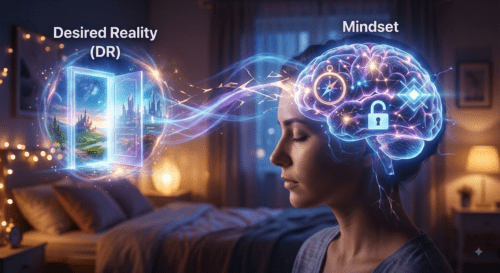
The Right Brain: Creativity and Intuition
The popular idea that people have a completely logical “left brain” and a purely creative “right brain” is an oversimplification of neuroscience. Both hemispheres work together in almost everything we do.
Still, the concepts of intuition, imagination, and creativity are useful when thinking about personal transformation.
Visualization allows you to mentally rehearse situations before they happen.
For example, if you want to change careers, you might imagine yourself confidently speaking during an interview, adapting to a new workplace, or completing tasks in your desired profession.
The visualization itself does not guarantee the outcome.
But it can help make your goal more concrete and emotionally familiar.
The Left Brain: Logic, Planning, and Action
Dreams need structure.
You may have a vivid vision of your ideal life, but without practical steps, that vision remains an idea.
This is where analytical thinking becomes essential.
If your goal is to find a new job, your plan might include:
- Updating your resume
- Learning a new skill
- Researching companies
- Networking with relevant people
- Applying consistently
- Preparing for interviews
In other words, imagination gives you a destination, while planning gives you a route.
The most effective approach is not intuition versus logic.
It is intuition plus logic.
The Power of the Present Moment
The concept of a “time leap” is often presented in spiritual communities as the ability to move into a reality where your desired future already exists.
There is no scientific evidence that consciousness literally travels through time in this way.
But there is a meaningful psychological interpretation.
You can change the direction of your life in the present moment.
A decision made today can alter your habits. Your habits can change your behavior. Your behavior can change your circumstances. Over time, those changes can produce a life that looks dramatically different from the one you once expected.
In that sense, every meaningful decision can feel like a leap into a new reality.
4. Practical Ways to Create a New Personal Reality
You do not need to believe in literal dimensional shifting to experiment with the idea.
You can treat “shifting reality” as a process of changing your attention, beliefs, emotional patterns, and actions.

1. Release What No Longer Serves You
It is difficult to build a new future while constantly defining yourself through the past.
Past failures, disappointments, and painful experiences can become part of your identity if you repeatedly tell yourself the same story about them.
This does not mean ignoring what happened.
Instead, acknowledge the experience, learn what you can from it, and gradually separate your identity from the event.
Mindfulness, journaling, forgiveness, and gratitude can all help create psychological distance from old patterns.
2. Change the Story You Tell Yourself
Your internal dialogue matters.
Consider the difference between:
“I always fail.”
and:
“This didn’t work, but I can learn from it.”
The second statement does not deny reality. It simply leaves room for change.
When a limiting belief appears, ask yourself:
“Is this an objective fact, or is it a story I have learned to repeat?”
That small question can create space for a different response.
3. Visualize Your Desired Future
Spend a few minutes each day imagining the life you want to build.
Do not focus only on the final result.
Imagine the process.
What would your typical morning look like?
What kind of work would you be doing?
Who would you spend time with?
How would you feel at the end of the day?
The more specific your visualization becomes, the easier it is to translate the idea into practical goals.
4. Take Inspired Action
This is where manifestation becomes real.
A vision without action remains a vision.
If you want a new career, apply for opportunities. If you want stronger relationships, communicate more openly. If you want to become healthier, change your daily routines.
You can listen to your intuition and remain open to unexpected opportunities, but meaningful change usually requires consistent action.
Synchronicities can be personally meaningful, but they should not replace critical thinking or practical decision-making.
5. Act Like the Person You Want to Become
One of the most powerful questions you can ask yourself is:
“What would my future self do today?”
Not someday.
Today.
Maybe your future self would spend thirty minutes learning something new. Maybe they would finally make the phone call they have been avoiding. Maybe they would stop saying yes to something that consistently drains them.
You do not have to become a completely different person overnight.
Small choices repeated consistently can gradually create a very different life.
Conclusion: You Can Change the Reality You Experience
The intersection of consciousness, neuroscience, spirituality, and theories of parallel worlds raises fascinating questions about the nature of reality.
Science has not demonstrated that people can consciously jump between parallel universes, nor has it established the Law of Attraction as a physical mechanism.
But that does not make the underlying questions meaningless.
Your attention influences what you notice. Your beliefs influence how you interpret experiences. Your emotions affect your decisions. Your decisions shape your behavior, and your behavior can gradually transform your circumstances.
That is a very real form of “reality shifting.”
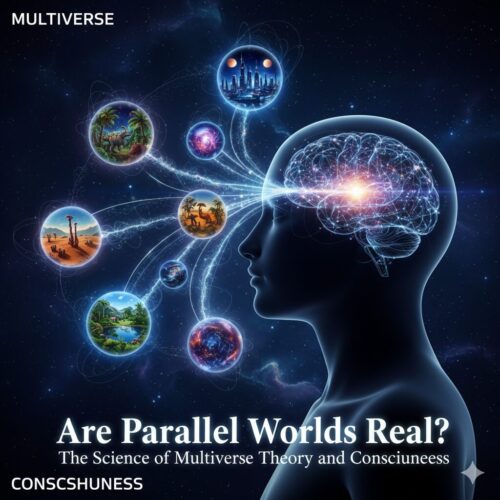
You may not be able to choose another universe with a single thought. But you can choose what you focus on, what beliefs you reinforce, what actions you take, and what direction you want your life to move in.
Perhaps the most useful way to think about parallel realities is not as distant universes waiting to be discovered, but as a reminder that many different futures are possible—and the choices you make today help determine which one you move toward.
Your dream life may not already exist somewhere in another dimension.
But it can begin with a thought, become a decision, and eventually turn into reality through consistent action.
FAQ: Parallel Worlds, Consciousness, and Reality Shifting
| Question | Answer |
|---|---|
| Do parallel worlds really exist? | The existence of parallel worlds has not been experimentally confirmed. The many-worlds interpretation of quantum mechanics is one possible interpretation of quantum theory, but it should not be treated as proof that parallel universes exist. |
| Can consciousness move between parallel worlds? | There is currently no scientific evidence that human consciousness can literally move from one universe or dimension to another. “Reality shifting” is better understood as a spiritual concept or a metaphor for changing your perception, mindset, and direction in life. |
| Is reality shifting scientifically proven? | No. Scientific research does not currently demonstrate that people can consciously shift into an alternate physical reality. However, changing attention, beliefs, habits, and behavior can genuinely change how a person experiences and responds to life. |
| What is the connection between consciousness and reality? | Your consciousness influences how you perceive and interpret the world. Expectations, memories, emotions, and beliefs affect what you notice and how you respond to events. This can make the same external situation feel very different to different people. |
| Does the Law of Attraction really work? | There is no established scientific evidence that thoughts physically attract matching events through an energetic frequency. However, focusing on a goal can influence attention, motivation, decisions, and behavior, which may increase the likelihood of taking actions that support that goal. |
| Can visualization help create a better future? | Visualization can be useful when combined with realistic planning and action. Imagining a desired outcome may help clarify goals and increase motivation, but visualization alone does not guarantee that the desired outcome will happen. |
| What is a quantum jump in spiritual practice? | In spiritual communities, a “quantum jump” or “quantum leap” often refers to a dramatic personal transformation or a sudden shift toward a desired life. This is different from the scientific meaning of quantum phenomena and should not be interpreted as proven physical travel between realities. |
| Are there really different versions of me in parallel universes? | Some interpretations of quantum mechanics allow for multiple branches of reality, but there is no direct evidence confirming that individual versions of you exist in separate universes. The idea can nevertheless be used as a helpful thought experiment for imagining alternative choices and possible futures. |
| How can I start shifting my personal reality? | Start with practical changes: identify limiting beliefs, clarify your goals, visualize the future you want, change habits that no longer serve you, and take consistent action. Small decisions repeated over time can lead to significant changes in your life. |
| What is the most important part of reality shifting? | The most practical approach is to combine awareness with action. A positive mindset can help, but meaningful change usually requires clear goals, realistic planning, flexibility, and consistent effort. |