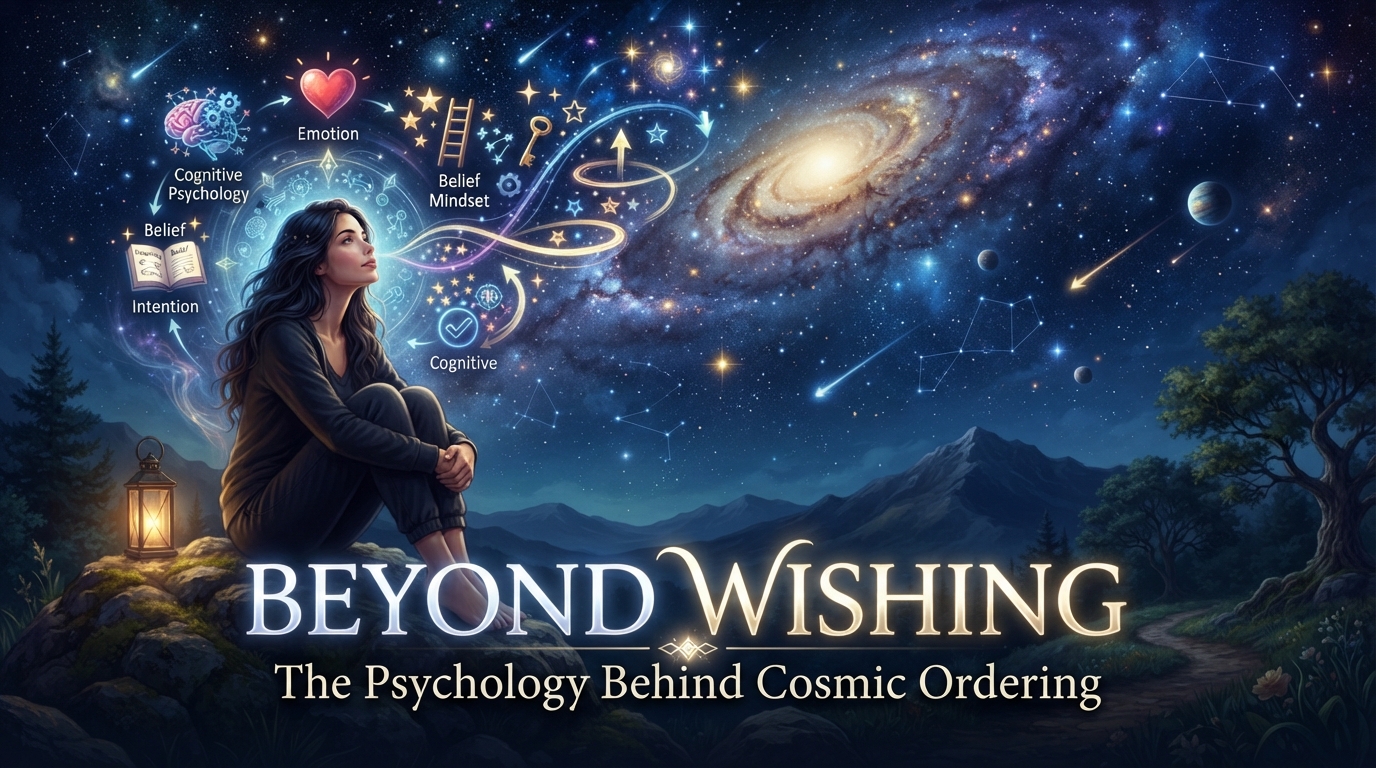
Why “Cosmic Ordering” Works for Some But Fails for Others
The idea is simple: just write down your wish, and the universe delivers it to your door.
It sounds like a mystical game, yet a surprising number of people take “Cosmic Ordering” very seriously.

While there is no scientific evidence to back it up, looking at the countless testimonials reveals a fascinating pattern. There are clear differences between those who seem to manifest their desires effortlessly and those who don’t.
Specifically, those for whom it “works” share a very distinct mindset.
The Fine Art of “Placing the Order”
Practitioners of Cosmic Ordering don’t just wish; they obsess over the method of delivery. Everyone seems to have their own set of personal rules, such as:
-
Writing with polite and clear intentions.
-
Ending sentences with strong nouns or completed states.
-
Formatting the wish exactly like a checkout page on an e-commerce site.
-
Closing every request with a note of gratitude.
The most interesting takeaway is that many successful manifestors value naturalness over effort.
One practitioner noted that instead of “trying too hard” or straining their willpower, they write their wishes with the same casual certainty they feel when ordering something from an online store.
Think about it: when you buy something online, you don’t spend every second worrying if the package will actually arrive. You simply trust the system. Applying that same “relaxed expectation” to life’s desires seems to be a key factor.
Is “Letting Go” More Important Than “Believing”?
A recurring theme in the world of Cosmic Ordering is that obsession blocks delivery.
This is particularly evident in stories about relationships. There are many accounts of people who desperately wished for a reconciliation, only for the breakthrough to happen after they got tired of asking and finally gave up.
Perhaps it’s just a coincidence. However, these stories are far too common to ignore.
The moment you stop constantly thinking, “Is it here yet?” or “Why hasn’t it arrived?”, reality begins to shift. This is a common thread not just in Cosmic Ordering, but in many theories regarding the subconscious mind.
The goal isn’t just to “make it happen,” but to reach a state of mind where you feel, “It’s already handled.” That sense of relief appears to be the real engine of change.
Why Small Wishes Lead to “Miraculous Alignments”
Intriguingly, success stories are much more frequent with small, everyday requests than with massive life changes.
Someone might write, “I want a lovely surprise,” only to receive an unexpected gift or a call from an old friend a few hours later. To a believer, this is “Cosmic Ordering in action.” To a skeptic, it’s “merely a coincidence.”

Yet, that very ambiguity is what makes this culture so fascinating. It operates in that “sweet spot” where it’s not entirely detached from reality, but just magical enough to make you think, “Maybe there’s something to this.”
Success is Ultimately a Matter of Interpretation
There is no single “right way” to do Cosmic Ordering. The community is split into various schools of thought:
-
The “Emotions don’t matter” camp.
-
The “Belief is everything” camp.
-
The “Anxiety cancels the order” camp.
-
The “Just write it and forget it” camp.

Despite these differences, the common denominator is that people use it as a tool to lighten their mental load.
When life feels heavy or overwhelming, we all have moments where we want to delegate our worries to something bigger than ourselves. Cosmic Ordering provides a creative outlet for that need.
Conclusion
When you look at the experiences surrounding Cosmic Ordering, there is a level of “functional reality” that is hard to dismiss as mere superstition.
We may never have objective proof that the universe is literally fulfilling orders. However, the psychological benefits are undeniable:
-
It helps organize your thoughts through writing.
-
It fosters a more positive, expectant outlook.
-
It provides a sense of security.
-
It helps you practice the art of letting go.
In the end, perhaps the question isn’t “Will the universe deliver?” but rather, “How does the act of writing change me?” That shift in perspective might just be the most important delivery of all.