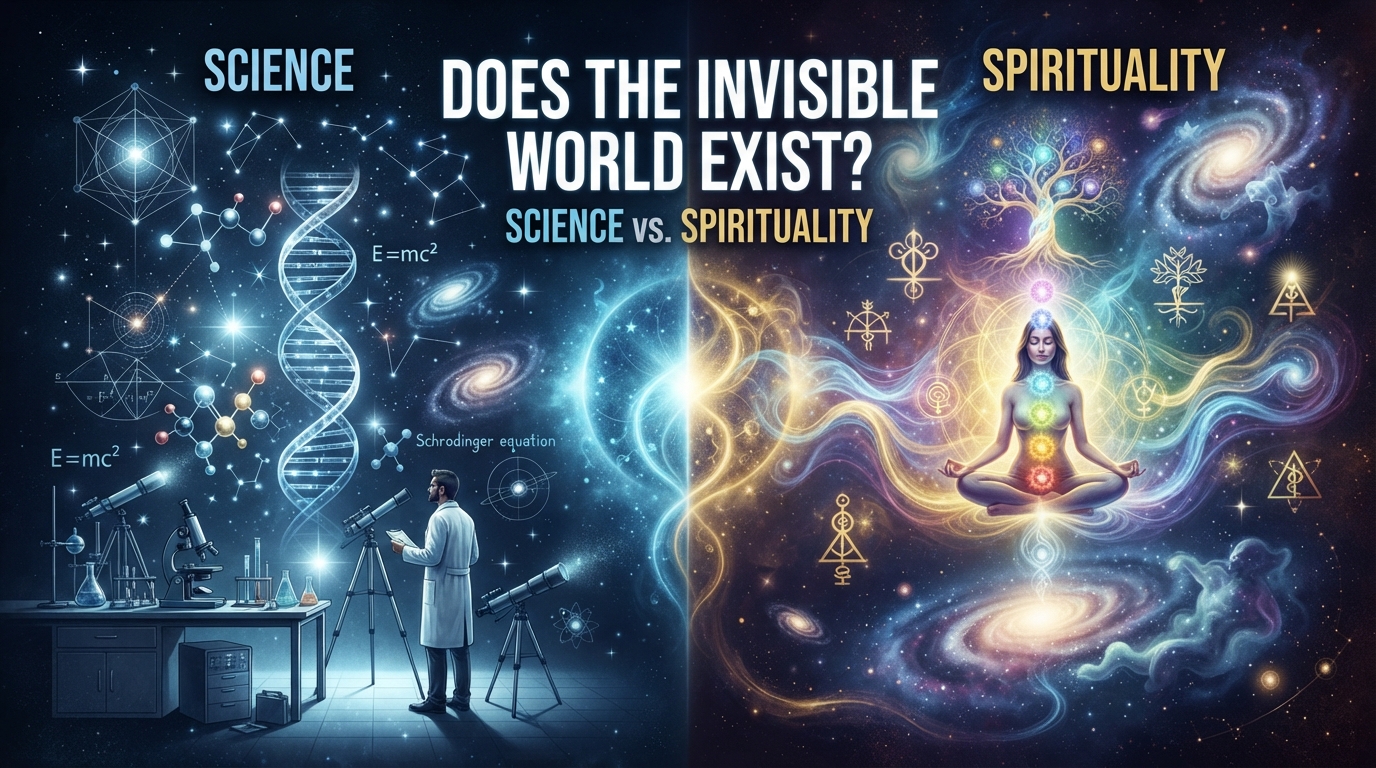
The Unseen Realm: A Spiritual and Scientific Exploration of the Invisible World and Its Influence on Our Lives
Introduction: Is There More to Reality Than What We Can See?
We live in a world shaped by what we can see, touch, hear, and measure. Yet much of reality exists beyond the reach of our ordinary senses. Invisible forces influence the universe, unseen processes shape our bodies and minds, and countless aspects of modern life depend on systems that remain hidden from direct perception.
For thousands of years, spiritual traditions, philosophers, and mystics have also described an unseen realm associated with consciousness, divine presence, spiritual beings, and dimensions beyond ordinary human experience. These ideas cannot all be scientifically verified, but they continue to influence the way people understand existence, purpose, and personal transformation.

Science, meanwhile, has shown that the visible portion of reality is only part of what exists. Electromagnetic waves outside the visible spectrum, microscopic particles, gravitational fields, and phenomena such as dark matter remind us that reality is not limited to what the human eye can perceive.
So, what should we make of the invisible world?
Rather than treating spirituality and science as competing explanations, it can be useful to explore what each perspective tells us about the limits of perception. This guide examines the invisible world from both spiritual and scientific viewpoints and considers how reflecting on the unseen can deepen self-awareness, encourage personal growth, and give everyday life a greater sense of meaning.
1. What Is the Invisible World? A Reality Beyond Ordinary Perception
The phrase “invisible world” can mean very different things depending on the context. For some people, it refers to spiritual realities such as the soul, divine consciousness, angels, or spiritual guides. From a scientific perspective, it can refer more generally to phenomena that cannot be directly observed with the human senses.
The Spiritual Perspective
In many spiritual traditions, the invisible realm is considered a deeper dimension of existence. It may be described as the realm of the soul, consciousness, divine intelligence, or spiritual beings.
Some traditions speak of angels, ancestors, spirit guides, or higher forms of consciousness that exist beyond the physical world. Others focus less on specific beings and more on an underlying spiritual reality that connects all forms of life.
Meditation, prayer, contemplation, and other spiritual practices are often viewed as ways of becoming more aware of this dimension. For believers, such experiences can provide comfort, insight, and a stronger sense of connection with something greater than the individual self.
These interpretations belong primarily to the realm of spirituality and personal belief rather than established scientific fact. Nevertheless, they have played an important role in human culture and continue to shape how many people understand their lives.
What Science Reveals About the Unseen
Science also provides many examples of realities that cannot be directly perceived by our senses.
Visible light represents only a small portion of the electromagnetic spectrum. Radio waves, infrared radiation, ultraviolet light, X-rays, and gamma rays are all invisible to the human eye, yet they are measurable and have practical effects.
The universe also contains phenomena that remain difficult to observe directly. Dark matter, for example, does not emit or reflect light in the way ordinary matter does, but scientists infer its existence from gravitational effects. Dark energy is another scientific concept used to explain the accelerating expansion of the universe.
These examples demonstrate an important point: invisible does not automatically mean imaginary.
At the same time, scientific invisibility should not be confused with proof of spiritual claims. A phenomenon being unseen is not, by itself, evidence that it has a supernatural origin. Science relies on observation, measurement, testing, and evidence.
A Broader Understanding of Reality
Whether we approach the unseen through spirituality or science, one idea becomes clear: human perception has limits.
Our senses evolved to help us function in the physical world, not to reveal every aspect of existence. Recognizing those limitations can encourage curiosity and intellectual humility.
There may be more to reality than what we immediately experience, but understanding that possibility requires us to remain open-minded without abandoning critical thinking.
| Dimension | Scientific Approach | Spiritual Approach |
| Primary Focus | Physical phenomena, measurable forces, and empirical data. | Consciousness, purpose, inner transformation, and the soul. |
| Examples of the Unseen | Electromagnetic spectrum, dark matter, algorithms, gravity. | Divine presence, soul connection, intuition, karma. |
| Method of Exploration | Observation, experimentation, and critical verification. | Meditation, prayer, self-reflection, and personal experience. |
| Core Value | Expanding objective knowledge and practical understanding. | Deepening self-awareness, inner peace, and existential meaning. |
2. The Invisible World and Spiritual Awareness
For those who embrace spiritual beliefs, the unseen world is not necessarily an escape from everyday reality. Instead, it can provide another framework for understanding ordinary experiences, emotions, relationships, and personal challenges.

Finding Inner Peace
Practices such as meditation, prayer, mindfulness, and quiet reflection can help people step away from constant stimulation and reconnect with their inner world.
When the mind becomes quieter, thoughts and emotions that are normally overlooked may become easier to recognize. This can create a greater sense of clarity and emotional balance.
From a spiritual perspective, some people interpret this experience as connecting with the unseen or with a higher form of consciousness. From a psychological perspective, it may simply reflect the benefits of slowing down and paying attention to one’s internal experience.
Either way, the practice can encourage greater self-awareness.
Faith and the Idea of a Higher Presence
For millions of people, the invisible world is closely associated with God or a divine presence.
God cannot be examined in a laboratory in the same way as a physical object. Faith therefore operates in a different domain from empirical science. Believers may experience the divine through prayer, religious traditions, personal experiences, intuition, or a profound sense of connection.
For some, this belief provides a sense of purpose and hope, especially during difficult periods. It can create the feeling that life has meaning beyond immediate circumstances and that personal struggles are part of a larger journey.
Intuition as an Inner Guide
Intuition is another experience often associated with the unseen.
People sometimes describe intuition as a quiet inner feeling, a sudden realization, or a strong sense that something is right or wrong before they can explain why.
Spiritual traditions may interpret this as guidance from the soul or a higher consciousness. Psychology, meanwhile, suggests that intuition can emerge from the brain rapidly processing patterns and information gathered through previous experiences.
These explanations do not necessarily have to be treated as mutually exclusive personal interpretations. What matters is learning to distinguish useful intuition from fear, impulse, or wishful thinking.
3. The Unseen Forces Shaping Relationships and Personal Growth
The invisible world can also be understood metaphorically as the hidden emotional and psychological forces that influence our relationships and decisions.
Much of what determines how we relate to others is invisible: trust, expectations, memories, beliefs, attachment, fear, love, and unresolved emotions.

The Idea of Twin Flames
The concept of twin flames is one example of a spiritual belief surrounding deep relationships.
According to this tradition, two people may share an unusually powerful soul-level connection. Their relationship is sometimes described as a spiritual mirror, encouraging both individuals to confront unresolved issues and grow emotionally.
For believers, the connection may be understood as part of a larger spiritual journey. However, twin flames are a spiritual concept rather than a scientifically established phenomenon.
Regardless of one’s beliefs, the idea can raise an interesting question: why do certain relationships affect us so deeply?
A powerful relationship can reveal parts of ourselves that might otherwise remain hidden. It can challenge our assumptions, expose emotional patterns, and encourage personal transformation.
Karma and the Consequences of Our Actions
Karma is another important concept found in several spiritual traditions.
In its broader philosophical sense, karma describes a relationship between actions and their consequences. Our choices, intentions, and behavior influence what happens next, even when those consequences are not immediately visible.
This idea can also be understood in everyday psychological and social terms. Kindness can strengthen relationships. Dishonesty can damage trust. Repeated habits can shape our character. Small decisions can gradually produce significant changes.
In this sense, what appears invisible at first can eventually become visible in our lives.
Hidden Emotional Wounds
Perhaps the most tangible “invisible world” exists within us.
Past experiences, unresolved grief, fear, limiting beliefs, insecurity, and emotional pain may not be visible to others, yet they can strongly influence our behavior.
Someone may appear confident while privately struggling with self-doubt. A person may repeatedly experience relationship difficulties without realizing that an old emotional pattern is influencing their choices.
Personal growth often begins when these hidden patterns become conscious.
Self-reflection, journaling, meditation, meaningful conversations, and professional therapy can all help people understand what has been operating beneath the surface. Bringing hidden emotions into awareness does not erase the past, but it can change our relationship with it.
4. The Invisible World in the Digital Age
It may seem strange to discuss an invisible world in an age dominated by technology and scientific progress. Yet modern technology provides some of the clearest examples of how invisible systems can transform everyday life.
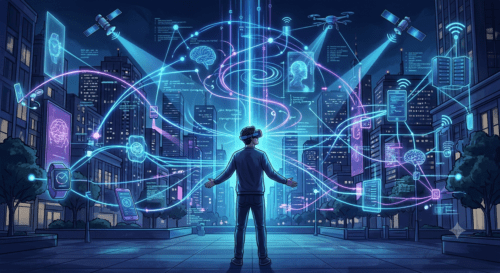
The Hidden Power of Code
Most people interact with digital technology without seeing the underlying code that makes it function.
Websites, applications, search engines, financial systems, and social platforms depend on layers of software, algorithms, databases, and networks that remain largely invisible to users.
We cannot see the code itself in the physical world, yet its consequences are real. It determines what information appears on a screen, how messages are delivered, how transactions are processed, and how people communicate.
The digital world therefore offers a useful analogy: something does not have to be visible to have a profound effect.
Living Beyond External Validation
The idea of an invisible inner world is also relevant to modern life.
Social media and digital culture can place enormous emphasis on appearance, popularity, achievement, and external approval. It becomes easy to measure our worth through numbers such as followers, likes, views, income, or professional status.
Yet some of the most important aspects of life cannot be measured so easily.
Peace of mind, meaningful relationships, integrity, purpose, gratitude, and emotional fulfillment are largely internal experiences.
Listening to this inner dimension does not mean ignoring practical reality. Rather, it means recognizing that external success is only one part of a meaningful life.
Where Science and Spirituality Meet
The invisible world can serve as a meeting point for scientific curiosity and spiritual reflection, provided we understand that the two approaches use different methods.
Science asks questions that can be tested through observation and evidence. Spirituality often explores questions of meaning, consciousness, purpose, and personal experience.
Neither approach needs to answer every question in exactly the same way.
Instead, both can encourage us to recognize the complexity of existence and the limits of what we currently understand.
Frequently Asked Questions (Q&A)
Q1: Does the existence of invisible scientific forces (like dark matter) prove spiritual realities?
A: Not directly. While scientific discoveries remind us that human perception is limited, physical invisible forces (like electromagnetism or dark matter) operate under natural laws and empirical evidence. Spiritual concepts belong to a different domain centered on personal belief, consciousness, and meaning.
Q2: How can I balance critical thinking with an openness to spiritual concepts?
A: You can remain curious about spiritual insights and their psychological benefits (such as peace of mind and self-reflection) while keeping an objective mindset regarding claims that require scientific proof. Open-mindedness does not mean abandoning logic; rather, it means recognizing the limits of human understanding.
Q3: How does exploring the “unseen world” benefit daily life?
A: Exploring the unseen—whether through self-reflection, emotional awareness, or understanding invisible physical forces—helps you cultivate emotional balance, strengthen relationships, and move beyond external validation (like social media approval) toward a more meaningful inner life.
Conclusion: Looking Beyond What We Can See
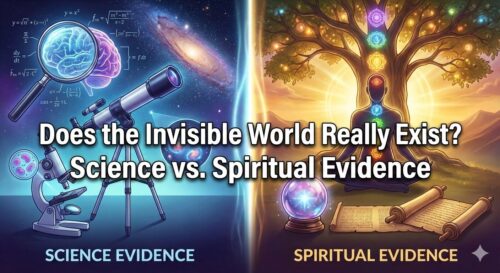
The invisible world can be understood in many different ways.
For some, it represents God, the soul, spiritual beings, or a higher dimension of consciousness. For others, it refers to the countless physical processes and forces that cannot be directly perceived by human senses. It can also describe the hidden psychological patterns, emotions, and beliefs that influence our behavior.
What we should avoid is assuming that everything invisible must therefore be supernatural—or, conversely, that everything we cannot currently explain must be meaningless.
A more balanced perspective begins with curiosity.
The universe contains realities far beyond ordinary human perception, while our inner lives contain depths that we often overlook. Exploring these unseen dimensions can encourage us to ask better questions about consciousness, relationships, purpose, and the nature of reality itself.
Ultimately, the journey into the invisible world may also be a journey inward.
When we learn to observe what lies beneath the surface—our thoughts, emotions, assumptions, relationships, and deepest values—we may begin to understand ourselves with greater clarity.
And sometimes, seeing what was previously unseen is the first step toward changing what we can see in our lives.