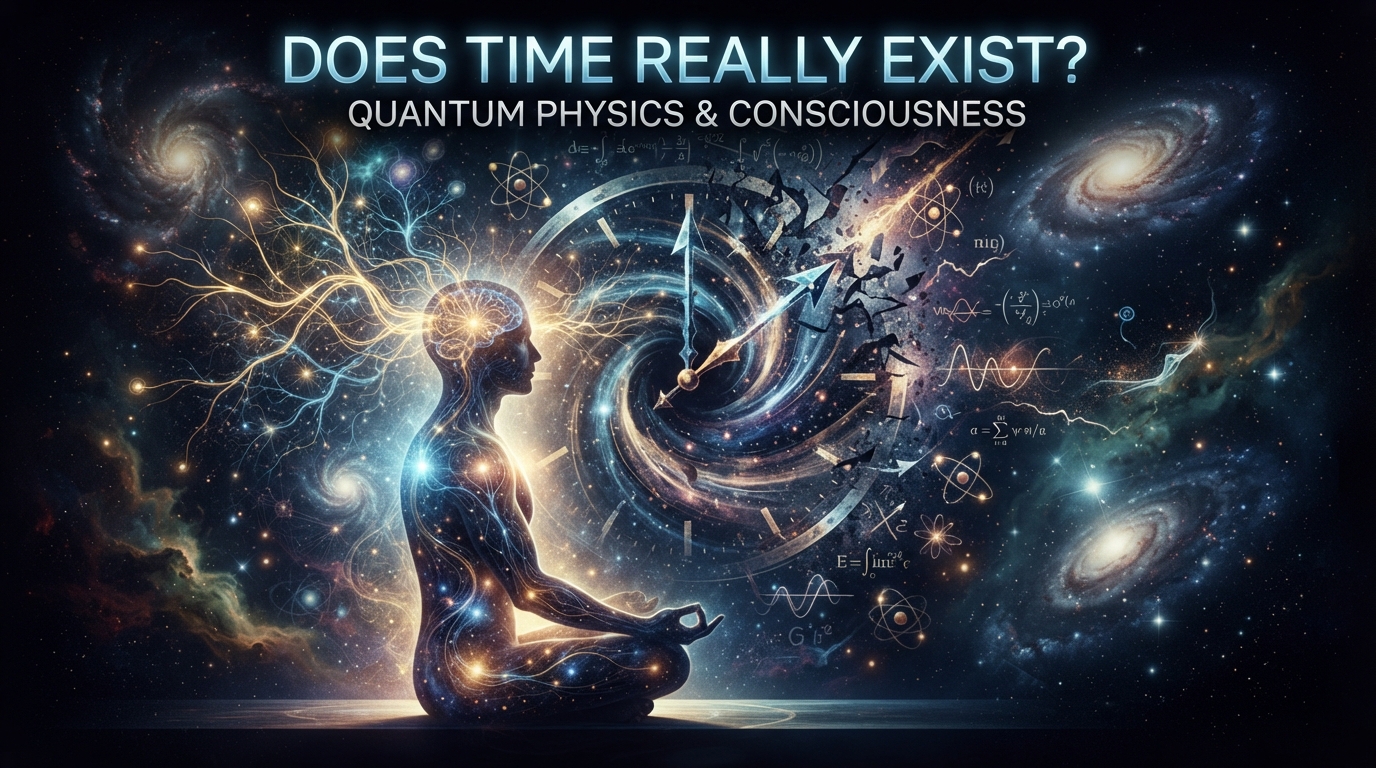
Does Time Really Exist? A Quantum, Spiritual, and Scientific Journey into the Mystery of Time
Introduction: What If Time Is Not What We Think It Is?
Time feels like one of the most obvious realities of human life. We wake up, go to work, watch the seasons change, grow older, and naturally divide our experiences into past, present, and future.
Yet when we look more closely, time becomes surprisingly difficult to define.
Is time something that exists independently of us? Is it a fundamental property of the universe, or is our experience of time partly created by the way our brains organize events and memories? Modern physics has revealed that time is far more flexible than everyday experience suggests, while spiritual traditions have questioned the idea of linear time for thousands of years.
From Einstein’s theory of relativity to modern ideas about quantum gravity, and from Buddhist mindfulness to Taoist philosophy, different perspectives point toward the same fascinating conclusion: our ordinary experience of time may not tell the whole story.
This does not necessarily mean that time is simply an illusion. Rather, it may mean that the time we experience in everyday life is only one layer of a much deeper reality.
In this article, we will explore time from three perspectives—modern physics, spirituality, and relativity—and consider what these ideas might teach us about consciousness, reality, and the mysterious nature of existence.
1. Quantum Physics and the Mystery of Time
At the scale of everyday life, time appears smooth and continuous. One second follows another, yesterday becomes today, and today eventually becomes tomorrow.
But when physicists investigate nature at extremely small scales, familiar concepts such as space and time become much more difficult to understand.
Is Time Made of Tiny Moments?
One popular idea is that spacetime itself might have a fundamental structure at extremely small scales. Some approaches to quantum gravity suggest that the smooth spacetime described by classical physics may not be the final description of reality.
However, it is important to make a distinction: standard quantum mechanics does not simply establish that time consists of tiny, discrete “quanta.” In conventional quantum theory, time is generally treated as a continuous parameter.
The deeper question arises when scientists attempt to combine quantum mechanics with general relativity. At that level, our current theories do not yet provide a complete picture of what time fundamentally is.
This leaves open a remarkable possibility: perhaps the continuous flow of time that we experience is an emergent feature of a deeper physical reality.
In other words, time may be less fundamental than it appears.
Does Observation Create Time?
Quantum mechanics also introduces another fascinating question: what role does observation play in physical reality?
Experiments at the quantum level demonstrate that measurement affects the systems being measured. However, this should not be interpreted as proof that human consciousness literally creates time or physical reality.
Still, the relationship between observer, measurement, and physical systems raises profound philosophical questions.
Our experience of time certainly depends on how we interact with the world. Memory, attention, anticipation, and perception all influence whether a period feels fast, slow, short, or long.
A five-minute wait can feel endless, while an entire afternoon can seem to disappear when we are deeply engaged in something.
This suggests that there are at least two different questions:
What is time physically?
And:
Why does time feel the way it does to consciousness?
Science has made remarkable progress on the first question, but the second remains deeply connected to neuroscience, psychology, and philosophy.
The Block Universe: Does Past, Present, and Future Already Exist?
Another fascinating interpretation comes from the idea commonly known as the block universe.
In relativity, spacetime is treated as a four-dimensional structure containing both spatial and temporal dimensions. Some philosophers and physicists interpret this framework as supporting an “eternalist” view, in which past, present, and future events can all be considered parts of spacetime.
Under this interpretation, time does not necessarily “flow” in the same way we experience it. Instead, our conscious experience may correspond to a particular sequence of events within spacetime.
This idea challenges our intuitive understanding of reality.
If past and future are part of the same spacetime structure, what exactly does it mean for the present moment to exist?
And if the future is already part of spacetime, how should we understand free will?
These questions remain open—and they are part of what makes the nature of time one of the most fascinating problems in modern physics and philosophy.
2. The Spiritual Perspective: The Power of the Eternal Present
Long before modern physics began questioning the nature of time, spiritual and philosophical traditions were already exploring the limitations of our ordinary perception of past, present, and future.
Rather than treating time purely as a physical measurement, many traditions focus on our relationship with time.

The Present Moment as the Place Where Life Happens
Buddhist traditions, Taoist philosophy, and various contemplative practices place considerable emphasis on awareness of the present moment.
The past can be remembered, but it cannot be directly experienced again.
The future can be imagined, planned for, or feared, but it has not yet arrived.
The present is where perception and action actually occur.
This does not mean that the past and future are meaningless. Memories influence our identity, while future plans help guide our choices. But constantly living in memory or anticipation can prevent us from fully experiencing what is happening now.
This is why mindfulness practices encourage people to return their attention to the present.
Instead of asking, “What happened yesterday?” or “What might happen tomorrow?”, the practice becomes:
What is happening right now?
That simple question can dramatically change our relationship with time.
Timelessness and the Idea of a Higher Reality
Many spiritual traditions also contain concepts of eternity, timelessness, or a reality that exists beyond ordinary temporal experience.
In some theological perspectives, God or an ultimate reality is understood as existing beyond the limitations of human time. From such a viewpoint, the past, present, and future may not be experienced as separate moments in the way humans experience them.
This can sound surprisingly similar to philosophical interpretations of spacetime.
However, science and spirituality should not be treated as if they have already reached the same conclusion. Physics describes measurable physical phenomena, while spiritual traditions often address meaning, consciousness, and the nature of existence.
The similarity is therefore best understood as an intriguing philosophical parallel rather than scientific proof of a spiritual theory.
Why Does Time Feel Faster or Slower?
Our subjective experience of time provides another fascinating connection between consciousness and temporality.
When we are bored, five minutes can feel extremely long.
When we are absorbed in a meaningful activity, several hours can seem to pass in an instant.
Stress can also distort our sense of time. During an intense or frightening experience, moments may appear unusually slow, while periods of routine can seem to disappear quickly when we look back on them.
This shows that psychological time and physical time are not identical.
A clock may measure the same interval, but consciousness does not always experience that interval in the same way.
This is one reason the present moment has such an important place in contemplative traditions. Learning to observe thoughts and sensations without constantly becoming lost in the past or future can change our subjective relationship with time.
3. Einstein’s Relativity: Time Is Not Universal
If there is one scientific theory that completely transformed humanity’s understanding of time, it is Albert Einstein’s theory of relativity.
Before Einstein, it was natural to imagine that time passed at the same rate everywhere in the universe.
Relativity demonstrated that this assumption was wrong.
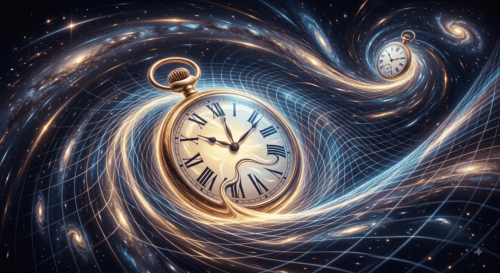
Space and Time Form Spacetime
Einstein’s theories showed that space and time are deeply interconnected.
Instead of thinking of space and time as completely separate concepts, modern physics describes them together as spacetime.
Matter and energy influence the geometry of spacetime, while the structure of spacetime influences how matter and energy move.
This becomes especially important around massive objects such as planets, stars, and black holes.
Gravity can affect the passage of time.
This phenomenon is known as gravitational time dilation.
For example, clocks positioned at different gravitational potentials do not necessarily tick at exactly the same rate. This effect has been measured experimentally and is important in technologies such as GPS.
Motion Can Change the Passage of Time
Relativity also tells us that motion affects the measurement of time.
As an object’s speed approaches the speed of light, time passes more slowly for that moving object relative to an observer in a different reference frame.
This effect is called time dilation.
It may sound like science fiction, but it is a measurable physical phenomenon.
GPS technology provides a practical example. Satellite clocks experience both velocity-related and gravitational effects that must be accounted for in order for the system to maintain accurate positioning.
Without correcting for relativistic effects, GPS would gradually become inaccurate.
This is a powerful reminder that time is not simply a universal cosmic clock ticking identically everywhere.
Is Time a Dimension or Something More?
Relativity therefore gives us a very different picture of time from everyday intuition.
Time is not completely independent of space.
It is affected by motion and gravity.
And measurements of time can depend on the observer’s reference frame.
Yet relativity alone does not answer the ultimate philosophical question of whether time “really exists.”
It tells us how time behaves within our best current physical theory.
The deeper question—whether time is fundamental or emerges from something more basic—remains an active subject of research.
Comparing Perspectives on Time
| Perspective | Core Concept | Key Takeaway |
| Quantum Physics | Emergence & Measurement | Time may not be fundamental; it could be an emergent property arising from deeper quantum dynamics. |
| Spiritual Traditions | Eternal Present | Past and future are mental constructs; direct conscious experience only occurs in the present moment. |
| Einstein’s Relativity | Spacetime & Dilation | Time is relative, not universal. Motion and gravity actively alter the rate at which time passes. |
4. Conclusion: What Does It Mean to Live in the Present?
So, does time really exist?
The most honest answer is: we do not yet know exactly what time is at the deepest level of reality.
Physics has shown that time is not the rigid, universal clock that humans once imagined. Einstein’s relativity demonstrates that time depends on motion and gravity. Quantum physics challenges our classical assumptions about reality, while the search for a theory of quantum gravity continues to raise fundamental questions about spacetime itself.
Spiritual traditions approach the question from a different direction. Rather than asking only what time is, they ask how our relationship with time affects consciousness and human experience.
These perspectives should not be confused with one another, but they can inspire the same profound reflection:
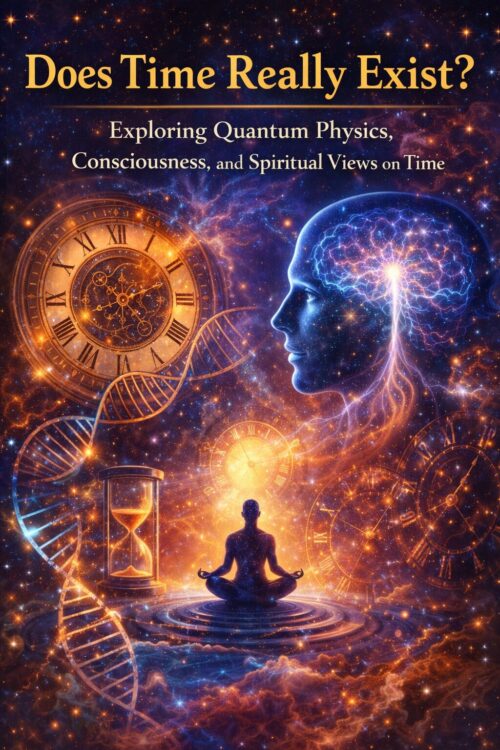
Perhaps our everyday experience of time is only one way of experiencing reality.
The past remains accessible through memory.
The future exists as possibility, expectation, and probability.
But experience itself always takes place in the present.
That is why learning to pay attention to the present moment can be valuable regardless of which theory of time we ultimately accept.
You do not need to believe that time is an illusion.
You do not need to choose between science and spirituality.
Instead, you can simply become more curious about the experience of time itself.
Notice how quickly an enjoyable moment passes.
Notice how slowly anticipation can feel.
Notice how memories reshape your perception of the past.
And notice how much of your attention is usually spent imagining a future that has not yet arrived.
Perhaps the greatest mystery of time is not simply whether it exists.
Perhaps the deeper question is how consciousness experiences it—and what that experience reveals about being human.
Frequently Asked Questions
Does quantum physics prove that time is an illusion?
No. While quantum gravity suggests that continuous spacetime may not be fundamental, standard quantum mechanics treats time as a continuous variable. Science points toward time being emergent rather than a simple illusion.
What is gravitational time dilation?
It is a phenomenon predicted by Einstein’s theory of relativity where gravity affects the passage of time. Clocks closer to strong gravitational fields tick slower relative to clocks farther away.
How does psychological time differ from physical time?
Physical time is measured objectively by clocks, whereas psychological time is subjective. Brain state, attention, age, and emotions dictate whether time feels as though it is speeding up or slowing down.