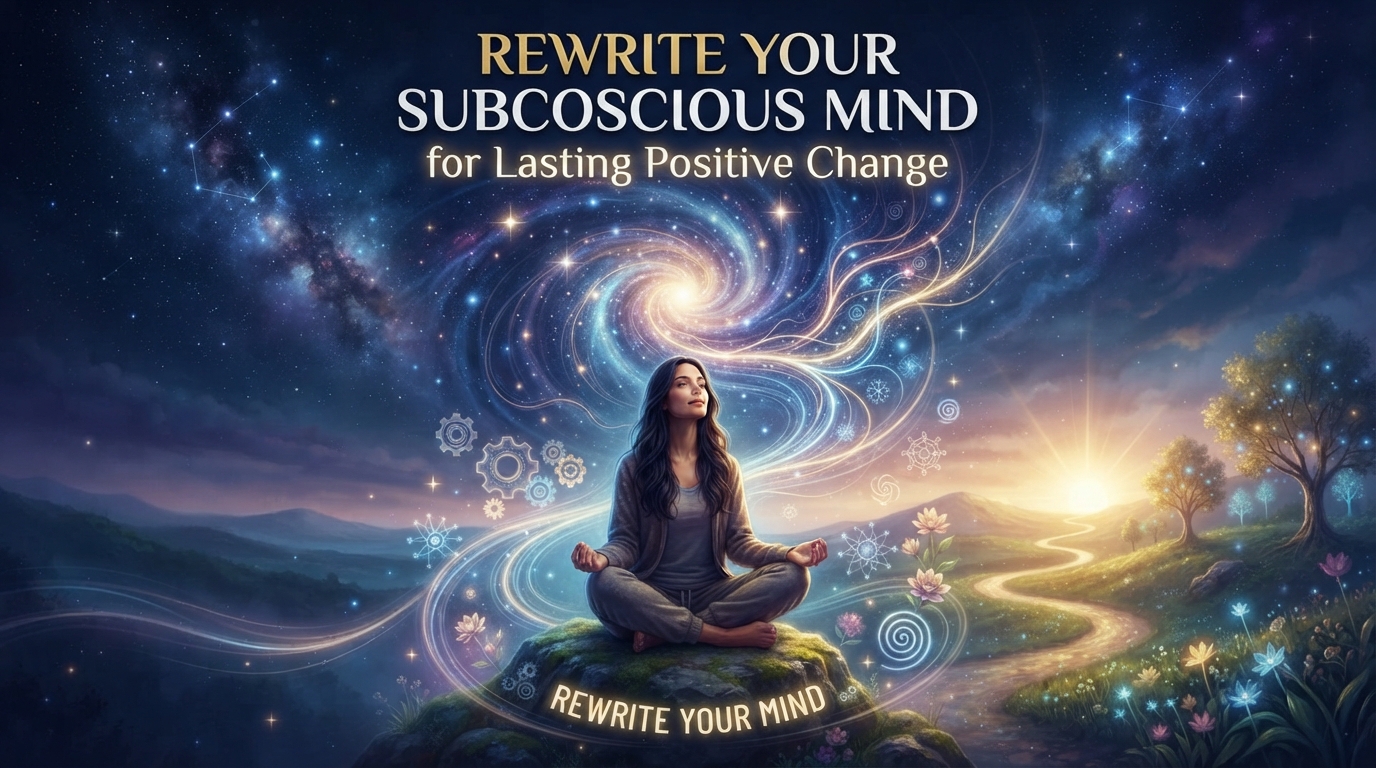
Rewriting Your Subconscious Mind: A Practical Guide to Creating a High-Vibrational Life
Introduction: Can You Really Reprogram Your Subconscious Mind?
Have you ever wondered why you keep falling into the same patterns, even when you genuinely want to change? You may set new goals, make better choices, and promise yourself that things will be different—only to find yourself returning to familiar habits and reactions.
One reason may be the influence of your subconscious mind.
Your subconscious contains deeply rooted beliefs, emotional associations, memories, and habits that can quietly influence the way you think and behave. Some of these patterns may have developed during childhood, while others were shaped by past relationships, disappointments, or repeated experiences.

The encouraging part is that these patterns are not necessarily permanent.
With awareness and consistent practice, you can begin to change the beliefs and habits that no longer serve you. This process is often described as subconscious reprogramming or rewriting your subconscious mind.
Rather than relying on positive thinking alone, the goal is to create a deeper shift in the way you interpret yourself, your circumstances, and your possibilities.
In this guide, we will explore how the subconscious mind influences daily life and examine practical techniques—including affirmations, visualization, gratitude, journaling, and mindfulness—that can help you build a more positive and intentional inner world.
Understanding the Subconscious Mind: The Hidden Patterns Behind Your Behavior
The subconscious mind can be thought of as the part of your mental life that operates largely outside your immediate awareness.
While your conscious mind analyzes information and makes deliberate decisions, many everyday behaviors happen automatically. The way you respond to stress, react to criticism, approach relationships, or think about money may be influenced by beliefs that you rarely stop to examine.

For example, someone who repeatedly thinks, “I’m not good enough,” may unconsciously avoid opportunities that could challenge that belief. Another person who believes that success is always difficult may hesitate to take risks, even when a promising opportunity appears.
These reactions do not mean that the subconscious is literally creating reality through thoughts alone. Rather, your underlying beliefs can influence what you notice, how you interpret events, and which actions you choose to take.
Thoughts Become Patterns
A single thought may seem insignificant, but repeated thoughts can gradually become familiar mental patterns.
If you constantly focus on failure, rejection, or scarcity, your attention may become biased toward evidence that supports those expectations. On the other hand, cultivating more constructive thoughts can encourage you to notice possibilities, solutions, and opportunities for growth.
This is why becoming aware of your habitual thinking is such an important first step.
Emotions Reinforce Beliefs
Emotions can make certain beliefs feel especially convincing.
A painful experience may create an emotional association that remains long after the original event has passed. For example, someone who experienced rejection may begin to associate vulnerability with danger and therefore avoid emotional intimacy in future relationships.
Understanding this connection between thoughts, emotions, and behavior can help you respond more consciously instead of automatically repeating old patterns.
5 Effective Ways to Rewrite Your Subconscious Mind
Reprogramming your subconscious is not something that happens overnight. It is better understood as a gradual process of becoming aware of old patterns and consistently practicing new ones.
Here are five approaches that can help.

1. Use Positive and Realistic Affirmations
Affirmations are short statements designed to reinforce a particular belief or intention.
Instead of repeatedly telling yourself, “I want to become successful,” you might use an affirmation such as:
“I am becoming more confident and capable every day.”
The key is to choose statements that feel meaningful and believable enough to engage with emotionally.
Repeating an affirmation while simply going through the motions may have little impact. It can be more effective when you connect the words to a specific intention and reinforce them through your daily behavior.
Try repeating one or two affirmations in the morning, writing them in a journal, or using them during meditation.
2. Practice Vivid Visualization
Visualization involves mentally rehearsing a desired situation before experiencing it.
Rather than simply imagining an impressive final result, picture yourself taking the steps required to reach it. Imagine how you would behave, what challenges you might encounter, and how you would respond.
For example, if your goal is to become more confident at work, visualize yourself speaking clearly during a meeting, sharing your ideas, and remaining calm when someone disagrees with you.
This kind of mental rehearsal can help make unfamiliar behaviors feel more familiar and may encourage you to act more confidently when similar situations arise.
3. Build a Daily Gratitude Practice
Gratitude can shift your attention from what is missing to what is already present in your life.
A simple practice is to write down three things you appreciate each day. They do not need to be major achievements. A meaningful conversation, a peaceful morning, a good meal, or progress toward a personal goal can all be enough.
Over time, this practice can encourage you to pay greater attention to positive experiences rather than automatically focusing on problems.
From a spiritual perspective, gratitude is also often associated with raising one’s vibration and cultivating a stronger sense of abundance.
4. Identify Your Limiting Beliefs
You cannot change a pattern that you have never noticed.
Take some time to observe the thoughts that repeatedly appear when you face challenges.
Ask yourself:
- What do I believe about myself?
- What do I believe about money, relationships, or success?
- Where might these beliefs have come from?
- Does this belief still serve me today?
- What evidence supports—or challenges—it?
Journaling can be particularly useful because writing allows you to slow down and examine thoughts that normally pass by unnoticed.
Once you identify a limiting belief, try replacing it with a more balanced perspective.
For example:
Old belief: “I’m not smart enough to succeed.”
New perspective: “I can continue learning, improving, and developing the skills I need.”
The goal is not to pretend that every difficulty is easy. It is to develop beliefs that are realistic, constructive, and supportive of growth.
5. Practice Mindfulness and Self-Observation
Mindfulness teaches you to observe your thoughts and emotions without immediately reacting to them.
This can be especially valuable when you are trying to change subconscious patterns.
When a familiar negative thought appears, pause instead of automatically accepting it as truth. Notice what triggered it, how your body feels, and what emotion is present.
You might say to yourself:
“I’m noticing the thought that I’m going to fail. I don’t have to act on it immediately.”
That small moment of awareness creates space between the thought and your response.
With consistent practice, you can begin to make more conscious choices instead of being controlled by automatic reactions.
What Changes When You Develop a More Empowering Mindset?
Rewriting subconscious patterns does not guarantee instant success or a perfect life. However, changing your internal habits can influence the way you approach challenges, relationships, opportunities, and personal goals.

Greater Confidence and Self-Esteem
When you stop constantly reinforcing negative beliefs about yourself, you may begin to develop a more stable sense of self-worth.
Instead of thinking, “I can’t do this,” you may begin asking, “What would help me learn how to do this?”
That shift can change the way you respond to setbacks.
Healthier Relationships
Your beliefs about yourself can influence the relationships you accept and the boundaries you maintain.
If you believe that you deserve respect and honest communication, you may become more willing to establish healthy boundaries and walk away from relationships that consistently undermine your well-being.
Changing your inner narrative does not magically change other people, but it can change the choices you make within relationships.
Greater Awareness of Opportunities
A more constructive mindset can also affect what you notice.
When you become less focused on fear and failure, you may become more willing to experiment, meet new people, learn new skills, and explore unfamiliar possibilities.
What once looked like a threat may sometimes become an opportunity for growth.
Creating a High-Vibrational Life: Balance Mind, Body, Emotions, and Spirit
Subconscious reprogramming becomes more sustainable when it is part of a broader approach to well-being.
Instead of focusing exclusively on thoughts, consider four interconnected areas of your life.

Mind: Your Thoughts and Beliefs
Your mental habits influence how you interpret your experiences. Affirmations, visualization, journaling, and mindfulness can help you become more intentional about those habits.
Body: Your Physical Well-Being
Sleep, movement, nutritious food, and regular periods of rest all influence your energy and ability to cope with stress.
It is difficult to maintain a positive mindset when you are constantly exhausted.
Emotions: Your Inner Experience
You do not need to eliminate negative emotions to live a positive life.
Fear, sadness, anger, and disappointment are normal human experiences. Instead of suppressing them, learn to acknowledge and process them in healthy ways.
Emotional awareness can help prevent difficult feelings from turning into deeply rooted patterns.
Spirit: Meaning and Inner Connection
For people who value spirituality, practices such as meditation, prayer, spending time in nature, or quiet reflection can provide a deeper sense of meaning and connection.
You do not need to follow a particular spiritual tradition. The important question is what helps you feel grounded, purposeful, and connected to something larger than your immediate worries.
When these four areas are supported together, personal transformation becomes more balanced and sustainable.
A Simple Daily Routine for Subconscious Reprogramming
You do not need hours of meditation or an elaborate spiritual routine to begin.

Try this simple 10-minute practice:
Morning — 3 minutes
Repeat one meaningful affirmation and visualize yourself handling one important situation with confidence and calm.
During the day — 2 minutes
When a negative thought appears, pause and ask:
“Is this a fact, or is it an old belief?”
Evening — 5 minutes
Write down:
- Three things you are grateful for.
- One challenge you handled well.
- One belief or reaction you would like to approach differently tomorrow.
The goal is consistency, not perfection.
Small practices repeated regularly can gradually become new habits.
Conclusion: Your Inner World Can Become a New Beginning
Rewriting your subconscious mind is not about forcing yourself to think positively every second or pretending that problems do not exist.
It is about becoming more aware of the beliefs, emotions, and habits that shape your responses—and then consciously choosing which ones you want to strengthen.
Affirmations can help reinforce new ideas. Visualization can help you mentally rehearse desired behaviors. Gratitude can shift your attention toward what is already meaningful. Journaling and mindfulness can reveal patterns that previously operated outside your awareness.

Together, these practices can help you develop a more supportive relationship with yourself.
A high-vibrational life does not mean living without difficulties. It means learning to meet those difficulties with greater awareness, resilience, gratitude, and purpose.
You do not have to transform everything at once.
Start with one belief.
Choose one daily practice.
Take one small action.
Over time, those small changes can become the foundation for a very different way of living.
Your transformation begins not when everything around you changes, but when you begin to change the way you respond to what is already in front of you.