The Ultimate Guide to Manifestation: How Thoughts Can Shape Your Reality
Introduction: Can Your Thoughts Really Become Reality?
The idea that “thoughts become reality” has fascinated people for generations. It appears in modern self-help, manifestation practices, spirituality, and the popular Law of Attraction. At first glance, the concept can sound almost magical: think about what you want, believe that it is possible, and somehow your desired reality will begin to appear.
But there is a more interesting question beneath the surface:
Can your thoughts actually change the reality you experience?
The answer is more nuanced than simply saying yes or no.

There is no established scientific evidence that thinking about a specific object or outcome can cause it to appear physically out of nowhere. However, there is strong evidence that our thoughts, expectations, emotions, and beliefs influence how we perceive information, make decisions, regulate our behavior, and respond to opportunities.
In other words, your thoughts may not magically create the external world, but they can profoundly influence the way you experience that world—and the actions you take within it.
This is where manifestation becomes especially interesting. The subject sits at the intersection of spirituality, psychology, neuroscience, and popular interpretations of quantum physics. By separating philosophical beliefs from established science, we can develop a more realistic and useful understanding of how the mind can shape our lives.
1. The Law of Attraction: A Spiritual and Philosophical Perspective
The Law of Attraction is commonly described by the idea that “like attracts like.” According to this belief system, your thoughts, emotions, and expectations are thought to influence the kinds of experiences and circumstances that enter your life.
For example, someone who consistently focuses on abundance may believe that they are more likely to attract financial opportunities. Someone who constantly expects rejection, on the other hand, may interpret situations through a completely different emotional lens.

From a spiritual perspective, manifestation practices often encourage people to:
- Clearly define what they want.
- Visualize their desired future.
- Cultivate positive emotions such as gratitude and confidence.
- Replace limiting beliefs with more empowering ones.
- Act as though their desired outcome is possible.
The underlying message is simple: your inner world matters.
Conscious Intentions and Deeply Held Beliefs
Manifestation teachings often distinguish between conscious thoughts and subconscious beliefs.
You may consciously tell yourself that you want success, for example, while simultaneously holding a deep belief that you are not capable of achieving it. This contradiction can affect your motivation, decisions, and willingness to take risks.
From a psychological perspective, this does not necessarily mean that your subconscious mind is “blocking” the universe. Rather, deeply held beliefs can influence behavior in subtle ways.
If you believe that failure is inevitable, you may avoid opportunities, give up quickly, or interpret setbacks as proof that you cannot succeed.
Changing the belief can therefore change the behavior—and changing the behavior can change the outcome.
Why Emotions Matter
Manifestation practices also place considerable importance on emotion.
Simply repeating a goal may not be enough to motivate meaningful change. When a goal is emotionally important, it can become easier to maintain attention, persist through difficulties, and make decisions consistent with that goal.
Gratitude, optimism, excitement, and hope can therefore be useful psychological tools.
However, it is important to distinguish this practical effect from the spiritual claim that emotions emit a measurable “frequency” that automatically attracts matching events from the universe. That specific claim has not been established as a scientific law.
The Law of Attraction can be meaningful as a philosophical or spiritual framework, but it should not be confused with experimentally verified physical laws such as gravity or thermodynamics.
2. The Science Behind Manifestation: How Your Brain Influences What You Experience
You do not need supernatural explanations to understand why manifestation can sometimes appear to work.
Neuroscience and psychology provide several mechanisms through which your internal focus can influence your external experience.
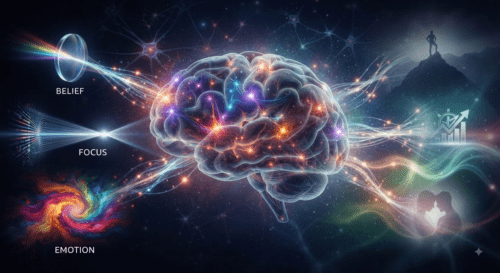
Selective Attention: Your Brain Cannot Notice Everything
Every moment, your senses are exposed to an enormous amount of information. Your brain cannot consciously process all of it.
As a result, attention acts as a filter.
When you become strongly interested in something, you may suddenly begin noticing it everywhere. Imagine that you decide to buy a particular model of car. After researching it, you may start seeing that same model on the road far more frequently than before.
The cars did not suddenly become more common.
Your attention changed.
This phenomenon is related to selective attention and attentional filtering. Your brain becomes more likely to notice information that is relevant to your current goals and interests.
That provides one grounded explanation for why manifestation can feel so powerful.
When you repeatedly focus on a goal, you may become better at recognizing information, people, resources, and opportunities that are connected to it.
Priming and Expectations
Psychology also examines how previous experiences and expectations can influence later thoughts and behavior. This broad area includes various forms of priming and expectancy effects.
Suppose you repeatedly think about starting a business. You might begin paying closer attention to entrepreneurship podcasts, industry news, potential customers, networking events, or problems that could become business opportunities.
These possibilities existed before you noticed them.
Your mental focus simply made them more relevant.
This is one practical way in which “thoughts become reality.”
The thought itself does not necessarily create the opportunity. Instead, the thought can influence what you notice, how you interpret information, and what you do next.
Self-Fulfilling Prophecies
Expectations can sometimes influence behavior in ways that make those expectations more likely to come true.
Consider two people entering the same job interview.
One believes, “I have nothing valuable to offer.”
The other thinks, “I have useful skills, and I can communicate them clearly.”
These beliefs may influence their posture, preparation, communication, persistence, and response to difficult questions. Their expectations can therefore affect their behavior, which may influence the final result.
This is much closer to a scientifically grounded explanation of manifestation than the idea that thoughts directly command the universe.
3. The Mind-Body Connection: Thoughts Can Affect Physical Well-Being
The relationship between mental states and physical health is another important part of the manifestation conversation.
Thoughts and emotions do not exist independently of the body. Stress, fear, excitement, anticipation, and relaxation can all influence physiological processes.
For example, persistent psychological stress can activate stress-response systems and contribute to physiological changes involving hormones such as cortisol. Long-term stress is associated with a range of negative health effects.
On the other hand, practices that promote relaxation, emotional regulation, social connection, and positive psychological states may support overall well-being.

This does not mean that positive thinking can cure every illness or that negative thoughts directly cause disease. Such claims go far beyond what science supports.
The more reasonable conclusion is this:
Your mental and emotional state can influence your body, and your physical state can influence how you think and behave.
This creates a continuous feedback loop between mind, body, behavior, and environment.
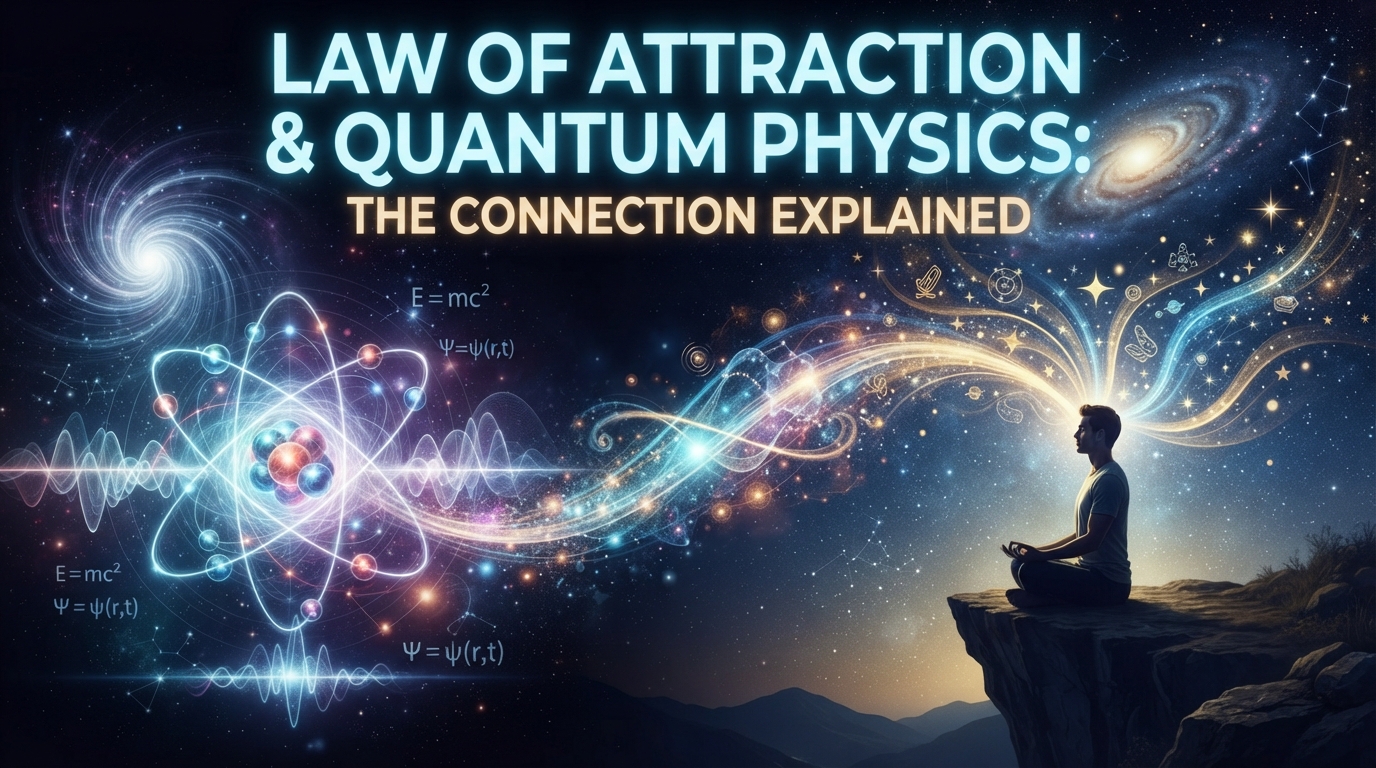
4. Quantum Mechanics and Manifestation: Where Science Ends and Speculation Begins
Few scientific concepts have been connected to manifestation as frequently as quantum mechanics.
Quantum physics describes the behavior of matter and energy at extremely small scales. At this level, nature behaves in ways that can seem very different from our everyday experience.
Because quantum experiments involve measurement and observation, some popular interpretations have suggested that consciousness itself has the power to create physical reality.
This idea is fascinating—but it requires considerable caution.

What Is the Observer Effect?
In quantum mechanics, the process of measurement can affect the physical system being measured. The exact meaning of “observation” depends on the experiment and interpretation, but it does not simply mean that a human mind looks at a particle and magically decides what the particle becomes.
In many quantum experiments, the interaction involved in measuring a system is itself physically significant.
This is very different from saying:
“If I think about something strongly enough, I can make it appear in the physical world.”
There is currently no established scientific basis for using quantum mechanics as a mechanism for everyday manifestation.
Why the Quantum Manifestation Claim Is Misleading
Quantum phenomena occur under physical conditions that are fundamentally different from ordinary human-scale experiences.
A quantum particle and a house, career, relationship, or bank account are not interchangeable examples.
Therefore, the fact that quantum systems behave probabilistically or that measurement affects certain quantum outcomes does not demonstrate that human thoughts can directly create macroscopic events.
Quantum mechanics is one of the most successful scientific theories ever developed, but using it as proof of the Law of Attraction is an interpretation that goes beyond established evidence.
That distinction is important—not because spirituality has no value, but because scientific ideas should not be presented as evidence for claims they do not actually establish.
5. What “Thoughts Become Reality” Really Means
Once we remove the supernatural assumptions, the phrase “thoughts become reality” becomes much more interesting.

Your thoughts can influence:
What you notice → What you believe → How you feel → What you decide → What you do → What results you create
Imagine that you decide to improve your career.
At first, the goal exists only as an idea.
You begin thinking about the type of work you want. That focus encourages you to research opportunities. You notice a course that could improve your skills. You start talking to people in the industry. You update your résumé. You apply for positions that previously seemed intimidating.
Eventually, one of those actions may produce a real-world result.
The original thought did not magically materialize the new career.
The thought initiated a chain of perception, decisions, behavior, and consequences.
That chain is where much of the practical power of manifestation lies.
6. How to Use Manifestation in a Practical Way
You do not have to choose between spirituality and science.
You can use manifestation as a structured method for clarifying your goals while relying on psychology and deliberate action to move toward them.

Step 1: Define What You Actually Want
Instead of saying:
“I want to be successful.”
Make the goal specific.
For example:
“I want to build a business that generates a stable monthly income.”
Specific goals give your attention a clearer target.
Step 2: Visualize the Process, Not Only the Result
Visualization can be useful when it helps you mentally rehearse actions.
Rather than imagining only the final reward, imagine yourself doing the work required to reach it.
Picture yourself:
- Studying consistently.
- Making difficult decisions.
- Speaking confidently.
- Handling setbacks.
- Completing important tasks.
- Continuing even when motivation decreases.
This turns visualization into preparation rather than wishful thinking.
Step 3: Identify Limiting Beliefs
Ask yourself:
- What do I believe about myself?
- What am I afraid will happen if I fail?
- Which assumptions are preventing me from taking action?
- Is there evidence that these beliefs are always true?
You do not need to replace every negative thought with exaggerated positivity.
A more useful approach is to develop realistic, flexible beliefs.
Instead of:
“I will definitely succeed.”
Try:
“I can improve my chances of success by learning, adapting, and taking consistent action.”
Step 4: Train Your Attention
Once your goal is clear, deliberately look for information related to it.
Read about the field. Talk to experienced people. Study successful examples. Look for problems that need solving.
Your goal becomes a filter that helps you identify relevant opportunities.
Step 5: Turn Intention Into Action
This is the step that separates practical manifestation from passive wishful thinking.
Ask yourself:
“What is one action I can take today that moves me closer to this goal?”
Then do it.
Even a small action can create momentum.
Step 6: Review and Adapt
Reality does not always follow your original plan.
If something fails, that does not necessarily mean you had the wrong mindset.
Perhaps the strategy needs to change.
Effective manifestation is therefore less about controlling every external event and more about developing the awareness and flexibility to respond intelligently to what happens.
7. The Real Power of Manifestation
The most useful interpretation of manifestation is not that your mind possesses unlimited supernatural power.

It is that your internal world influences how you engage with the external world.
Your thoughts influence your attention.
Your beliefs influence your expectations.
Your emotions influence your motivation and behavior.
Your behavior influences your environment.
And your environment provides feedback that can reshape your thoughts and beliefs.
This creates a dynamic cycle.
When you consciously participate in that cycle, you gain greater influence over the direction of your life.
That is a much more realistic—and arguably more powerful—interpretation of the idea that thoughts become reality.
Conclusion: Your Thoughts Are the Beginning, Not the End
The phrase “thoughts become reality” contains an important insight, but it should not be interpreted as a literal promise that thinking about something will automatically make it appear.
The Law of Attraction offers a spiritual and philosophical framework that encourages intention, visualization, gratitude, and positive expectation. For many people, these practices can provide motivation and a sense of direction.
Science offers a different but complementary perspective.
Neuroscience shows that attention shapes what information we notice. Psychology demonstrates that beliefs and expectations can influence behavior. Stress and emotional states can affect the body. And deliberate actions can gradually change the circumstances in which we live.
Quantum mechanics, meanwhile, should be treated with particular care. Although quantum physics reveals a deeply fascinating relationship between measurement and physical systems, it does not currently provide scientific proof that human thoughts can directly manifest everyday objects or events.

Perhaps the most empowering version of manifestation is therefore surprisingly simple:
Think clearly. Feel intentionally. Act consistently. Learn from reality. Adapt when necessary.
Your thoughts may not control the universe.
But they can influence what you notice, what you believe is possible, what you choose to do, and ultimately the direction in which your life develops.
And that is already a remarkable form of personal power.
So, what reality will you begin building with your thoughts—and your actions—today?