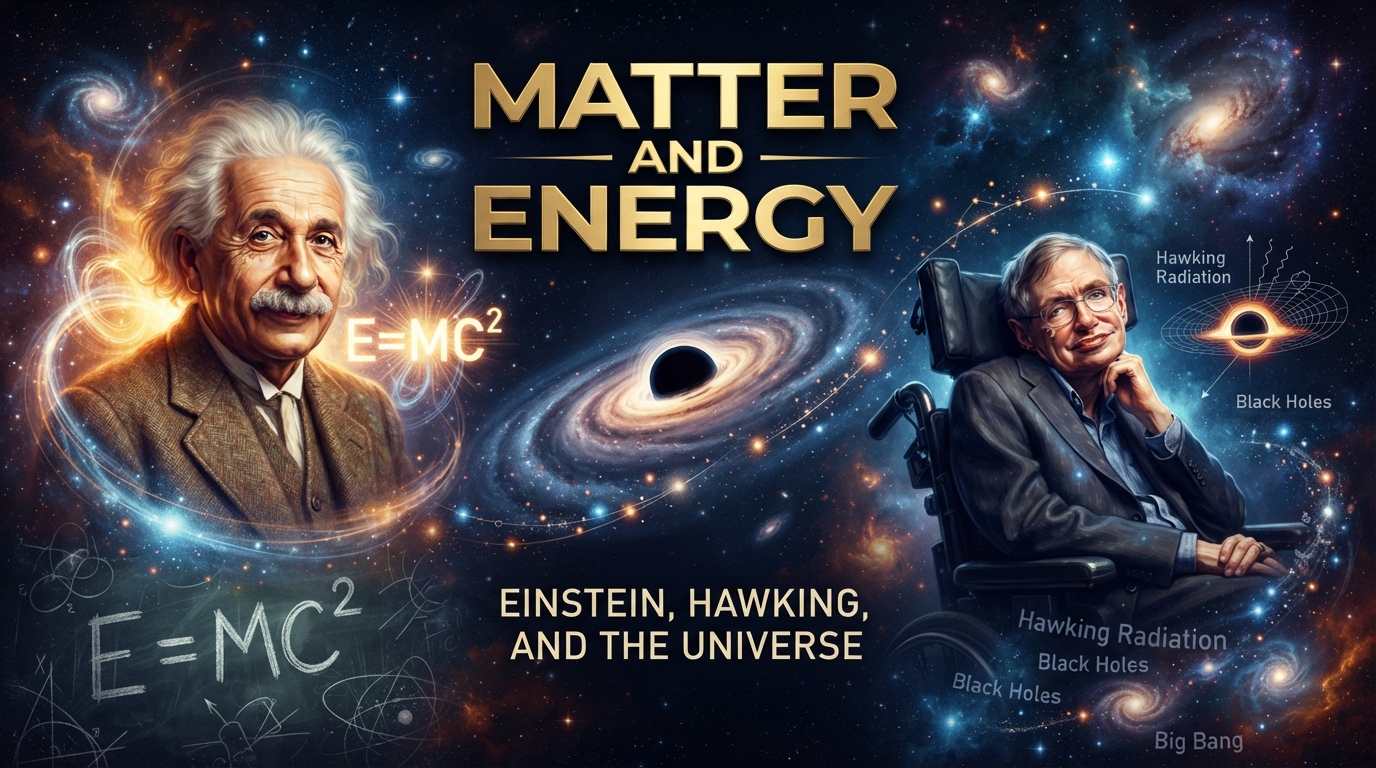
The Holographic Universe: Exploring the Hidden Nature of Matter, Energy, and Reality
Introduction: Could Reality Be More Than It Appears?
For centuries, philosophers wondered whether the world we experience truly represents reality. Today, this question is no longer confined to philosophy alone. Advances in modern physics have inspired scientists to investigate whether space, matter, and even time are deeper phenomena than our senses suggest.
From Albert Einstein’s groundbreaking discovery that matter and energy are fundamentally connected to Stephen Hawking’s revolutionary work on black holes, modern physics has revealed that reality may be built upon principles far more extraordinary than previously imagined. One of the most fascinating ideas to emerge is the Holographic Principle—the proposal that our seemingly three-dimensional universe could actually be encoded on a two-dimensional boundary.
While this concept remains an active area of theoretical research rather than established fact, it has profoundly influenced cosmology, quantum gravity, and our understanding of the universe. In this guide, we’ll explore the relationship between matter and energy, examine the holographic hypothesis, review the scientific ideas that inspired it, and discuss what it could mean for our understanding of existence.
1. Matter and Energy: The Foundation of the Physical Universe
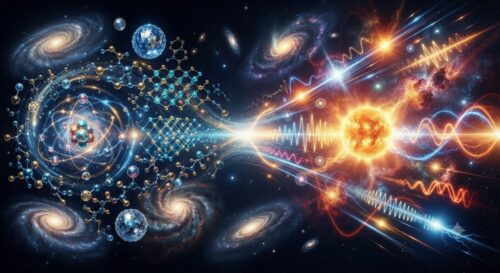
Everything we observe—from stars and galaxies to living organisms—is ultimately governed by the relationship between matter and energy.
Einstein’s Revolutionary Equation
Albert Einstein forever changed physics with his famous equation:
E = mc²
This elegant formula demonstrates that mass and energy are different expressions of the same physical reality. Under the right conditions, matter can be converted into energy, and energy can also produce matter.
This principle is observed in numerous physical processes, including:
- Nuclear fusion powering the Sun
- Nuclear fission inside reactors
- Particle creation in high-energy collisions
- The evolution of stars throughout the universe
Rather than existing as completely separate entities, matter and energy continuously transform according to the laws of physics.
Why Matter Appears Solid
Although everyday objects feel solid, modern physics reveals a more complex picture.
Atoms consist mostly of empty space, while electrons occupy probability distributions rather than fixed paths. The sensation of solidity arises primarily from electromagnetic interactions between atoms rather than from objects being completely “filled” with material substance.
This perspective reminds us that our intuitive experience of the physical world differs significantly from its microscopic structure.
2. The Holographic Principle: A New Way of Viewing Space
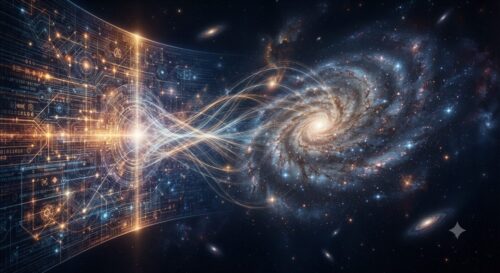
Among the most intriguing proposals in theoretical physics is the possibility that space itself may emerge from more fundamental information.
Understanding the Hologram Analogy
A traditional hologram begins as a flat surface containing encoded information. When illuminated correctly, it produces the appearance of a fully three-dimensional object.
Some physicists have suggested that the universe may function in a mathematically similar way.
According to the Holographic Principle, the information describing everything inside a volume of space could, in theory, be represented on its lower-dimensional boundary.
Importantly, this does not mean scientists have proven that we live inside a literal hologram. Instead, it is a mathematical framework that has proven remarkably useful in certain areas of theoretical physics.
Information as a Fundamental Building Block
If the holographic description accurately reflects aspects of nature, then concepts such as:
- Space
- Distance
- Geometry
- Physical objects
may emerge from deeper informational relationships rather than existing as the universe’s most fundamental ingredients.
This possibility has become one of the most active research areas in quantum gravity.
| Concept | Conventional Perspective | Holographic Perspective |
|---|---|---|
| Space | Three-dimensional geometry is fundamental. | Three-dimensional space may emerge from lower-dimensional information. |
| Matter | Physical particles occupy space. | Matter may be described through underlying quantum information. |
| Reality | Objects exist within spacetime. | Spacetime itself may emerge from deeper physical principles. |
| Information | A property carried by physical systems. | Potentially one of the universe’s most fundamental elements. |
3. Einstein, Hawking, and the Search for Reality
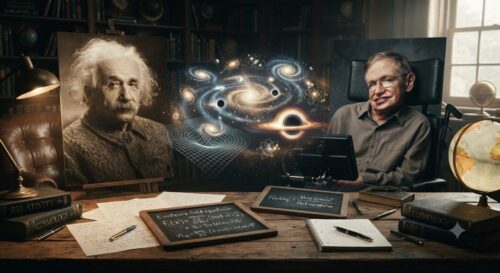
The holographic concept builds upon decades of groundbreaking work by some of history’s greatest physicists.
Einstein’s Legacy
Einstein’s General Theory of Relativity transformed our understanding of gravity.
Instead of viewing gravity as a force acting across space, Einstein showed that massive objects curve spacetime itself.
This framework accurately predicts:
- Planetary motion
- Black holes
- Gravitational lensing
- The expansion of the universe
His theories established the foundation for modern cosmology and inspired generations of physicists investigating the deepest structure of reality.
Hawking and the Information Puzzle
Stephen Hawking made pioneering contributions to black hole physics.
His prediction that black holes emit what is now called Hawking radiation raised an unexpected question known as the Black Hole Information Paradox.
If black holes eventually evaporate, what happens to the information describing everything that fell inside them?
Because quantum mechanics generally predicts that information should be preserved, resolving this paradox became one of theoretical physics’ greatest challenges.
Research into this problem helped motivate the holographic framework, suggesting that information associated with a three-dimensional region could be encoded on a two-dimensional boundary.
Although many questions remain open, these ideas continue to drive advances in quantum gravity and cosmology.
4. What Does This Mean for Reality?

The Holographic Principle encourages us to rethink some of our deepest assumptions about the universe.
Looking Beyond Appearances
Modern physics increasingly suggests that reality may be more subtle than everyday experience indicates.
Questions that continue to inspire scientific research include:
- Is spacetime truly fundamental, or does it emerge from deeper quantum processes?
- Could information be more fundamental than matter?
- How do gravity and quantum mechanics fit together?
- What role does observation play in describing physical systems?
While definitive answers remain elusive, these questions are expanding our understanding of the cosmos.
Rather than proving that reality is an illusion, the holographic framework offers a powerful mathematical perspective that may help unite quantum mechanics and gravity into a more complete theory of nature.
Frequently Asked Questions
| Question | Answer |
|---|---|
| What does E = mc² actually mean? | It shows that mass and energy are equivalent and can transform into one another. This relationship explains many natural processes, including nuclear reactions and stellar evolution. |
| Has the Holographic Principle been proven? | No. It remains a highly influential theoretical framework with strong mathematical support in certain models, but it has not been experimentally confirmed as a description of our universe. |
| Why are black holes important to this idea? | Black holes revealed deep questions about how information behaves under extreme gravity, leading physicists to develop holographic descriptions that may resolve these puzzles. |
| Does this mean the universe is literally a hologram? | Not necessarily. The term “holographic” is an analogy describing how information may be encoded mathematically rather than evidence that reality is a projected illusion. |

Conclusion
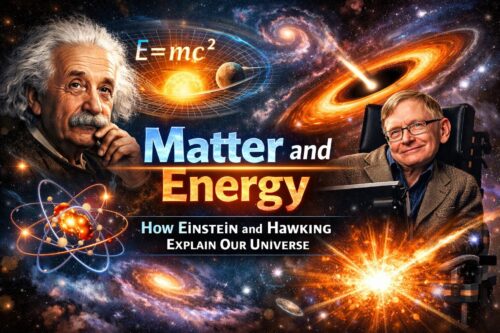
The relationship between matter and energy revealed by Einstein, combined with Stephen Hawking’s groundbreaking research into black holes, has transformed our understanding of the universe. Together, these discoveries have inspired the Holographic Principle—one of the most thought-provoking ideas in modern theoretical physics.
Although the holographic description remains an evolving scientific hypothesis, it has opened new pathways toward understanding quantum gravity, spacetime, and the role of information in the cosmos. Whether or not our universe ultimately proves to possess a holographic structure, the pursuit of these questions continues to reshape our view of reality.
As science progresses, the boundary between matter, energy, space, and information becomes increasingly interconnected, inviting us to look beyond appearances and appreciate the extraordinary complexity of the universe we inhabit.