The Ultimate Guide to Meteorites: Exploring the Science, Mystery, and Spiritual Meaning of Space Rocks
Introduction: Why Meteorites Fascinate Us
Few objects connect us to the universe as directly as a meteorite.
These ancient pieces of rock and metal have traveled through space for millions or even billions of years before reaching Earth. Some originated from asteroids, while others come from the Moon or Mars. Each one carries clues about the history of the solar system and the processes that shaped the planets.
But meteorites have fascinated humanity for reasons that go beyond science.
Across different cultures and spiritual traditions, stones that seemed to fall from the heavens were often regarded as sacred objects, divine signs, or symbols of transformation. Today, some people continue to see meteorites as reminders of our connection to something much larger than ourselves.
So what exactly is a meteorite? How is it different from a meteor or a meteoroid? What can these space rocks teach us about the origins of our solar system, and why do they continue to hold such powerful symbolic meaning?
This guide explores the science, history, symbolism, and enduring fascination surrounding meteorites.
1. The Science of Meteorites: Ancient Materials from Space
A meteorite is far more than an unusual-looking rock. It is a physical sample of material that formed beyond Earth and survived its journey through our atmosphere.
From Asteroid Fragment to Meteorite
The story usually begins with a larger body in space, such as an asteroid. Collisions between asteroids can break these objects apart, creating smaller fragments called meteoroids.
When a meteoroid enters Earth’s atmosphere at high speed, it encounters increasing resistance from the surrounding air. The resulting intense heating produces the brilliant streak of light that we observe in the night sky.
At this stage, the phenomenon is called a meteor.
If part of the original object survives its passage through the atmosphere and reaches Earth’s surface, the surviving material is called a meteorite.
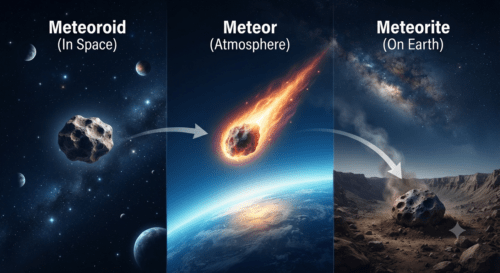
This means that the terms describe different parts of the same journey:
Meteoroid → Meteor → Meteorite
Not every meteoroid becomes a meteorite. Many objects burn up completely before they can reach the ground.
Time Capsules from the Early Solar System
One of the greatest scientific values of meteorites is their age.
Some meteorites contain minerals that formed roughly 4.5 billion years ago, around the time when the solar system itself was taking shape. Because many meteorites have remained relatively unchanged since that early period, scientists can study them as natural records of the conditions that existed before the planets fully formed.
By analyzing their minerals, isotopes, and chemical composition, researchers can investigate questions such as:
- How did the solar system form?
- What materials were present in the early protoplanetary disk?
- How did planets and asteroids develop?
- Where did water and other important ingredients come from?
- What chemical processes occurred before life appeared on Earth?
In this sense, a meteorite can function like a tiny geological time capsule.
Meteorites and the Building Blocks of Life
Some meteorites, particularly certain carbon-rich varieties known as carbonaceous chondrites, contain organic molecules.
Scientists have found amino acids and other carbon-containing compounds in meteorites. These discoveries are important because such compounds are associated with the chemistry necessary for life.
This does not mean that meteorites have been proven to contain extraterrestrial life. Instead, they provide evidence that some of the chemical ingredients associated with life can form or survive in space.
This has contributed to scientific research into astrobiology and the question of how life’s essential ingredients became available on the early Earth.
The Risks of Cosmic Impacts
Meteorites can also remind us of the destructive side of space.
Large asteroid impacts have dramatically altered Earth’s history. The Chicxulub impact, for example, is strongly associated with the mass extinction that eliminated the non-avian dinosaurs about 66 million years ago.
Today, astronomers monitor near-Earth objects (NEOs) to identify asteroids and other objects whose orbits could potentially bring them close to Earth.
The study of meteorites therefore has two sides: it helps us understand where we came from while also improving our understanding of potential cosmic hazards.
2. Meteorite, Meteor, or Meteoroid? Understanding the Difference
The words meteorite, meteor, and meteoroid sound similar, so it is easy to confuse them. However, each term has a specific meaning.
What Is a Meteoroid?
A meteoroid is a relatively small natural object traveling through space.
It may be a fragment of an asteroid or another celestial body. Meteoroids can vary considerably in size and composition, ranging from small rocky particles to much larger objects.
As long as the object remains in space, it is referred to as a meteoroid.
What Is a Meteor?
A meteor is not the space rock itself.
The term refers to the visible phenomenon produced when a meteoroid enters an atmosphere and creates a bright streak of light.
This is why the familiar expression “shooting star” can be misleading. A shooting star is not actually a star. It is the visible result of a small object interacting with Earth’s atmosphere.
What Is a Meteorite?
A meteorite is the surviving portion of a meteoroid that reaches the ground.
Meteorites can be collected and studied directly, making them especially valuable to researchers and collectors.
Their surfaces may show distinctive features produced during atmospheric entry. Some iron meteorites, for example, may display thumbprint-like depressions known as regmaglypts.
The three terms can therefore be remembered quite simply:
| Term | Meaning |
|---|---|
| Meteoroid | The object while it is traveling through space |
| Meteor | The flash or streak of light produced in the atmosphere |
| Meteorite | The surviving material that reaches the ground |
Understanding this distinction makes the entire journey of a meteorite much easier to visualize.
3. The Spiritual Meaning of Meteorites: Symbols of Cosmic Connection
Science explains where meteorites come from and what they are made of. Spiritual traditions, meanwhile, have often asked a different question:
What might it mean when something from the heavens reaches Earth?
The answers vary widely across cultures, but meteorites have frequently been associated with the divine, the mysterious, and the transformative.
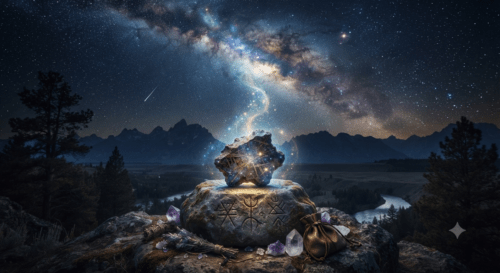
Stones from the Sky
Before modern astronomy could explain meteors and meteorites, objects falling from the sky naturally seemed extraordinary.
Throughout history, unusual stones believed to have fallen from the heavens have been treated as sacred or significant objects in different cultures. Their celestial origin gave them a symbolic status that ordinary rocks did not possess.
This history helps explain why meteorites continue to carry a sense of mystery today.
For some people, simply holding a meteorite creates a powerful sense of perspective. The object may have existed before human civilization, traveled through space, and eventually arrived on our planet.
That idea alone can be deeply meaningful.
A Symbol of Transformation
Meteorites are often associated with transformation, change, and new beginnings.
Their journey provides a powerful metaphor:
A fragment begins in the depths of space, travels through darkness, passes through the intense heat of an atmosphere, and eventually becomes something that can be discovered and held on Earth.
For people drawn to spiritual symbolism, this journey can represent the challenges and transformations of human life.
Difficult experiences may feel like periods of intense pressure, but they can also become turning points that lead to greater self-awareness.
Meditation and Personal Reflection
Some people incorporate meteorites into meditation or spiritual practices because of their symbolic connection with the cosmos.
A meteorite can serve as a physical reminder to step back from everyday concerns and consider the larger picture.
Rather than claiming that meteorites possess scientifically proven healing powers or special frequencies, it may be more useful to view them as objects of personal symbolism.
Holding a meteorite while meditating, journaling, or reflecting can encourage thoughts about time, existence, change, and our place in the universe.
The meaning comes from the experience and the individual interpretation.
Cosmic Perspective and Grounding
There is an interesting paradox in the symbolism of meteorites.
They come from the vastness of space, yet they eventually become part of the Earth beneath our feet.
For some people, this represents a balance between cosmic awareness and earthly grounding.
A meteorite can remind us that we are part of a much larger universe while also bringing that enormous idea into something tangible that we can actually touch.
4. Collecting Meteorites: Science, Beauty, and a Piece of the Cosmos
Meteorites have become fascinating objects for collectors, researchers, artists, and jewelry designers.
Their appeal comes from a combination of rarity, scientific importance, unusual appearance, and the extraordinary story behind each specimen.
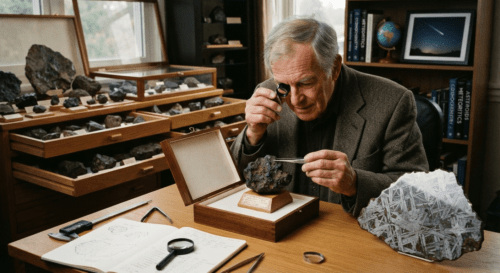
Why Are Meteorites Valuable?
Not every meteorite is extremely rare or expensive, but authentic specimens can be highly desirable depending on their classification, condition, size, provenance, and scientific importance.
Meteorites from the Moon or Mars, for example, are especially unusual and scientifically valuable.
Even common meteorites can be fascinating because each specimen represents material that formed beyond Earth.
For collectors, the appeal is not simply monetary.
It is the story.
A small meteorite may have existed long before humans appeared and traveled through the solar system before eventually becoming part of a collection.
The Beauty of Iron Meteorites
Some iron meteorites contain nickel-iron alloys that reveal remarkable crystalline patterns when professionally cut, polished, and etched.
One of the best-known examples is the Widmanstätten pattern.
This geometric structure forms naturally as certain metallic minerals cool extremely slowly inside an asteroid. The pattern cannot be reproduced through ordinary manufacturing because its formation requires conditions that occur over extraordinary periods of time.
As a result, iron meteorites are sometimes transformed into distinctive jewelry, watches, decorative objects, and works of art.
Owning a Piece of the Universe
For many collectors, the greatest appeal is emotional rather than financial.
A meteorite offers a rare physical connection to the universe beyond Earth.
You can look at an object that originated somewhere beyond our planet and realize that its journey began long before modern civilization.
That perspective can inspire curiosity, humility, and wonder.
In a world filled with digital images of distant planets and galaxies, a meteorite offers something different:
a piece of cosmic history that you can actually hold.
Conclusion: Meteorites as Windows into the Universe
Meteorites occupy a fascinating space between science, history, art, and spirituality.
Scientifically, they provide extraordinary evidence about the formation of the solar system and the materials that existed billions of years ago. Some contain organic compounds that help researchers investigate the chemistry associated with the origins of life.
Culturally and spiritually, meteorites have inspired ideas about divine messages, transformation, cosmic connection, and the mysteries of existence.
Their symbolism does not need to replace scientific understanding. In fact, the two perspectives can coexist.
Science can tell us where a meteorite came from and what it is made of.
Symbolism can invite us to consider what its journey means to us.
Perhaps that is the enduring fascination of these ancient space rocks. They remind us that Earth is not an isolated world. We are part of a vast cosmic history, and sometimes a small fragment from that history finds its way into our hands.
A meteorite may be only a piece of rock—but its story can stretch across billions of years and countless worlds.