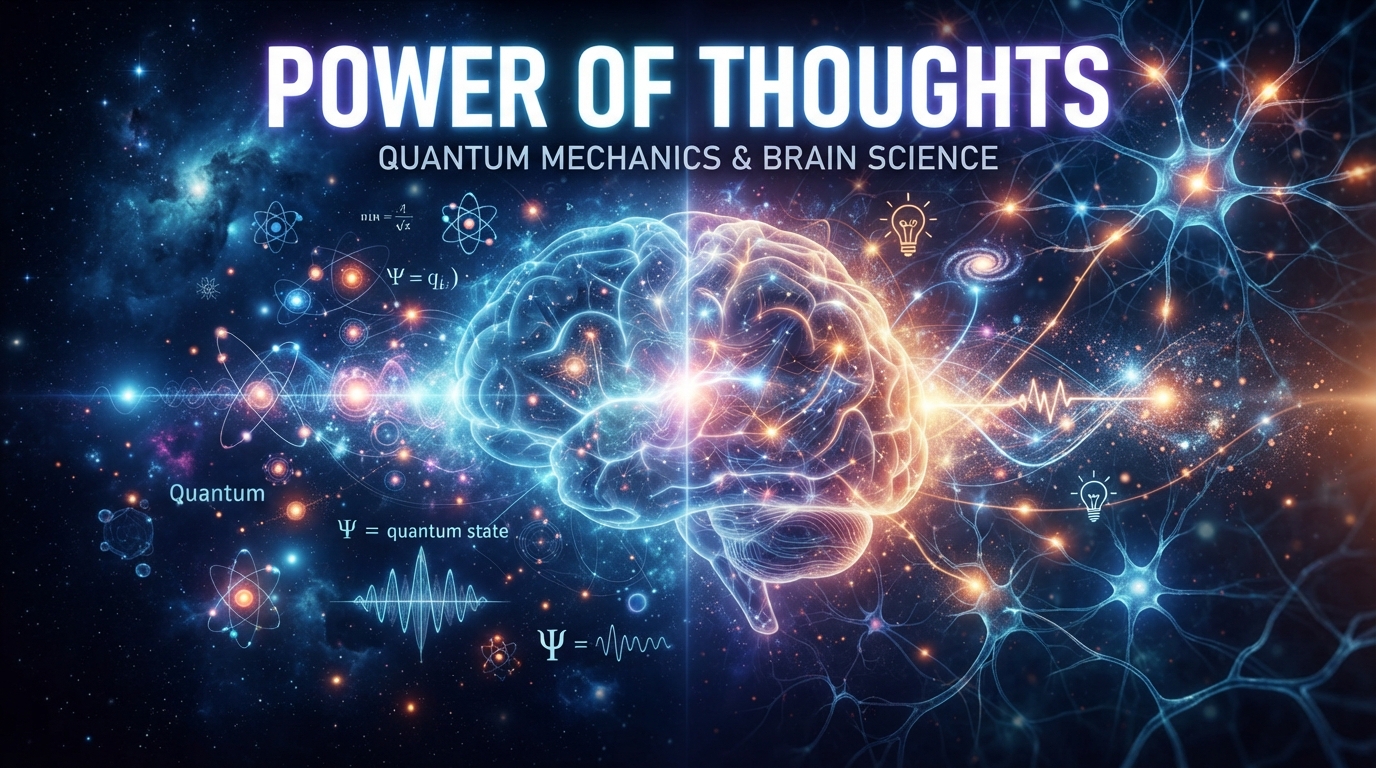
The Science of Manifestation: Exploring the Connection Between Mindset, Neuroscience, Quantum Theory, and Personal Growth
Introduction
For centuries, philosophers, spiritual teachers, and mystics have suggested that human thoughts possess the power to shape life experiences. This belief forms the foundation of the Law of Attraction, a philosophy proposing that focused thoughts, emotions, and intentions influence the opportunities and circumstances we encounter.

In recent decades, this concept has attracted growing interest from psychology, neuroscience, and even discussions surrounding quantum physics. While many popular claims linking manifestation to quantum mechanics remain speculative rather than scientifically verified, modern research does reveal fascinating ways in which our beliefs, attention, emotions, and behaviors influence the reality we experience every day.
This guide explores what science currently supports, where spiritual interpretation begins, and how practical mental habits can genuinely improve decision-making, resilience, and personal success.
1. Understanding Manifestation Through Both Science and Spirituality
Manifestation is often described as the process of intentionally directing thoughts toward desired outcomes.
Although scientific evidence does not support the idea that thoughts alone can directly alter physical reality, there are several mechanisms through which mindset significantly affects our lives.

The Law of Attraction as a Personal Philosophy
The Law of Attraction teaches that people attract experiences matching their dominant emotional and mental patterns. Those who consistently cultivate optimism, gratitude, confidence, and purpose are believed to attract opportunities aligned with these qualities, whereas persistent fear, doubt, and negativity are thought to reinforce limiting experiences.
From a scientific perspective, this should not be interpreted as invisible energetic forces magically rearranging reality. Instead, our habitual thinking influences perception, motivation, emotional regulation, communication, and behavior—all of which strongly affect life outcomes.
Energy, Vibration, and Scientific Interpretation
Spiritual teachings frequently describe everything in the universe as energy vibrating at different frequencies. Modern physics indeed demonstrates that matter consists of energy at a fundamental level. However, this fact should not be confused with evidence that human thoughts emit measurable frequencies capable of attracting external events.
The language of vibration can instead be understood metaphorically, describing emotional states that influence behavior, relationships, and decision-making.
Quantum Physics and the Observer Effect
Quantum mechanics studies particles at extremely small scales where behavior differs dramatically from everyday experience. One concept frequently discussed is the observer effect, which refers to how certain measurements influence quantum systems.
Popular manifestation literature often suggests that conscious observation collapses infinite possibilities into personal reality. While this interpretation is intriguing, mainstream physicists generally agree that current evidence does not support applying quantum phenomena directly to human thought or daily life.
Nevertheless, quantum theory reminds us that reality is often more complex than intuition suggests, inspiring continued philosophical exploration without providing scientific proof of manifestation itself.
Neuroplasticity: The Brain’s Ability to Adapt
One of the strongest scientific foundations supporting personal transformation is neuroplasticity.
Every thought activates networks of neurons. Repeated thinking strengthens these neural pathways, making certain beliefs and behaviors increasingly automatic over time.
This explains why consistent optimism, learning, visualization, and positive self-talk can gradually reshape habits, emotional responses, and decision-making. Rather than changing the external world directly, repeated thoughts change the person interacting with that world.
2. How the Brain Helps Turn Thoughts into Results
Modern neuroscience offers several well-established explanations for why focused thinking often appears to produce remarkable outcomes.

The Reticular Activating System (RAS)
The Reticular Activating System acts as the brain’s information filter.
Because the human brain receives enormous amounts of sensory input every second, the RAS determines which information deserves conscious attention.
This explains familiar experiences such as suddenly noticing a particular car model after deciding to purchase one or recognizing opportunities related to a recently established goal.
When individuals repeatedly focus on a meaningful objective, the RAS naturally becomes more sensitive to people, resources, conversations, and possibilities connected with that objective. The opportunities already existed—the brain simply becomes better at recognizing them.
Priming the Mind for Success
Psychological priming refers to the way previous experiences influence later thoughts and actions.
Daily affirmations, visualization exercises, inspiring reading, and positive language all serve as forms of mental priming. These practices prepare the subconscious mind to expect progress rather than failure.
As confidence increases, individuals often become more willing to take initiative, communicate effectively, and persist through challenges.
Beliefs Shape Decisions
Our belief systems influence countless everyday choices.
Someone who believes success is achievable is more likely to:
- pursue new opportunities
- continue learning
- accept constructive criticism
- recover after setbacks
- remain motivated over long periods
Conversely, limiting beliefs often discourage action before genuine opportunities are even explored.
Emotions Influence Performance
Thoughts and emotions are deeply interconnected.
Positive emotions are associated with neurotransmitters such as dopamine and serotonin, which support motivation, learning, creativity, and problem-solving.
Individuals experiencing optimistic emotional states generally perform better socially, think more flexibly, and adapt more effectively during stressful situations.
These measurable biological effects demonstrate how internal mental states can indirectly influence external achievements.
Comparing Traditional Manifestation Beliefs with Scientific Mechanisms
| Concept | Traditional/Spiritual Interpretation | Scientific Reality |
| Thoughts | Thoughts emit frequencies that attract reality. | Thoughts shape neural pathways (Neuroplasticity). |
| Focus | Visualizing attracts external events. | The RAS filters information to find relevant opportunities. |
| Beliefs | Beliefs unlock “manifestation” power. | Beliefs determine your willingness to act and persevere. |
| Emotions | Emotional vibration changes the world. | Emotions influence neurotransmitters (dopamine/serotonin), impacting performance. |
| Results | Results appear through attraction. | Results emerge from consistent, purposeful action. |
3. Why Action Is the Essential Ingredient of Manifestation
Mindset creates direction, but consistent action creates measurable results.

Intention Must Lead to Behavior
Visualization and positive thinking become valuable only when followed by deliberate effort.
Successful individuals typically:
- establish clear goals
- notice relevant opportunities
- build practical skills
- maintain consistent habits
- adjust strategies when necessary
Manifestation becomes most effective when intention guides meaningful action.
Resilience Creates Long-Term Success
Every worthwhile goal involves setbacks.
Individuals with growth-oriented mindsets interpret mistakes as information rather than personal failure. This perspective encourages experimentation, learning, and continuous improvement.
Scientific research consistently shows that resilience predicts long-term achievement across education, business, athletics, and personal development.
Opportunity Requires Participation
The Law of Attraction should not be understood as replacing effort.
Imagining a desired future does not automatically produce it. Instead, a focused mind becomes better prepared to recognize possibilities and respond effectively when opportunities arise.
In this sense, mindset serves as a catalyst rather than a substitute for action.
4. Practical Techniques to Develop a Manifestation Mindset
Whether viewed through a spiritual or psychological lens, several daily habits can strengthen focus, confidence, and purposeful action.

Practice Detailed Visualization
Spend several minutes each day imagining your goals in vivid detail.
Picture yourself succeeding while engaging all five senses. Imagine the environment, conversations, emotions, and achievements as realistically as possible.
This exercise reinforces motivation while helping the brain become familiar with desired outcomes.
Repeat Meaningful Affirmations
Choose affirmations that encourage realistic confidence.
Examples include:
- I grow stronger through consistent effort.
- Every day I recognize new opportunities.
- I am capable of learning and improving.
- My actions move me closer to my goals.
Repeated consistently, affirmations help reinforce healthier patterns of thinking.
Build a Daily Gratitude Practice
Gratitude shifts attention away from scarcity and toward appreciation.
Writing three to five things you’re thankful for each day encourages greater emotional balance, reduces stress, and promotes optimism.
Research has linked gratitude practices with improved psychological well-being and stronger interpersonal relationships.
Focus on Small Daily Progress
Major achievements are usually built through small, repeated actions.
Instead of waiting for dramatic inspiration, identify one meaningful task each day that supports your larger objective.
Over time, consistent progress creates momentum that often appears effortless from the outside.
Stay Flexible
Manifestation is not about controlling every outcome.
Unexpected changes frequently reveal better opportunities than originally imagined. Maintaining curiosity, adaptability, and patience allows growth even when plans evolve.
Frequently Asked Questions (Q&A)

Q1: Is the Law of Attraction scientifically proven?
A: Not in the literal or magical sense. Science does not support the idea that thoughts emit mysterious energy waves that physically pull objects, people, or events toward you. However, the psychological and neurological mechanisms behind manifestation—such as neuroplasticity, cognitive filtering via the Reticular Activating System (RAS), and psychological priming—are well-supported by science. These mechanisms change how you perceive, react, and take action in the world.
Q2: What is the biggest difference between popular manifestation trends and the scientific perspective?
A: Popular trends often frame manifestation as a passive process where visualizing or “feeling the vibe” is enough to manifest external changes. The scientific perspective emphasizes that mindset acts as an internal catalyst: it reshapes neural pathways and sharpens focus, which in turn drives the consistent, purposeful action required to produce real-world results.
Q3: How does the Reticular Activating System (RAS) work in manifestation?
A: The RAS acts as your brain’s content filter, sifting through millions of bits of sensory information every second to highlight what matters to you. When you consistently focus on a goal or intention, your RAS flags relevant information, resources, and opportunities in your environment that you might otherwise have overlooked.
Q4: Can practicing manifestation backfire or cause harm?
A: Yes, if misunderstood. Relying on “toxic positivity” (suppressing negative emotions or ignoring real risks) or believing that thoughts alone replace concrete action can lead to disappointment, inaction, or undue self-blame when things go wrong. Healthy manifestation combines an optimistic, goal-oriented mindset with realistic planning, action, and emotional resilience.
Q5: How long does it take to see results when changing my mindset?
A: Because neuroplasticity relies on repeated experience to build and strengthen neural pathways, mindset shifting is a gradual process. While subtle shifts in awareness (via the RAS) can happen almost immediately, changing deeply ingrained habits, beliefs, and life outcomes typically takes consistent daily practice over weeks or months.
Conclusion
Manifestation occupies an intriguing space where spirituality, psychology, and neuroscience intersect. Although scientific evidence does not support the claim that thoughts alone can directly alter physical reality, research strongly demonstrates that our beliefs, attention, emotions, and behaviors profoundly influence the lives we create.
Neuroplasticity shows that the brain can continuously reshape itself through repeated experience. The Reticular Activating System explains why focused goals become increasingly visible in everyday life. Psychology demonstrates that confidence, optimism, gratitude, and resilience encourage behaviors associated with greater success.
Rather than viewing manifestation as magical thinking, it may be more useful to see it as intentional mental conditioning combined with purposeful action. A clear vision guides attention, positive beliefs strengthen perseverance, and consistent effort transforms possibility into achievement.
Ultimately, your thoughts are not merely passive reflections of reality—they are powerful influences on how you perceive challenges, seize opportunities, and shape your future. When mindset and action work together, meaningful personal transformation becomes not only possible but increasingly probable.