
Quantum Mechanics and Consciousness: Can Your Mind Influence Reality?
Introduction
The relationship between quantum mechanics and consciousness has fascinated scientists, philosophers, and spiritual thinkers for decades. Popular ideas such as the Law of Attraction often draw inspiration from quantum physics, suggesting that our thoughts can shape reality.

While modern science has not confirmed a direct connection between human consciousness and external events, the discussion offers an interesting perspective on how beliefs, perception, and intentional action influence our lives.
Rather than proving that thoughts magically create reality, quantum theory encourages us to question how observation, perception, and probability contribute to our understanding of the universe. Combined with psychology and neuroscience, these concepts can inspire practical strategies for personal growth.
Quantum Mechanics and the Nature of Reality
Quantum mechanics explores the behavior of matter and energy at the smallest scales. Unlike everyday objects, quantum particles often exist in probabilistic states until they are measured. This phenomenon has inspired philosophical discussions about the role of observation in defining reality.

Some people interpret the observer effect as evidence that consciousness directly shapes the physical world. However, in scientific research, the observer effect generally refers to interactions involved in measurement rather than the power of human intention alone. Even so, the idea reminds us that perception strongly influences how we experience life.
Another concept frequently associated with manifestation is that everything consists of energy. Although all matter ultimately involves energy, scientific physics does not support the claim that positive thoughts emit measurable frequencies capable of attracting desired events. Nevertheless, our attitudes, emotions, and behaviors clearly affect our decisions, relationships, and opportunities, making mindset an important factor in achieving personal goals.
How the Brain Shapes Experience
The human brain continuously processes enormous amounts of sensory information, filtering and organizing it into a meaningful picture of reality. Our beliefs, memories, and expectations influence how we interpret events, often determining whether we perceive challenges as obstacles or opportunities.
Popular discussions often describe the left hemisphere as logical and the right hemisphere as creative. While this distinction is somewhat simplified, different brain networks do specialize in various cognitive functions.

Analytical thinking helps us solve problems, while imagination supports creativity, innovation, and long-term vision. Success usually comes from integrating both modes of thinking rather than relying exclusively on one.
Psychologist Carl Jung introduced the concept of the collective unconscious, proposing that humanity shares universal symbols and archetypes. Although this remains a psychological theory rather than an established scientific fact, many people find it useful for understanding shared human experiences and cultural patterns.
Turning Vision into Action
Visualization can be a powerful mental exercise when combined with realistic planning. Athletes, entrepreneurs, and performers frequently imagine successful outcomes before taking action. This practice can strengthen motivation, improve confidence, and increase focus.

However, visualization alone is rarely enough. Once a clear vision has been established, it should be supported by concrete goals and consistent effort. Breaking large ambitions into smaller tasks creates momentum and makes progress measurable.
Meditation, mindfulness, and controlled breathing can also support this process by reducing stress, improving concentration, and encouraging emotional balance. These practices help quiet mental distractions, allowing clearer thinking and more intentional decision-making.
Four Steps to Personal Growth

1. Create a Clear Vision
Define your objective with as much detail as possible. A specific goal is easier to pursue than a vague wish.
2. Build an Action Plan
Transform your vision into achievable steps. Daily progress, even in small amounts, is more effective than waiting for dramatic breakthroughs.
3. Stay Consistent
Challenges and setbacks are natural parts of any journey. Flexibility, persistence, and continuous learning increase the likelihood of long-term success.
4. Practice Gratitude
Gratitude encourages a positive mindset and helps people recognize opportunities they might otherwise overlook. Appreciating current achievements also strengthens motivation for future goals.
Conclusion
Quantum mechanics continues to expand our understanding of the universe, while psychology and neuroscience reveal how the human mind shapes perception and behavior. Although there is no scientific evidence that consciousness alone can directly alter external reality through quantum processes, our thoughts undeniably influence our decisions, habits, emotions, and interactions.
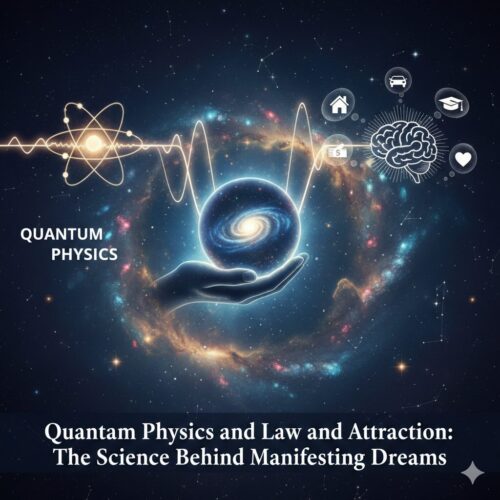
When clear intention is combined with disciplined action, emotional resilience, and an open mind, meaningful change becomes possible. Instead of viewing manifestation as magic, it can be understood as the process of aligning mindset, behavior, and consistent effort toward a purposeful life. In that sense, the greatest power of the mind lies not in bending the laws of physics, but in transforming the way we think, act, and ultimately shape our own future.