Is Reality “Outside” or Inside? A Deep Dive into Perception and the Ego
Is Reality Out There, or Are We Projecting It?
Most of us live under the unquestioned assumption that reality exists “out there”—independent of us. We see the physical world, other people, and events as objective facts that would exist whether we were here or not.

However, a different school of thought suggests that reality is nothing more than a “projection of our inner world.” In this view, the world we see is not an objective landscape but a reflection filtered through our own consciousness.
From this perspective, the definition of “reality” expands from a collection of physical objects to “everything that is perceived.” Taken to the extreme, one could argue that the universe itself only exists because you are here to perceive it.
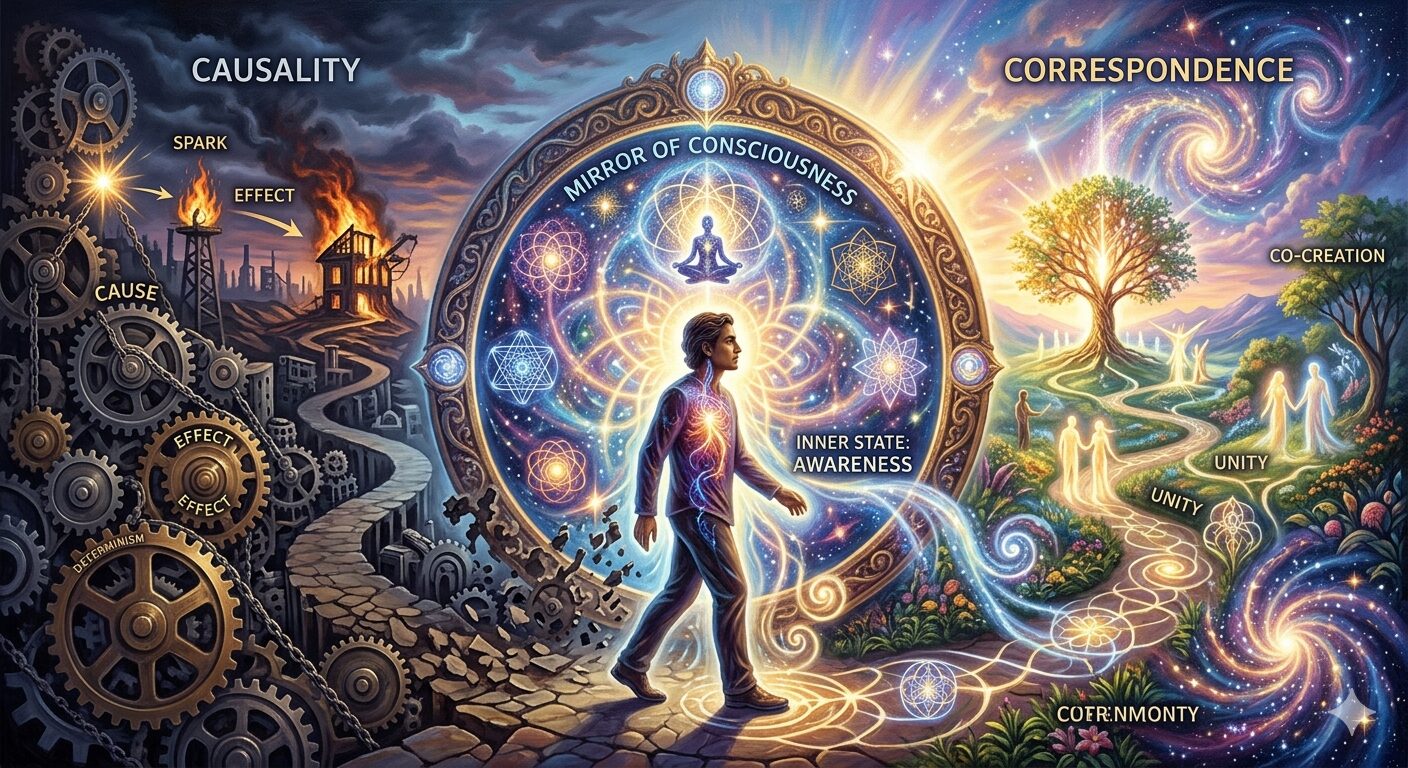
Does “Inner Change” Create Reality? The Trap of Causality
The phrase “Change your inner world, and your reality will change” is a popular concept. While it sounds empowering, it often hides a significant psychological trap: the trap of causality.
When we view the inner world as the cause and reality as the effect, we become bound by linear time—the idea that “A must happen before B.” This often conflicts with the metaphysical premise that “everything already exists in the now.”

More importantly, this causal thinking can strengthen the Ego. It’s easy to fall into a cycle of self-blame: “My life isn’t improving because my inner state isn’t good enough yet.” This creates a loop of self-negation.
Instead of causality, what if we viewed it as “Correspondence” (Alignment)? The inner and outer worlds might not be cause and effect, but rather two things changing simultaneously. Shifting to this view helps us let go of the exhausting need to control the external world and allows us to simply flow with the shift.
The Ego and the Mechanism of Denial
To understand this theme, we must address the role of the Ego. The Ego’s primary job is to maintain its own boundaries, often by using “denial.” It has a peculiar tendency to unconsciously reject the things that are already present within us.
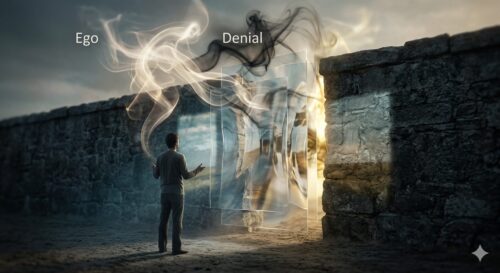
When we encounter something in the “outside” world that causes intense discomfort, it is often a reflection of something we are actively denying within ourselves.
The key here is not to “try and change it” but to “feel it.” By simply recognizing and acknowledging these reflections, we begin to integrate the fragmented parts of our psyche. It’s a quiet, subtle process, but one that leads to true wholeness.
The “World = Self” Paradox: Loneliness vs. Liberation
If we accept the idea that “The World = Self,” we eventually hit a challenging question: What about other people?
Are others independent souls with their own consciousness, or are they merely appearances within your own field of awareness? There is no easy answer. This line of thinking can lead to a profound sense of “Solipsistic Loneliness”—the feeling that no one else truly exists.

On the other hand, many find great liberation in this perspective. It shifts the power from external forces back to the individual. You are no longer a victim of circumstance; you are the source of meaning.
Of course, even if you believe you are “creating” your reality, it rarely behaves exactly as you want it to. This gap between intention and manifestation is exactly what makes the human experience so complex and intriguing.
Summary
There is no definitive answer to the question, “What is reality?” However, shifting your perspective can radically change how you experience life
Ultimately, the goal isn’t necessarily to find the “correct” theory, but to find the perspective that feels most natural and allows you to live with the least amount of resistance.