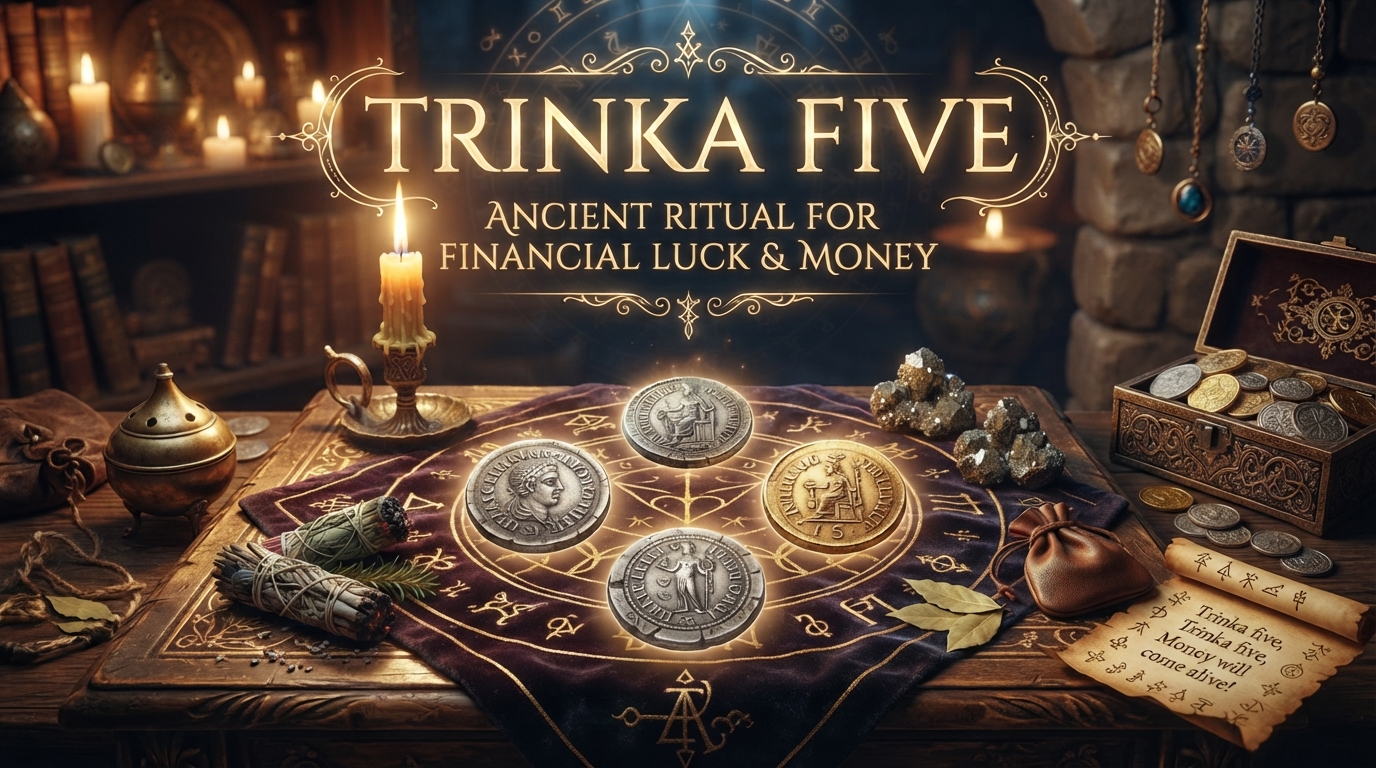
Trinka Five: Exploring the Mystical History and Practice of a Traditional Money Ritual
Introduction: The Mystery Behind Trinka Five
When people face sudden financial difficulties, they often look for help in more than one place. Practical solutions such as finding additional work, asking for assistance, or negotiating payments may be essential, but throughout history, people have also turned to prayer, ritual, and spiritual traditions for comfort and hope.
One practice that has gained attention online is known as Trinka Five, a ritual said to be associated with Romani folk traditions and intended to be used during moments of financial difficulty.
Accounts of the practice describe it not as a method for becoming wealthy, but as a focused spiritual request for help with an immediate financial need. The ritual is surrounded by mystery, and many versions of the story have been passed through informal and modern sources rather than well-documented historical records.
That distinction is important.
There is no reliable evidence that Trinka Five can literally cause money to appear, nor is there strong historical documentation proving a single, ancient Romani origin for the ritual in the form commonly presented today. Instead, it is best understood as a piece of contemporary spiritual folklore inspired by ideas about intention, prayer, symbolism, and financial relief.
In this article, we will explore the story behind Trinka Five, examine its supposed cultural connections, explain the ritual as it is commonly described, and consider how it can be approached respectfully and realistically.
1. Trinka Five and the Romani Cultural Connection
The Romani people have a long and complex history. Their ancestors are generally understood to have originated in the Indian subcontinent before migrating through regions of the Middle East and eventually into Europe and other parts of the world.
Over centuries, Romani communities developed diverse languages, customs, beliefs, and traditions. There is no single Romani culture that represents every community, and spiritual practices have varied considerably across different regions and historical periods.

A Tradition Shaped by Resilience
Romani history has often been marked by migration, discrimination, economic hardship, and efforts to preserve cultural identity under difficult circumstances.
Folklore, storytelling, music, craftsmanship, and various forms of traditional knowledge have played important roles in different Romani communities.
Some popular accounts also associate Romani culture with fortune-telling, divination, and folk practices. However, these associations have frequently been exaggerated or stereotyped in popular culture.
For that reason, it is important not to treat every ritual described online as an established practice shared by all Romani people.
What Is Trinka Five Supposed to Do?
The modern descriptions of Trinka Five generally present it as a focused request for financial assistance.
The central idea is relatively simple: rather than asking for unlimited wealth, the practitioner identifies a specific financial problem and asks for enough help to deal with it.
This distinction gives the ritual a particular symbolic character.
It is not framed as a celebration of material excess. Instead, it represents the hope of finding a way through a difficult situation.
Whether someone interprets the ritual spiritually, psychologically, or symbolically, that focus can be meaningful.
A clearly defined financial goal can also encourage people to think more carefully about what they actually need, rather than simply wishing for “more money.”
Oral Tradition and Modern Retellings
One reason the origins of Trinka Five are difficult to verify is that the ritual is often described through informal retellings.
Stories about folk rituals frequently change as they move between families, communities, books, websites, and social media. Details can be added, removed, or modified over time.
This means that the version of Trinka Five commonly found today may not be identical to whatever practice may have existed in an earlier cultural context.
Rather than presenting one version as unquestionably ancient, it is more responsible to recognize the ritual as part of a broader landscape of folk spirituality and modern spiritual folklore.
2. How the Trinka Five Ritual Is Commonly Described
For people interested in the symbolic or spiritual aspects of Trinka Five, the ritual itself is generally presented as simple.
The emphasis is placed less on elaborate objects or complicated ceremonies and more on intention, concentration, repetition, and emotional clarity.
Step 1: Define the Financial Need
Begin by finding a quiet place where you can concentrate without interruption.
Take several slow breaths and allow yourself to become calmer.
Then identify the financial problem as specifically as possible.
Instead of thinking, “I need more money,” you might define the situation more clearly:
“I need $500 to cover an unexpected bill.”
The purpose of this exercise is not to guarantee that the requested amount will magically appear. Rather, defining the problem gives your mind a concrete goal.
It can also make it easier to identify practical solutions afterward.
Step 2: Repeat the Traditional Phrase
Modern descriptions of Trinka Five commonly focus on repeating the words “Trinka Five” or a related phrase several times.
Different versions of the ritual may use different wording and repetition patterns. There is no universally verified historical formula that can be confirmed as the one authentic version.
For that reason, it is better to treat the commonly circulated wording as a modern ritual formulation rather than as a definitively preserved ancient text.
The repetition itself can serve as a form of focused meditation.
By concentrating on a short phrase, you temporarily reduce the mental noise created by fear and financial stress.
Step 3: Visualize the Desired Outcome
While repeating the phrase, some practitioners visualize the financial problem being resolved.
For example, you might imagine receiving the income you need, finding a new opportunity, completing a successful job, or discovering another legitimate way to cover the expense.
The purpose of visualization does not have to be supernatural.
Visualization can also help transform an abstract fear into a clearly defined goal.
Afterward, take a few moments to acknowledge the situation and release the ritual.
Then return to the practical steps that can actually improve your circumstances.
3. Important Principles: Respect, Intention, and Realistic Expectations
Rituals can be meaningful, but they should never replace practical action—especially when someone is facing a serious financial emergency.
Trinka Five is best approached as a symbolic or spiritual practice rather than a guaranteed method of obtaining money.
| Approach | Spiritual Ritual (Trinka Five) | Practical Financial Action |
| Primary Focus | Intentions, emotional clarity, and mindset | Concrete solutions, income, and debt management |
| Key Benefits | Reduces panic and helps define specific goals | Delivers measurable financial relief and stability |
| Best Used For | Gaining focus and transforming fear into hope | Resolving bills, negotiating payments, and budgeting |
Use It as Reflection, Not a Substitute for Action
If you are struggling to pay rent, medical expenses, debt, or essential household bills, practical assistance should come first.
Depending on your situation, this could include contacting creditors, negotiating payment plans, applying for assistance programs, seeking additional employment, speaking with trusted people, or consulting a qualified financial adviser.
A ritual may help you feel calmer and more focused, but it cannot guarantee a particular financial outcome.
The most useful approach is therefore to combine reflection with action.
Avoid Fear-Based Interpretations
Some modern versions of the Trinka Five story claim that using the ritual incorrectly can cause negative spiritual consequences.
There is no reliable scientific evidence supporting such claims.
If a ritual is approached with intense fear—”What if I do it wrong?” or “What if something bad happens?”—the practice can potentially increase anxiety rather than relieve it.
A healthier approach is to view the ritual as a personal moment of intention.
You can use it to pause, breathe, clarify your needs, and remind yourself that financial problems do not define your entire future.
Respect the Cultural Context
Perhaps the most important consideration is cultural respect.
Romani communities are diverse, and it is misleading to portray them as a single group defined by magic, fortune-telling, or mystical practices.
If you encounter claims that Trinka Five is an ancient Romani ritual, remember that its precise historical origins are difficult to verify.
Approaching the subject with curiosity rather than certainty allows the tradition to be explored without reinforcing stereotypes.
This is especially important when discussing practices attributed to minority cultures.
Frequently Asked Questions About Trinka Five
Is Trinka Five a proven method to get fast cash?
No. There is no evidence that Trinka Five creates money out of thin air. It functions primarily as a psychological or spiritual focus exercise to help clarify financial needs and reduce stress.
Is Trinka Five an authentic Romani tradition?
While widely attributed to Romani folklore online, there are no definitive historical records proving a single, ancient Romani origin. It is best understood as contemporary spiritual folklore.
Can practicing Trinka Five incorrectly cause bad luck or harm?
No. Claims of spiritual harm or negative consequences are modern fear-based additions to the story. Approaching the ritual with intention and a calm mindset avoids unnecessary anxiety.
How should I combine the ritual with real-life steps?
Use the ritual to calm your mind and specify the exact amount you need. Immediately follow up by taking practical actions, such as budgeting, contacting creditors, or seeking extra work.
4. Conclusion: What Trinka Five Can Represent Today
Trinka Five is often presented as an ancient money ritual connected to Romani spirituality, but its exact historical origins are difficult to establish.
What can be explored more confidently is the symbolic idea behind the practice: when people feel financially overwhelmed, they often seek a way to transform fear into hope, uncertainty into intention, and helplessness into action.
That idea is much broader than any single ritual.
Repeating a phrase, visualizing a goal, or taking a quiet moment to pray can help someone step back from panic and think more clearly. The value may come not from supernatural forces producing money, but from the way a focused ritual changes a person’s emotional state and attention.
There is also something valuable in the distinction between wanting unlimited wealth and asking for enough to solve a specific problem.
When a financial goal becomes concrete, it becomes easier to consider realistic ways of achieving it.
Ultimately, Trinka Five is best approached with an open mind and a grounded perspective.
You can appreciate its mystery without assuming that every claim surrounding it is historically proven.
You can explore its spiritual symbolism without treating it as a guaranteed financial solution.
And you can use the ritual, if it has personal meaning for you, as a moment to pause, clarify your intention, and reconnect with hope—while continuing to take practical steps toward financial stability.
Perhaps that is the most useful lesson hidden within the story of Trinka Five: hope can inspire us, but meaningful change usually begins when hope is followed by action.