Prophecy and Premonition: The Mystery of Prediction and Our Power to Shape the Future
Introduction: Why Are We So Fascinated by the Future?
For thousands of years, human beings have looked toward the unknown with a mixture of curiosity, hope, and fear. We want to know what tomorrow will bring, whether a major change is approaching, or whether there is some hidden pattern behind the events of our lives.
This desire to glimpse the future has given rise to countless traditions, from ancient oracles and religious prophets to astrology, tarot, dream interpretation, and modern psychic practices. But what exactly is prophecy? Is it a supernatural ability to see events that have already been determined? Could it be a form of divine communication? Or might some experiences described as prophecy actually come from the remarkable ability of the human mind to recognize patterns and subtle signals?

Premonitions raise similar questions on a more personal level. Many people have experienced a sudden feeling that something was about to happen, only to see a seemingly unexpected event unfold later. While such experiences are difficult to verify scientifically, they continue to challenge the way we think about intuition, consciousness, and the future.
In this article, we will explore the history of prophecy, the connection between prophecy and premonition, the psychological mechanisms behind prediction, and the role of divination practices such as tarot and astrology. Most importantly, we will consider a deeper question: if the future can be perceived in some way, does that mean it is already fixed—or do our choices still have the power to change it?
1. The History and Mystery of Prophecy: From Ancient Oracles to Modern Seers
Prophecy has appeared in remarkably diverse cultures throughout human history. Although the traditions and beliefs surrounding it vary widely, they often share a common purpose: helping people make sense of uncertainty.
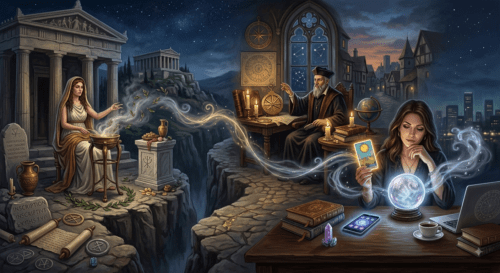
Ancient Prophecy and Divine Messages
In many ancient civilizations, prophecy was understood as a form of communication between the human world and the divine. Kings, warriors, rulers, and ordinary people often consulted prophets or sacred institutions when facing important decisions.
One of the most famous examples is the Oracle of Delphi in ancient Greece. People traveled great distances to seek guidance from the oracle, whose messages were often mysterious and open to interpretation. Rather than providing simple yes-or-no answers, prophetic statements frequently took the form of symbols, metaphors, or ambiguous warnings.
This ambiguity was part of the power of prophecy. Instead of simply revealing a predetermined future, a prophecy could encourage people to reflect on their choices and circumstances. It provided a framework through which people could understand events that otherwise seemed chaotic or impossible to control.
The idea of prophecy as a message from a higher power has continued to influence religious and spiritual traditions throughout history. Even today, many people regard prophets, spiritual teachers, or intuitive practitioners as potential sources of insight into questions that cannot easily be answered through ordinary reasoning.
Why Is the Future So Difficult to Predict?
There is an interesting paradox at the heart of prediction: humans constantly attempt to forecast the future, yet the future is influenced by countless variables.
Even modern scientific forecasting has limits. Weather models, economic projections, and other forms of prediction rely on enormous amounts of data, but unexpected changes can still alter the outcome. Human behavior is particularly difficult to predict because people can change their minds, respond to new information, and make decisions that were impossible to anticipate beforehand.
This raises an intriguing philosophical question. If the future is constantly being shaped by countless decisions and changing circumstances, can anyone truly know it with absolute certainty?
Perhaps this uncertainty is precisely what makes prophecy so fascinating.
The Psychology of Believing in Predictions
There is also a psychological dimension to prophecy that deserves attention.
Human beings are naturally inclined to search for patterns and meaning. When a prediction appears to come true, we may remember it vividly while forgetting the predictions that turned out to be wrong. This tendency is often associated with confirmation bias.
Vague or symbolic predictions can also feel remarkably accurate because they allow people to connect the message with events in their own lives. Once a significant event occurs, we may look back and reinterpret an earlier statement as if it had predicted that exact event.
This does not necessarily settle the question of whether every prophetic experience has a psychological explanation. However, it reminds us that extraordinary claims deserve careful consideration and that our own minds can influence how we interpret mysterious experiences.
2. Prophecy and Premonition: The Mysterious Power of Intuition
Prophecy is often associated with major events or messages intended for a community, while premonition is usually more personal. A premonition is a feeling, impression, or apparent knowledge that something is going to happen before the event takes place.
Almost everyone is familiar with the idea of a “gut feeling.” Sometimes we suddenly feel uncomfortable about a situation without knowing exactly why. At other times, we may think about a person moments before receiving a message from them.
Are these experiences supernatural? There is no scientific consensus demonstrating that people can reliably perceive future events through paranormal means. Yet there are interesting psychological explanations for why intuition can sometimes feel remarkably accurate.
The Subconscious Mind and Intuition
Our brains constantly process information that never reaches conscious awareness.
A person may notice someone’s facial expression, tone of voice, body language, or changes in their usual behavior without consciously recognizing each individual detail. The brain can combine these subtle signals and produce a strong intuitive impression.
For example, you might suddenly feel that a colleague is upset even though they have not said anything unusual. Your conscious mind may not know what prompted the feeling, but your subconscious may have already detected several small clues.
In this sense, intuition can be understood as a form of rapid, unconscious pattern recognition.
That does not make every intuitive experience correct. But it does demonstrate how much information the human mind can process beneath the surface of conscious thought.
Prophetic Dreams and the Unconscious
Dreams have long been associated with prophecy. Across cultures, people have described dreams that seemed to anticipate future events.
From a spiritual perspective, prophetic dreams may be interpreted as messages or glimpses of information beyond ordinary consciousness. From a psychological perspective, dreams may reflect the brain’s attempt to process memories, emotions, fears, expectations, and possibilities.
Sometimes a dream may appear prophetic simply because it contains elements that later resemble something that happens in waking life. Other times, the dream may reflect concerns that were already developing beneath conscious awareness.
Whatever interpretation we choose, the connection between dreams and intuition remains fascinating. Dreams remind us that our minds continue processing information even when we are not consciously directing them.
The Self-Fulfilling Prophecy
One of the most interesting psychological ideas connected to prediction is the self-fulfilling prophecy.
A belief about the future can influence behavior in ways that make the expected outcome more likely.
Imagine someone becomes convinced that they will fail an important examination. Their anxiety may prevent them from concentrating, reduce their motivation to study, and cause them to perform poorly. The original expectation then appears to have been correct.
The same mechanism can work in a positive direction. Someone who believes they can succeed may be more willing to prepare, persist through difficulties, and take opportunities that eventually improve their chances of success.
This reveals an important aspect of prophecy: sometimes, the prediction itself is not what changes the future. Our response to the prediction does.
3. Divination and the Search for Meaning: Tarot, Astrology, and Beyond
Prophecy is closely connected with divination, the practice of seeking insight through symbolic systems, rituals, or interpretive tools.
Tarot cards, astrology, numerology, and other traditions have been used for centuries to explore questions about relationships, personal direction, challenges, and the future. Although these practices are not scientifically established methods of predicting future events, many people find value in them as tools for reflection and meaning-making.
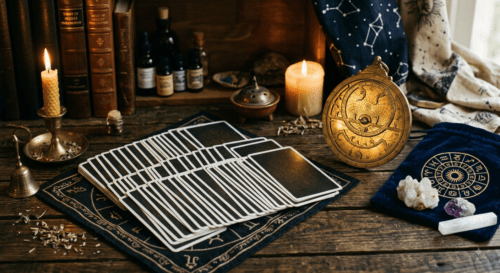
Tarot as a Mirror for the Inner World
Tarot is often portrayed as a method for predicting exactly what will happen. However, many contemporary practitioners approach it differently.
Rather than viewing the cards as a fixed script for the future, they use the imagery and symbolism as prompts for reflection. A particular card may encourage someone to think about their fears, relationships, ambitions, or unresolved emotions.
In this way, tarot can function less like a crystal ball and more like a mirror.
The value may not lie in proving that a card can reveal an objective future, but in helping a person ask better questions about their present circumstances. The interpretation can create space for self-reflection and potentially lead to decisions that would otherwise remain unexplored.
Astrology and the Search for Cosmic Patterns
Astrology takes a different approach by examining the positions and movements of celestial bodies and interpreting them in relation to human life.
Modern science does not establish astrology as a reliable method for predicting individual events. Nevertheless, astrology has remained culturally influential for thousands of years because it offers people a symbolic framework for thinking about personality, relationships, timing, and major life transitions.
For believers, an astrological chart can represent a kind of cosmic blueprint. For others, it may simply be a symbolic language that encourages self-examination.
Either way, the enduring appeal of astrology reflects a deeply human desire to find patterns and meaning within a complicated world.
A Prediction Should Be a Guide, Not a Sentence
Perhaps the healthiest way to approach prophecy and divination is to treat them as possibilities rather than absolute commands.
A prediction that says something difficult may happen does not necessarily mean that the outcome is unavoidable. Instead, it can become an opportunity to examine our choices, prepare for potential challenges, or reconsider the direction we are taking.
Likewise, a positive prediction should not encourage passive waiting. If someone believes that good fortune is approaching, the most constructive response may be to remain alert to opportunities and take practical action.
The future becomes meaningful not simply because someone claims to see it, but because we decide what to do with the information we receive.
FAQ: Prophecy and Premonition
| Question | Answer |
|---|---|
| What is prophecy? | Prophecy is traditionally understood as a message or insight about future events, often associated with divine inspiration, spiritual practices, or prophetic figures. In a broader sense, it can also refer to attempts to understand or anticipate what may happen in the future. |
| What is the difference between prophecy and premonition? | Prophecy is often associated with messages or predictions about larger events, while a premonition is usually a personal feeling or impression that something is going to happen before it occurs. |
| Can people really predict the future? | There is currently no reliable scientific evidence that humans can consistently predict future events through supernatural abilities. However, intuition, pattern recognition, probability, and subconscious processing can sometimes make predictions appear surprisingly accurate. |
| What causes a premonition? | A premonition may sometimes result from subconscious processing. The brain can notice subtle details and patterns that do not reach conscious awareness, creating a strong feeling that something is about to happen. Spiritual traditions may interpret such experiences differently. |
| Are prophetic dreams real? | Many people report dreams that seem to predict later events, but prophetic dreams have not been scientifically established as a reliable way to see the future. Dreams can also reflect memories, emotions, expectations, and unconscious concerns. |
| What is a self-fulfilling prophecy? | A self-fulfilling prophecy occurs when a person’s belief about a future outcome influences their behavior in ways that make that outcome more likely to happen. |
| Can tarot cards predict the future? | Tarot has not been scientifically proven to predict future events. Many people nevertheless use tarot as a symbolic tool for self-reflection, exploring emotions, identifying possibilities, and thinking about difficult decisions. |
| Is astrology a form of prophecy? | Astrology is traditionally used to interpret celestial patterns in relation to human experiences and future possibilities. Although it is not scientifically established as a predictive method, many people use it for reflection, personal meaning, and exploring life patterns. |
| Does believing in a prediction change the future? | It can sometimes influence behavior. When people strongly believe a particular outcome is possible, they may unconsciously make choices that increase or decrease the likelihood of that outcome. |
| Is the future already predetermined? | This remains a philosophical and spiritual question rather than a scientifically settled fact. Some traditions emphasize fate, while others emphasize free will. A practical perspective is that many aspects of the future remain uncertain and can be influenced by our choices. |
| Should prophecy be taken literally? | Not necessarily. Prophetic messages are often symbolic or open to interpretation. Treating predictions as possibilities rather than absolute commands can encourage reflection without giving away personal responsibility or free will. |
| What is the most useful way to approach prophecy? | A balanced approach is to remain curious while maintaining critical thinking. Prophecy, intuition, dreams, tarot, and astrology can be explored as sources of reflection and meaning, but important life decisions should also consider evidence, circumstances, and practical judgment. |
4. Conclusion: Prophecy, Free Will, and the Future We Create
Prophecy and premonition occupy a fascinating space between spirituality, psychology, philosophy, and human imagination. There is currently no scientific basis for concluding that people can reliably see a fixed future through supernatural means. At the same time, the experiences associated with intuition, dreams, symbolic interpretation, and prediction continue to raise intriguing questions about how the human mind understands uncertainty.
Perhaps the most valuable lesson of prophecy is not the promise of knowing exactly what will happen.
It is the reminder that our beliefs about the future can influence how we live in the present.
A prophecy may be interpreted as a divine message, an intuitive impression, a psychological projection, or simply a symbolic story. Regardless of the interpretation, the future is not something we experience until it arrives. Until then, countless possibilities remain open, and our decisions can influence which possibilities become reality.
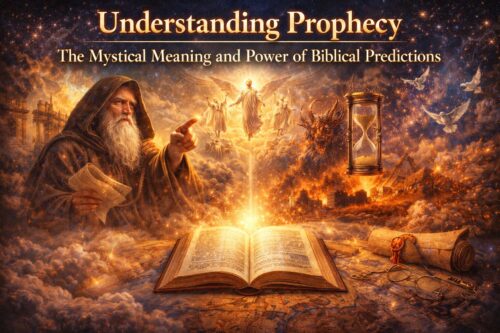
This is where prophecy and free will meet.
Instead of asking only, “What will happen to me?” we might ask a more empowering question:
“What can I do today to create the future I want?”
Perhaps the true mystery of the future is not that it can be predicted, but that it is constantly being created.
We may never know exactly what lies ahead. Yet uncertainty does not have to be something we fear. It can also be an invitation—to remain curious, make conscious choices, learn from our experiences, and participate actively in the unfolding story of our lives.
The future may be unknown, but that is precisely what makes it an adventure.