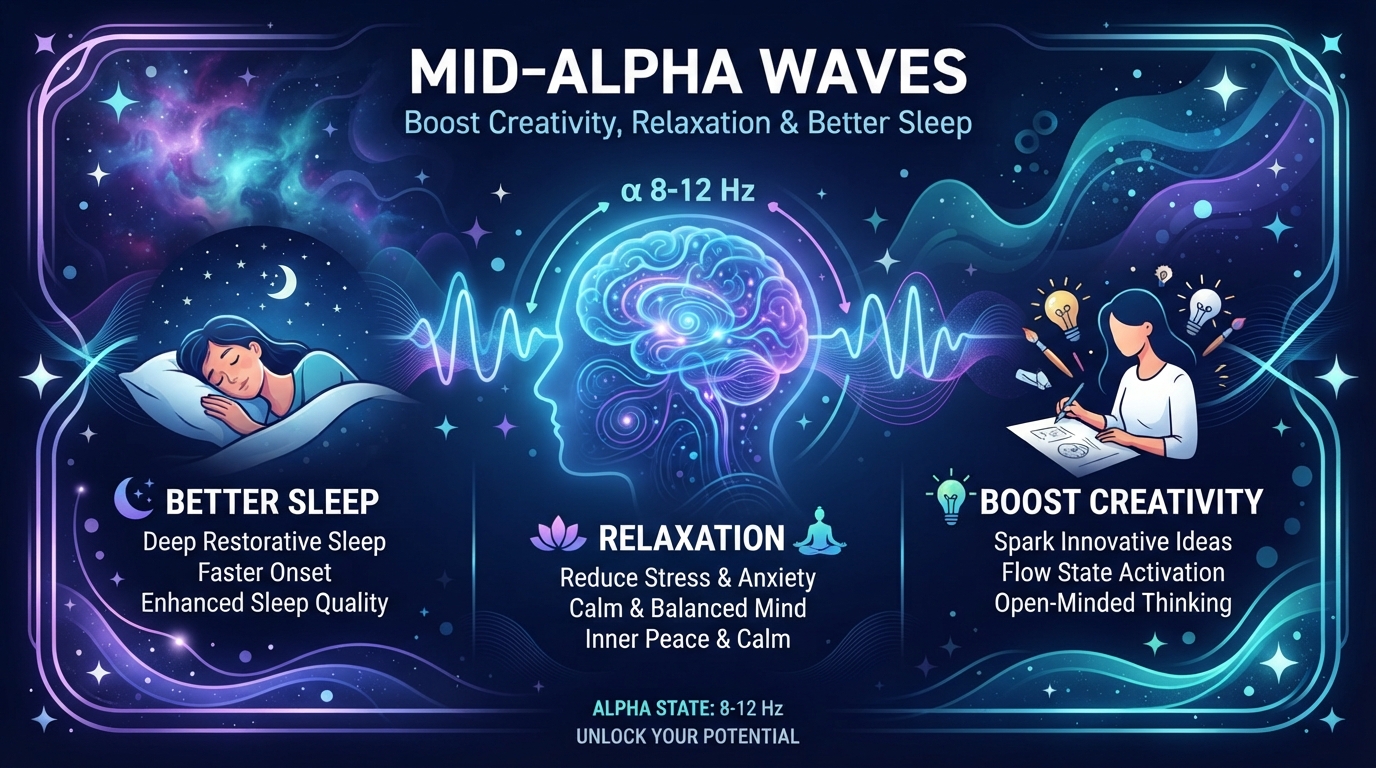
Mid-Alpha Waves: The Ultimate Guide to Relaxation, Creativity, and Peak Performance
Introduction: What Are Mid-Alpha Waves?
Have you ever experienced a moment when your mind felt completely calm, yet you remained alert and focused? Perhaps it happened during meditation, while listening to music, taking a walk, or becoming deeply absorbed in a creative project.
This state of relaxed awareness is often associated with alpha brainwave activity.
Brainwaves are patterns of electrical activity produced by the brain, and their frequency changes depending on our mental and physical state. Alpha waves generally fall within the 8–12 Hz range, with mid-alpha activity often referring to the middle portion of this range. Rather than representing a single magical frequency, mid-alpha activity can be viewed as part of a broader brain state associated with relaxation, internal attention, and reduced mental tension.
Understanding alpha activity can offer useful insight into meditation, creativity, concentration, stress management, and sleep preparation. While brainwave research is still evolving, there are practical ways to encourage the relaxed-alert state commonly associated with alpha activity.
In this guide, we’ll explore what mid-alpha waves are, how they may relate to your mental state, and simple techniques you can use to create more moments of calm focus in everyday life.
Understanding Mid-Alpha Waves: The Science Behind Relaxed Focus
Your brain is constantly producing electrical activity. Researchers classify different brainwave patterns according to their frequency, including delta, theta, alpha, beta, and gamma activity.
Alpha waves are typically associated with a state in which you are awake but relaxed. They can become more noticeable when you close your eyes, reduce external stimulation, meditate, or simply take a break from demanding mental activity.
Mid-alpha activity sits within this broader alpha range and is often discussed in relation to a balanced state between relaxation and alertness.
Imagine the difference between being completely exhausted and being intensely focused on a stressful deadline. Neither state is particularly conducive to relaxed creativity. Alpha activity represents something closer to the middle ground: your mind is awake, but it isn’t constantly reacting to every external stimulus.
A State Between Relaxation and Attention
One reason alpha activity is interesting is that it appears to be influenced by both external and internal attention.
When you step away from constant notifications, conversations, and competing demands, your brain has more opportunity to process thoughts internally. This doesn’t necessarily mean that alpha waves directly “unlock” creativity, but relaxed mental states can make it easier to notice connections, explore possibilities, and think without excessive pressure.
This may help explain why useful ideas sometimes appear when you stop forcing yourself to solve a problem.
A solution might suddenly come to you while taking a shower, walking outside, or relaxing before sleep. The brain hasn’t necessarily stopped working—it may simply be processing information in a different way.
Why Mental Quiet Matters
Modern life provides almost unlimited stimulation. Emails, social media, notifications, multitasking, and constant information consumption can make it difficult to experience genuine mental quiet.
Creating periods of reduced stimulation may therefore be valuable in its own right.
Alpha-associated states can serve as a useful framework for understanding this experience: less mental noise, more internal space, and enough alertness to remain aware of what is happening.
How Alpha Activity May Affect the Mind and Body
Alpha waves aren’t a cure-all, and they shouldn’t be treated as a guaranteed shortcut to better health or higher performance. However, research into alpha activity and relaxation suggests several interesting connections.

1. Relaxation and Stress Management
Relaxation practices such as meditation, slow breathing, and mindfulness can influence brain activity, including alpha activity.
When you deliberately slow down and shift your attention away from stressful stimuli, you may also reduce the physical arousal associated with stress. Your breathing can become steadier, your muscles may relax, and your attention can become less reactive.
This is one reason people often feel mentally refreshed after meditation or a quiet period of intentional relaxation.
The goal isn’t necessarily to “produce more alpha waves.” A more useful goal is to develop the ability to move from a tense, overstimulated state toward a calmer form of awareness.
2. Calm Focus and Cognitive Performance
Being relaxed doesn’t mean being mentally inactive.
In fact, some forms of relaxation can create a useful environment for concentration. When unnecessary distractions are reduced, you may find it easier to stay with one task instead of constantly switching your attention.
This can be particularly helpful when reading, studying, writing, brainstorming, or working through a complicated problem.
Rather than trying to force yourself into an extreme state of concentration, you can experiment with a different approach: reduce the tension and let attention become more stable naturally.
3. Creativity and New Ideas
Creativity often benefits from a combination of attention and freedom.
When you’re under intense pressure, your thinking can become narrow and repetitive. When you’re completely disengaged, however, you may not have enough focus to develop an idea.
A relaxed-alert state offers a middle ground.
This may be one reason creative insights can emerge during activities such as walking, drawing, journaling, listening to music, or quietly reflecting. Your conscious mind remains engaged while there is enough mental space for associations and possibilities to emerge.
The famous “aha!” moment isn’t necessarily caused by one specific brainwave frequency. Instead, creativity involves complex interactions among attention, memory, emotion, brain networks, and environmental factors.
Still, creating a relaxed mental environment can make creative thinking easier.
Mid-Alpha Waves, Meditation, and the Transition to Sleep
Alpha activity is particularly interesting when we look at the period between active wakefulness and sleep.
As you become drowsy, brain activity gradually changes. Alpha activity is commonly observed during relaxed wakefulness and the early transition toward sleep, before slower theta and delta activity becomes more prominent.
Preparing the Mind for Sleep
If your biggest nighttime problem is a racing mind, relaxation techniques may help you create a smoother transition into sleep.
Instead of going directly from emails, social media, or intense work to bed, consider giving your brain a short period of reduced stimulation.
Dim the lights. Put your phone away. Take several slow breaths. Listen to quiet music or practice a short body scan.
These habits don’t guarantee a particular brainwave pattern, but they can help establish the relaxed environment that supports healthy sleep routines.
Alpha Waves Are Not Deep-Sleep Waves
It’s important to make one distinction clear: alpha waves are not the dominant brainwaves of deep sleep.
Deep non-REM sleep is characterized primarily by slower delta activity. Alpha activity is more closely associated with relaxed wakefulness and the early stages of winding down.
So rather than thinking of alpha waves as a mechanism that directly produces deep sleep, it is more accurate to think of relaxation as part of the preparation for sleep.
A Simple Evening Ritual
Try creating a 10–15 minute transition period before bed.
You could:
- Practice slow, comfortable breathing.
- Listen to calm instrumental or ambient music.
- Stretch gently.
- Practice mindfulness or meditation.
- Write down thoughts that are keeping your mind busy.
- Read something relaxing instead of scrolling through social media.
The consistency of the routine may be more important than trying to achieve a specific brainwave frequency.
4 Practical Ways to Encourage a Relaxed-Alert State
You don’t need an EEG device or expensive technology to experiment with alpha-friendly relaxation practices.
The following activities are simple starting points.

1. Meditation and Mindfulness
Meditation is one of the most accessible ways to practice relaxed awareness.
You don’t have to meditate for an hour. Start with five to ten minutes.
Sit comfortably, focus on your breathing, and notice when your attention wanders. When it does, gently bring it back.
The objective isn’t to eliminate every thought. It’s to become less reactive to those thoughts.
With regular practice, this can help you become more comfortable with periods of mental quiet.
2. Slow Breathing and Visualization
Your breathing is closely connected to your body’s arousal state.
Try breathing slowly and comfortably for several minutes. Avoid forcing extremely deep breaths; simply allow the breath to become smooth and unhurried.
You can combine this with visualization. Imagine a quiet beach, a forest path, a peaceful room, or another environment that makes you feel safe and relaxed.
The purpose isn’t to manipulate your brain into a specific frequency. Instead, you’re giving your nervous system a signal that it is time to slow down.
3. Creative Activities
Creative activities can naturally encourage a state of absorption.
Writing, painting, drawing, playing an instrument, cooking, photography, gardening, and other hobbies can all create opportunities to become deeply engaged without excessive pressure.
Choose an activity that you genuinely enjoy rather than treating creativity as another productivity exercise.
Sometimes the best ideas appear when you stop demanding that they appear.
4. Spend Time in Nature
Nature can provide a welcome break from digital stimulation.
A quiet walk through a park, sitting beneath trees, watching the ocean, or simply spending a few minutes outdoors can give your attention a chance to recover.
You don’t have to turn every walk into a formal meditation session.
Leave your phone in your pocket. Notice the sounds around you. Pay attention to the movement of the wind, the temperature of the air, and the details of your surroundings.
That simple shift in attention can create a surprisingly refreshing mental reset.
How to Incorporate Mid-Alpha Practices Into Daily Life
The most effective approach is usually the simplest one: make relaxation a regular part of your routine rather than something you only do when you’re already overwhelmed.

For example, you might create three small moments during your day:
Morning:
Spend five minutes breathing quietly before checking your phone.
Afternoon:
Take a short walk without listening to notifications or consuming information.
Evening:
Use ten minutes of stretching, meditation, reading, or calm music to transition toward sleep.
These practices don’t need to be complicated.
The goal is to give your brain regular opportunities to move away from constant stimulation and toward a calmer form of awareness.
Over time, you may become better at recognizing the difference between genuine focus and tense concentration.
Common Misconceptions About Mid-Alpha Waves
Because brainwave frequencies are frequently discussed in wellness and spiritual communities, it’s easy to encounter exaggerated claims.
Here are a few important distinctions.
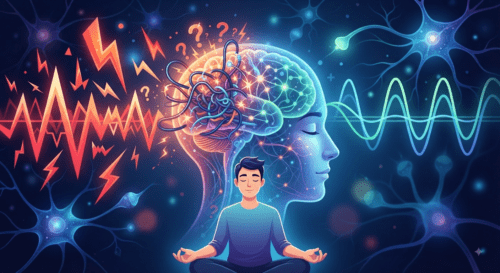
Mid-Alpha Is Not a Magical Frequency
There is no single frequency that automatically produces creativity, wealth, healing, or enlightenment.
Brain activity is much more complicated than that.
Listening to a particular frequency may feel relaxing to some people, but individual responses vary, and claims that a specific sound frequency can reliably produce extraordinary results should be treated cautiously.
More Alpha Isn’t Always Better
Alpha activity is associated with relaxation in many contexts, but the brain needs different patterns of activity for different tasks.
You don’t want to remain relaxed all the time. Driving, solving a difficult problem, exercising, and responding to an emergency require different levels of alertness.
The goal is flexibility, not maximum alpha activity.
Relaxation Is the Bigger Picture
Instead of obsessing over whether you’re producing exactly 9 Hz or 10 Hz activity, focus on the experience itself.
Are you breathing comfortably?
Can you concentrate without excessive tension?
Are you less distracted?
Do you feel mentally refreshed?
These practical outcomes are often more meaningful than chasing a particular number.
Conclusion: Creating More Space for Calm, Creativity, and Focus
Mid-alpha waves offer an interesting window into the relationship between brain activity and our everyday mental states.
Although the science does not support treating one specific frequency as a universal key to creativity, healing, or peak performance, alpha activity is strongly associated with relaxed wakefulness and provides a useful framework for understanding calm attention.
Meditation, slow breathing, creative activities, time in nature, and a peaceful evening routine can all help you cultivate this relaxed-alert state.

The real benefit may not come from “hacking” your brain into a particular frequency. It may come from something much simpler: learning how to create moments of quiet in a world that rarely stops making noise.
When the mind has room to breathe, concentration can become steadier, stress can feel more manageable, and creative ideas may have more space to emerge.
You don’t need to completely change your lifestyle.
Start with five quiet minutes today.
Close your eyes. Breathe slowly. Put away the distractions. Let your attention settle.
And notice what happens when you give your mind a little more room to think.
Alpha Beta Gamma Frequency Player
Frequency Player
Alpha & Beta Waves — Relaxation, Focus, and Mental Clarity
Select a Frequency
Choose one of the three bands above to learn about its effect and hear the matching tone.
⚠️ Headphones recommended for the best experience | Avoid listening to pure tones at high volume for extended periods.
These descriptions are offered for general wellness purposes only and are not a substitute for medical advice.