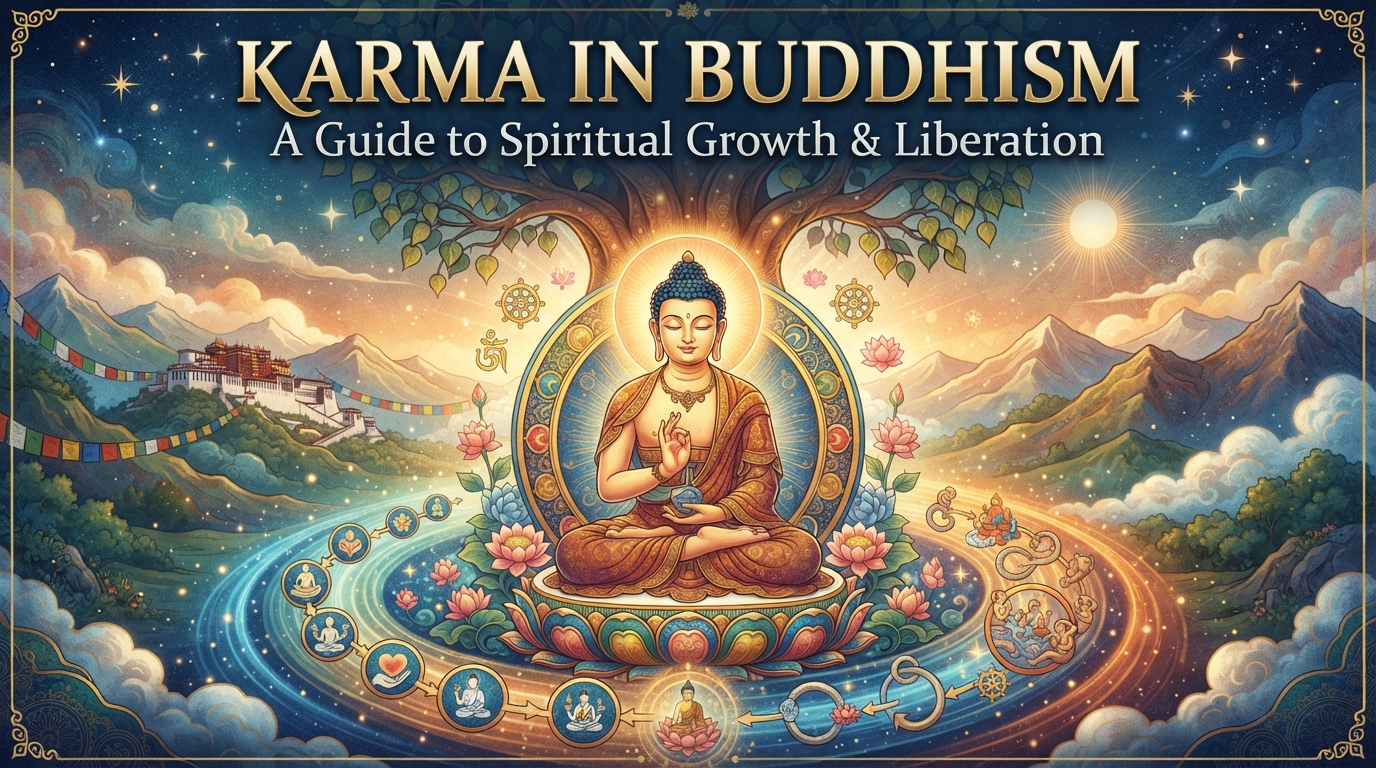
Karma: A Complete Guide to Cause and Effect, Spiritual Growth, and Personal Destiny
Introduction: What Does Karma Really Mean?
Have you ever said, “That’s my karma,” when something unexpectedly good—or painfully difficult—happened to you?
In modern Western culture, karma is often understood as a simple form of cosmic payback: do something good and something good will happen to you; do something bad and you will eventually suffer the consequences. But traditional teachings about karma are much deeper than this popular interpretation.
The idea of karma has its roots in ancient Indian philosophical and religious traditions, including Hinduism, Buddhism, and Jainism. Although the meaning and interpretation of karma differ between traditions, the concept generally centers on intentional action and its consequences.

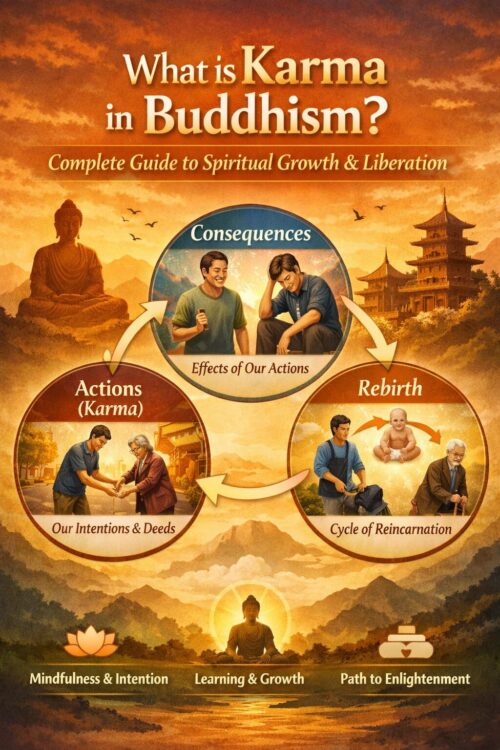
Karma is therefore not simply a system of rewards and punishments. Rather, it can be understood as a principle that connects our intentions, choices, habits, and actions with the experiences that follow from them. In many traditions, karma is also closely connected with samsara, the cycle of birth, death, and rebirth, and with the search for spiritual liberation.
Understanding karma can encourage us to look more carefully at the way we think, speak, and behave. Instead of seeing ourselves as powerless victims of fate, we can begin to recognize the influence our choices have on our relationships, character, and future.
The Law of Action: How Karma Shapes Your Life
Karma begins with a deceptively simple question: What are the consequences of the way we act?
Everyday choices may seem insignificant, but repeated thoughts and behaviors gradually shape our character and influence the world around us. This is one reason karma has remained such a powerful concept for understanding personal responsibility.
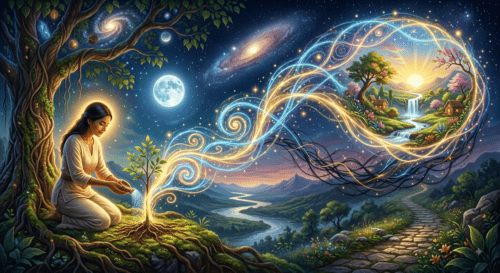
Every Action Begins With Intention
Karma is often translated as “action,” but in Buddhist philosophy, intention plays a particularly important role. An action motivated by compassion is not considered equivalent to an action motivated by hatred, greed, or selfishness.
Acts of generosity, honesty, patience, and kindness can encourage constructive patterns, while actions rooted in anger, cruelty, deception, or attachment can reinforce destructive ones.
This does not necessarily mean that the universe immediately sends a matching reward or punishment. Karma is better understood as a process in which intentions and actions contribute to consequences, habits, and patterns that unfold over time.
In this sense, karma is less about an invisible scorecard and more about understanding how what we repeatedly do can shape who we become.
Karma and the Cycle of Rebirth
In several Indian traditions, karma is connected to the idea of samsara, the ongoing cycle of birth, death, and rebirth.
Within these traditions, actions from previous lives can influence future circumstances, while actions in the present contribute to what may unfold in future lives. The exact explanation differs considerably between Hindu and Buddhist traditions, so karma should not be reduced to a single universal doctrine.
For someone who accepts the idea of rebirth, this perspective can create a powerful sense of responsibility. Life is not simply a series of random events; our choices become part of a much larger spiritual journey.
Even without accepting reincarnation literally, the principle can still offer a useful perspective: our choices leave traces. They influence our habits, relationships, reputation, character, and the circumstances we help create.
Three Traditional Perspectives on Karma
Some Hindu philosophical traditions describe karma through three broad categories. These concepts are particularly useful for understanding how past actions and present choices are related.
1. Sanchita Karma — Accumulated Karma
Sanchita karma refers to the accumulated store of karma from past actions. It represents the broader collection of karmic tendencies and consequences that have not yet become fully active.
2. Prarabdha Karma — Karma Being Experienced
Prarabdha karma is traditionally described as the portion of accumulated karma that has begun to produce results in the present life. It is associated with circumstances that are already unfolding and therefore cannot simply be avoided through ordinary choices.
3. Agami Karma — Karma Being Created
Agami karma refers to karma generated through present actions and intentions. This category highlights the importance of personal choice: what you think, say, and do today can influence what develops in the future.
Together, these ideas emphasize an important distinction between what has already unfolded and what you can still influence.
| Category of Karma | Definition | Core Focus | Ability to Change |
| Sanchita Karma | Accumulated store of all past actions | The entire pool of unmanifested karmic potential | Cannot change directly, but can be dissolved over time through practice |
| Prarabdha Karma | The active portion of karma currently unfolding | Current life circumstances, body, and initial environment | Cannot be undone; must be experienced and navigated wisely |
| Agami Karma | Karma being created right now through present actions | Present choice, intention, and reaction | Fully within your control; shapes all future karma |
Karma and Spiritual Liberation
If karma continually produces consequences, does that mean we are destined to remain trapped in an endless cycle?
Many Eastern traditions answer this question by pointing toward liberation.
In Buddhism, liberation from samsara is associated with nirvana. Hindu traditions use concepts such as moksha to describe liberation from the cycle of rebirth. Although these ideas are not identical, they share a concern with overcoming the ignorance, attachment, and craving that keep beings bound to suffering.

Releasing Destructive Patterns
Spiritual growth does not necessarily mean trying to “erase” karma overnight. Instead, it involves becoming aware of the patterns that repeatedly generate suffering.
Meditation, mindfulness, self-reflection, ethical conduct, and other spiritual practices can help people recognize habitual reactions before acting on them.
For example, someone who constantly responds to criticism with anger may eventually notice the pattern. With greater awareness, there is a small but important space between the triggering event and the response.
That space creates the possibility of choosing differently.
Over time, changing the way we respond can transform deeply established patterns.
The Power of Conscious Living
One of the most practical lessons associated with karma is the importance of awareness.
We often act automatically. A familiar fear produces the same reaction. A painful memory influences the way we treat someone. A desire for approval leads us to say things we do not truly mean.
Conscious living means learning to observe these impulses rather than allowing them to control every decision.
Before speaking, we can ask:
- Is what I am about to say necessary?
- Am I reacting from anger or fear?
- What intention is behind this action?
- Could I respond with greater patience or understanding?
These simple questions can turn ordinary moments into opportunities for personal growth.
Creating Positive Karma
Cultivating positive karma does not have to involve dramatic spiritual practices.
Small acts of kindness matter. So do honesty, generosity, patience, forgiveness, and consideration for other people.
When we consistently act with greater awareness and compassion, we can create healthier patterns in our own lives and positively influence those around us.
This is one of the most accessible ways to understand “good karma”: not as a promise that the universe will immediately reward us, but as a commitment to creating causes that are more likely to lead toward constructive outcomes.
How Karma May Influence Relationships, Work, and Well-Being
Karma is often discussed in highly spiritual terms, but its underlying ideas can also be applied to everyday life.
The way we treat other people, approach our responsibilities, and respond to challenges can gradually shape the direction of our lives.

Karma and Relationships
Relationships provide some of the clearest opportunities to observe our patterns.
We may repeatedly become involved with similar types of people, react to conflict in familiar ways, or carry unresolved resentment from one relationship into another.
From a karmic perspective, these experiences can be viewed as opportunities for learning rather than simply as rewards or punishments from the past.
Practicing empathy, honesty, forgiveness, and healthy boundaries can change the quality of our relationships. When we stop repeating destructive patterns, we also create the possibility of building healthier connections.
Rather than asking, “Why does this always happen to me?” a more constructive question may be:
“What can this experience teach me about the way I relate to others?”
Karma and Career
Work is another area where actions have consequences.
Integrity, reliability, patience, and a willingness to contribute to others can build trust over time. On the other hand, dishonesty, manipulation, and irresponsible behavior can damage professional relationships and create long-term difficulties.
Karma does not guarantee that every honest person will become wealthy or that every dishonest person will immediately fail. Real life is far more complicated than that.
However, the karmic perspective encourages us to pay attention to the causes we are creating through our professional choices.
Success becomes more meaningful when it is built on integrity rather than at the expense of other people.
Karma and Personal Well-Being
Our habits also influence how we experience life.
Sleep, nutrition, exercise, stress management, relationships, and emotional habits can all affect our overall well-being. While these factors should not be interpreted as a simple reflection of someone’s “good” or “bad” karma, our daily choices clearly have consequences.
The same principle applies to our mental habits.
Constantly feeding resentment, fear, or self-criticism can reinforce negative patterns. Developing greater self-awareness and learning healthier ways to process difficult emotions can gradually change the way we experience ourselves and the world around us.
Karma, viewed in this practical sense, becomes less about blaming ourselves for hardship and more about recognizing where we still have the power to choose differently.
Frequently Asked Questions About Karma
Is karma the same thing as fate or destiny?
No. Fate implies a fixed outcome that you cannot change. Karma emphasizes agency and personal responsibility—while past choices shape your present situation, your current choices actively create your future.
Does karma mean every bad thing that happens to me is my fault?
No. Traditional philosophies do not teach that every single event or illness is a direct punishment for past actions. Viewing misfortune purely as “bad karma” can lead to unjust self-blame or victim-blaming.
Can you clear or erase past karma entirely?
In many spiritual traditions, intense spiritual practice, self-awareness, forgiveness, and wise action do not necessarily “erase” the past, but they can neutralize its emotional power and prevent you from generating new negative patterns.
How quickly does karma work?
Karma does not follow a fixed schedule. Some consequences unfold immediately (like feeling instant regret after an angry outburst), while others develop slowly over years or shape long-term habits and future circumstances.
Conclusion: Turning Karma Into a Path of Personal Growth
Karma is much more than the familiar idea of “what goes around comes around.”
Across Hinduism, Buddhism, and other Indian traditions, karma has been explored as a profound relationship between intention, action, consequence, suffering, rebirth, and spiritual liberation. Its meaning varies between traditions, but one message remains especially relevant to everyday life: our choices matter.
We cannot control everything that happens to us. We cannot rewrite the past, and we cannot guarantee what the future will bring.
What we can influence is how we respond.
When we become more aware of our intentions, act with greater compassion, take responsibility for our choices, and learn from our experiences, we begin to change the patterns that shape our lives.
Whether you understand karma as a spiritual law, a philosophical principle, or a framework for self-reflection, it offers a valuable invitation:
Pay attention to what you are creating through your thoughts, words, and actions.
Every moment gives us another opportunity to choose with greater wisdom—and to create a future that reflects the person we are becoming.