The Law of Vibration and Resonance: Understanding How Energy, Frequency, and Consciousness Influence Your Life
Introduction
Have you ever met someone whose positive attitude instantly lifted your mood? Or entered a place that felt peaceful even before anyone spoke? Many people describe these experiences as sensing a person’s “energy” or “vibration.”
The concept behind these experiences is often explained through the Law of Vibration and Resonance. Popular in both spiritual philosophy and personal development, this principle suggests that everything in the universe is constantly moving, vibrating, and interacting through energy.
Although modern science and spirituality interpret these ideas differently, both acknowledge that matter is fundamentally dynamic rather than completely static. This fascinating intersection has inspired millions of people to become more aware of their thoughts, emotions, habits, and environments.
In this guide, we’ll explore the origins of the Law of Vibration and Resonance, examine its relationship with physics and consciousness, discuss emotional energy, and share practical methods that may help you cultivate a more positive and intentional life.
What Is the Law of Vibration and Resonance?
Everything Is in Motion
One of the foundational ideas behind the Law of Vibration is that nothing in the universe is truly motionless. Every atom, molecule, and particle constantly moves.
In physics, particles naturally possess motion and energy. On a microscopic scale, matter behaves in ways that often seem very different from our everyday experience.
Spiritual teachings build upon this scientific observation by proposing that thoughts, emotions, intentions, and consciousness also carry energetic qualities. While these interpretations extend beyond established scientific consensus, they have become influential in many meditation, mindfulness, and manifestation practices.
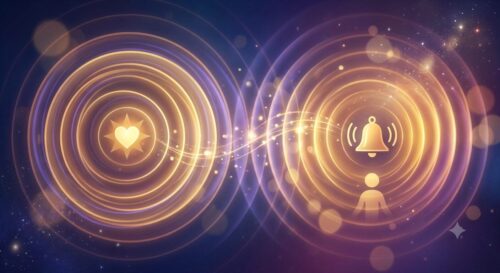
The principle of resonance adds another layer to this concept. Resonance occurs when two systems share compatible frequencies, allowing energy to transfer more efficiently. This physical phenomenon has inspired the metaphor that people, emotions, and life experiences may also “resonate” with similar patterns.
The Scientific Perspective
Modern physics has transformed our understanding of matter.
Instead of viewing reality as completely solid and fixed, quantum mechanics revealed that atoms consist mostly of empty space, with subatomic particles existing in constant motion.
This doesn’t mean that physical reality is an illusion, but it does demonstrate that the microscopic world is far more dynamic than it appears.
Scientists describe these interactions using mathematics and observable evidence, while spiritual traditions often interpret them symbolically as expressions of universal energy.
Although these viewpoints are not identical, they both encourage us to appreciate the complexity of the universe.
Energy, Frequency, and Human Consciousness
Max Planck’s Contributions
The development of quantum theory began with the pioneering work of physicist Max Planck.
His research demonstrated that energy is emitted in discrete units known as quanta, laying the foundation for modern quantum mechanics.
Planck’s discoveries fundamentally changed physics by showing that energy behaves differently at microscopic scales than previously believed.
While many spiritual authors reference Planck when discussing vibration, it’s important to recognize that his scientific work focused on measurable physical phenomena rather than metaphysical manifestation.
Nevertheless, his discoveries continue to inspire broader conversations about the energetic nature of reality.
Nikola Tesla’s Famous Quote
Few individuals are quoted more often in discussions about vibration than Nikola Tesla.
He is widely credited with saying:
“If you want to understand the secrets of the universe, think in terms of energy, frequency, and vibration.”
Whether viewed as literal scientific advice or philosophical inspiration, this statement has become one of the defining ideas behind vibration-based spirituality.
Tesla recognized that frequency governs many natural processes, from electricity to wireless communication. His words continue to encourage people to think beyond visible matter and consider the invisible forces shaping everyday life.
Thoughts and Emotional Patterns
Every day, your brain generates thousands of thoughts.
Some create optimism and motivation.
Others reinforce fear, doubt, or stress.
Psychologists have long recognized that repeated thought patterns influence behavior, decision-making, confidence, and overall well-being.
From the perspective of the Law of Vibration and Resonance, these recurring mental patterns form your energetic signature—the frequency you consistently express through your actions, emotions, and beliefs.
Whether interpreted scientifically or spiritually, maintaining constructive thought patterns often contributes to healthier habits and improved emotional resilience.
Resonance: Why Similar Energies Seem to Connect
Understanding Resonance in Physics
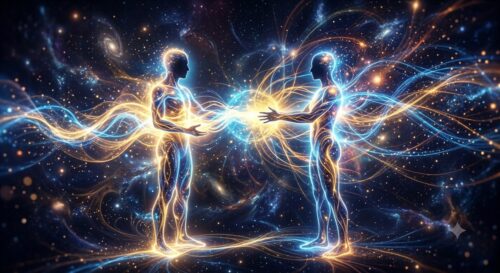
Resonance is a well-established scientific phenomenon.
When one vibrating object shares the same natural frequency as another, energy transfers efficiently, causing the second object to vibrate as well.
Musical instruments provide one of the simplest demonstrations.
Strike one tuning fork tuned to A440, and another nearby tuning fork of the same frequency will begin vibrating without direct contact.
Different frequencies, however, produce little or no response.
This elegant principle has become a powerful metaphor for human relationships and emotional experiences.
Applying Resonance to Daily Life
Many personal development teachers suggest that people naturally gravitate toward environments, conversations, and relationships that match their prevailing attitudes.
For example:
- Optimistic individuals often encourage one another.
- Highly motivated teams frequently inspire greater productivity.
- Chronic negativity may influence the emotional atmosphere of an entire workplace.
Although these social dynamics involve psychology, communication, and behavior rather than measurable energetic frequencies, the metaphor of resonance offers an accessible way to understand why environments matter.
Emotional States and Personal Growth

Many spiritual traditions describe emotions as existing along a spectrum of vibration.
Lower emotional states often include:
- Shame
- Guilt
- Fear
- Hopelessness
- Resentment
Higher emotional states commonly include:
- Courage
- Compassion
- Gratitude
- Love
- Joy
- Inner peace
Some authors have attempted to assign numerical values to these emotional levels. While such scales are not universally accepted within scientific research, many people find them useful as reflective tools for personal growth.
Rather than judging emotions as “good” or “bad,” it may be more helpful to view them as signals that guide self-awareness and emotional regulation.
Practical Ways to Cultivate a More Positive Frequency
Practice Daily Gratitude

Gratitude shifts attention away from scarcity and toward appreciation.
Keeping a simple gratitude journal, reflecting on meaningful experiences, or expressing thanks to others can strengthen emotional well-being and foster a more optimistic outlook.
Even a few minutes each day can gradually reshape your perspective.
Choose Your Environment Carefully
The people you spend time with influence your mindset more than you may realize.
Supportive friendships, encouraging mentors, and positive communities often reinforce healthy behaviors.
Likewise, reducing exposure to constant negativity can create space for greater emotional balance.
Your environment doesn’t determine your future—but it certainly affects the direction you’re moving.
Become More Intentional About Information
Everything you consume influences your mental landscape.
This includes:
- News
- Social media
- Music
- Books
- Podcasts
- Entertainment
Regularly exposing yourself to uplifting, educational, and inspiring content may contribute to a calmer, more focused mindset.
Being intentional about your informational diet is just as important as maintaining a healthy physical diet.
Spend Time in Nature
Nature offers an opportunity to disconnect from constant stimulation.
Walking through forests, sitting beside the ocean, or simply spending time in a quiet park allows the nervous system to slow down.
Many people report feeling more centered and emotionally refreshed after spending time outdoors.
Whether explained through psychology, biology, or spiritual symbolism, reconnecting with nature remains one of the simplest ways to improve overall well-being.
Move Your Body
Physical movement supports both mental and emotional health.
Exercise improves circulation, releases endorphins, reduces stress, and encourages emotional regulation.
You don’t need an intense workout.
Walking, yoga, stretching, dancing, or mindful breathing can all help restore balance and increase energy throughout the day.
Frequently Asked Questions
| Question | Answer |
|---|---|
| What is the Law of Vibration? | The Law of Vibration is the belief that everything in the universe is constantly moving and vibrating. Spiritual traditions extend this concept to thoughts, emotions, and consciousness. |
| Is the Law of Resonance scientifically proven? | Resonance is a well-established principle in physics. However, applying resonance directly to manifestation or attracting life experiences is a philosophical and spiritual interpretation rather than an established scientific conclusion. |
| Can positive thinking raise your vibration? | Positive thinking can improve emotional well-being, influence behavior, and support healthier habits. Many spiritual practices describe this as raising one’s vibration. |
| Why is gratitude considered a high vibration emotion? | Gratitude encourages appreciation, optimism, and emotional resilience. Within many spiritual traditions, it symbolizes abundance rather than scarcity, making it one of the most frequently recommended practices for personal growth. |
| How can I start improving my personal energy today? | Begin with small daily habits such as mindful breathing, gratitude journaling, spending time in nature, exercising regularly, and surrounding yourself with supportive people. Consistency is often more effective than dramatic change. |
Conclusion
The Law of Vibration and Resonance offers a compelling framework for thinking about personal growth, emotional awareness, and the interconnected nature of life.
While scientific research and spiritual philosophy approach these ideas from different perspectives, both recognize that change begins with movement. Our habits shape our thoughts, our thoughts influence our actions, and our actions gradually create the lives we experience.
Whether you interpret vibration as a physical phenomenon, a psychological metaphor, or a spiritual principle, the practical message remains remarkably similar: become more conscious of what you think, what you feel, and what you repeatedly practice.
Every choice you make contributes to the atmosphere of your life. By cultivating gratitude, surrounding yourself with positive influences, caring for your body, and approaching each day with intention, you create the conditions for meaningful personal transformation.
Ultimately, your life is shaped not by a single moment, but by the patterns you consistently choose to reinforce. Those patterns become your rhythm—and that rhythm influences the direction of your journey.