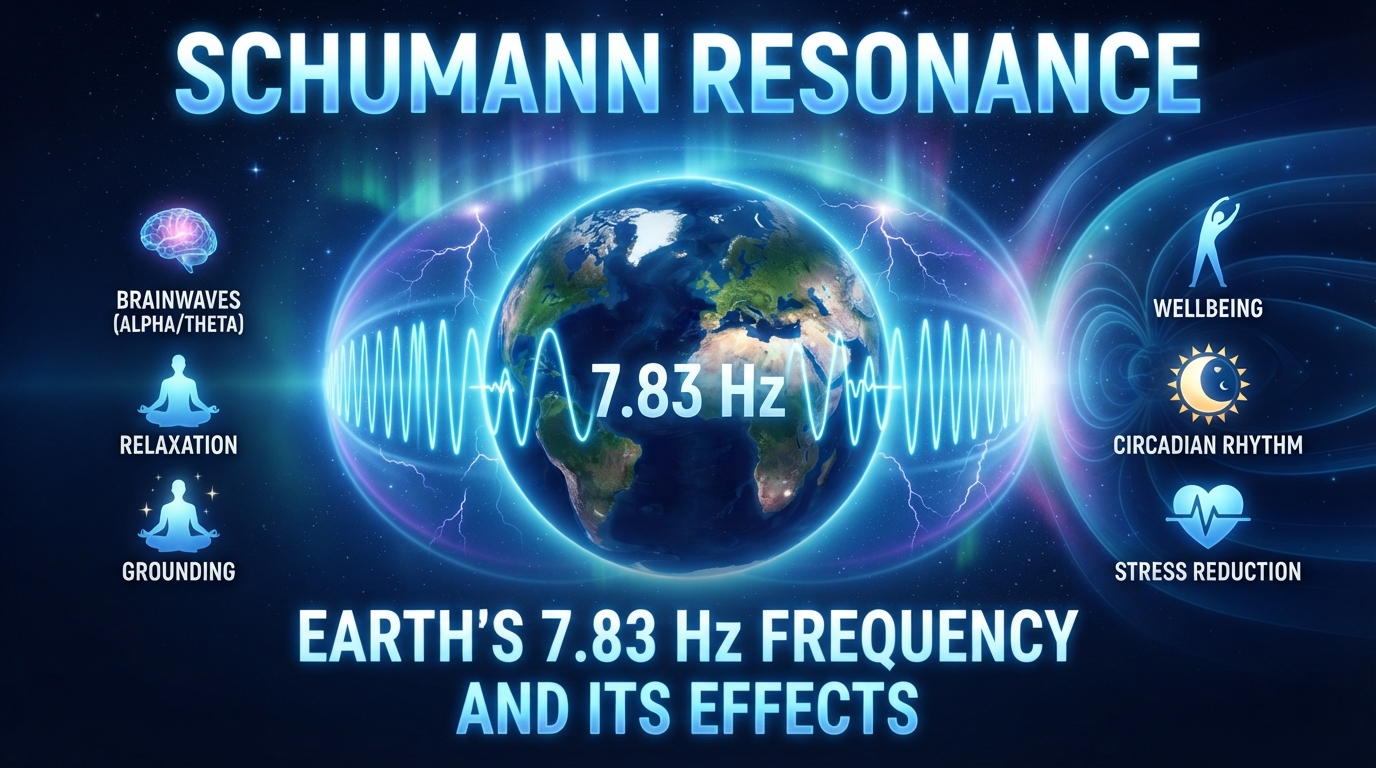
The Schumann Resonance: Your Ultimate Guide to Earth’s “Heartbeat” at 7.83 Hz
Introduction: What Is the Schumann Resonance?
What if the Earth had its own natural rhythm?
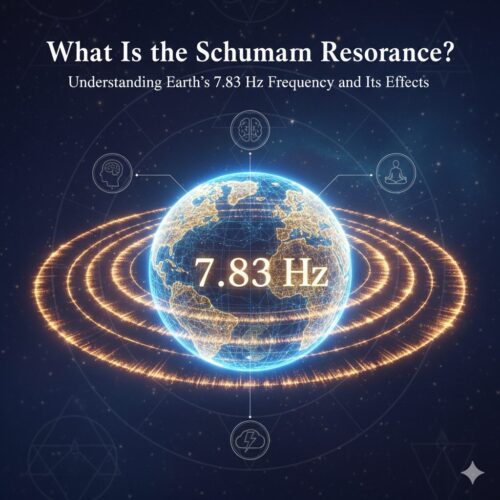
Although the idea of an “Earth heartbeat” may sound mystical, there is a real scientific phenomenon behind the expression. It is known as the Schumann Resonance, a group of extremely low-frequency electromagnetic resonances that occur in the space between Earth’s surface and the ionosphere.
The most commonly discussed frequency is approximately 7.83 Hz, often called the fundamental Schumann Resonance. These resonances are generated mainly by lightning activity around the planet, which continuously excites the Earth-ionosphere cavity.
The Schumann Resonance has attracted attention far beyond atmospheric physics. Researchers study it as part of Earth’s electromagnetic environment, while meditation communities and spiritual practitioners have become interested in its possible relationship with relaxation, consciousness, and our sense of connection with nature.
But what does the science actually tell us? And why has 7.83 Hz become such a fascinating number?
Let’s explore the phenomenon from both scientific and experiential perspectives.
The Science Behind the Schumann Resonance
To understand the Schumann Resonance, it helps to imagine Earth and its atmosphere as a gigantic natural resonant cavity.
The Earth’s surface forms one boundary, while the electrically conductive ionosphere acts as another. The region between them can support electromagnetic waves at particular frequencies.
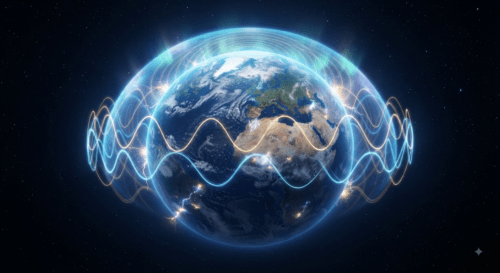
Lightning plays a crucial role in this process.
Thousands of thunderstorms occur around the world, and lightning strikes generate broad-spectrum electromagnetic energy. Some of this energy becomes trapped within the Earth-ionosphere cavity and travels around the planet.
As electromagnetic waves move through this enormous cavity, they can interfere with one another. Under the right conditions, this produces standing-wave patterns known as Schumann resonances.
The lowest major resonance is generally measured at around 7.83 Hz, although the exact value can vary.
Why 7.83 Hz?
The fundamental frequency is determined largely by the size and electrical properties of the Earth-ionosphere cavity.
Earth has a circumference of roughly 40,000 kilometers, creating an enormous environment in which electromagnetic waves can propagate. Because the ionosphere is not a perfectly uniform boundary, the actual resonance does not correspond to a simple textbook calculation.
The commonly observed fundamental mode is therefore close to 7.83 Hz rather than exactly 8 Hz.
Several higher resonant modes also exist. They are commonly observed around:
- 7.83 Hz
- 14.3 Hz
- 20.8 Hz
- 27.3 Hz
- 33.8 Hz
These values can shift somewhat depending on atmospheric and ionospheric conditions.
Is the Schumann Resonance Always Exactly 7.83 Hz?
Not quite.
The number 7.83 Hz is best understood as an approximate reference value rather than a perfectly fixed frequency. The resonances can vary in frequency and intensity depending on factors such as lightning activity, atmospheric conditions, solar activity, and changes in the ionosphere.
This is one reason scientists monitor Schumann Resonances: they provide useful information about processes occurring in the atmosphere and near-Earth electromagnetic environment.
In other words, Earth’s “heartbeat” is not a perfectly metronomic beat. It is a dynamic natural phenomenon.
Schumann Resonance and the Human Brain: Is There a Connection?
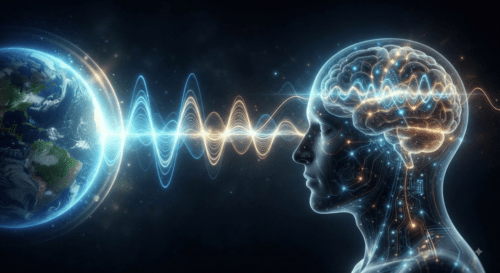
One of the most fascinating aspects of the Schumann Resonance is its frequently discussed relationship with human brain activity.
The human brain produces electrical activity that can be measured through electroencephalography (EEG). Different patterns of brain activity are commonly associated with different mental states.
For example:
- Theta activity: approximately 4–8 Hz, often associated with drowsiness, deep relaxation, memory processing, and certain stages of meditation.
- Alpha activity: approximately 8–12 Hz, commonly associated with relaxed wakefulness and reduced mental activity.
At approximately 7.83 Hz, the fundamental Schumann Resonance sits near the boundary between commonly described theta and alpha ranges.
This overlap is intriguing, but it is important not to confuse frequency similarity with proof of a biological effect.
Does the Brain Synchronize With 7.83 Hz?
The concept of entrainment suggests that biological rhythms can sometimes become synchronized with external rhythmic stimulation. This phenomenon is well established in some contexts, but that does not automatically prove that the human brain synchronizes specifically with the natural Schumann Resonance.
There is ongoing interest in whether extremely low-frequency electromagnetic phenomena may interact with biological systems. However, claims that the 7.83 Hz Schumann Resonance directly controls human brainwaves, consciousness, or emotional states remain scientifically unproven.
The relationship is therefore best viewed as an interesting area of research rather than an established fact.
Why Does 7.83 Hz Feel So Significant to Many People?
There may be a psychological reason as well as a physical one.
Humans naturally look for patterns and connections between ourselves and the environment. Learning that the planet has measurable electromagnetic resonances can create a powerful sense of connection with nature.
For someone practicing meditation, the idea of “tuning into Earth’s frequency” can also become a useful mental metaphor.
Even when the experience is subjective, it can still be meaningful.
The Schumann Resonance in Meditation and Spiritual Practices
The Schumann Resonance has become increasingly popular in meditation, sound therapy, and spiritual communities.
You may find meditation recordings, music, or devices marketed as being “tuned to 7.83 Hz.” These are often presented as tools for relaxation, grounding, emotional balance, or spiritual awareness.

It is worth making an important distinction, however.
Listening to a recording described as “7.83 Hz” does not necessarily reproduce the electromagnetic conditions of the Earth-ionosphere cavity. A low-frequency electromagnetic resonance and an audible sound are fundamentally different physical phenomena.
Nevertheless, using 7.83 Hz as a meditation theme can still have value.
Meditation itself has been associated with relaxation and changes in attention and stress responses. If the idea of Earth’s natural rhythm helps you slow down, breathe more deeply, and become more present, the practice may feel beneficial regardless of whether the Schumann Resonance itself is causing the effect.
In this sense, the resonance can serve as both a scientific phenomenon and a meaningful symbol of connection with nature.
Schumann Resonance in the Modern World
Modern life has transformed the electromagnetic environment in which we live.
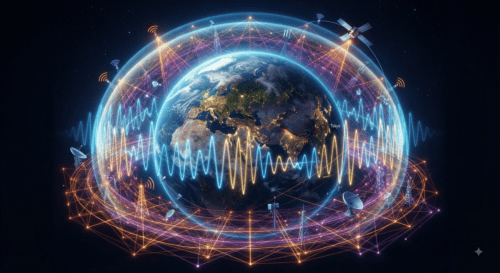
Wireless networks, telecommunications, electrical systems, satellites, and countless electronic devices produce electromagnetic signals across a wide range of frequencies. This has naturally raised questions about how human-made electromagnetic fields relate to Earth’s natural electromagnetic environment.
However, it is important not to lump all electromagnetic fields together.
The Schumann Resonance occupies an extremely low-frequency range, while technologies such as Wi-Fi and mobile communications operate at much higher frequencies. Their physical characteristics, sources, and interactions with matter are different.
What About Electromagnetic “Pollution”?
The term electromagnetic pollution is sometimes used to describe the increasing presence of artificial electromagnetic fields in modern environments.
Research into possible biological effects of electromagnetic exposure is ongoing, and the effects depend on factors such as frequency, intensity, duration, and exposure conditions.
At present, there is no established scientific evidence that everyday exposure to modern electromagnetic technology disrupts the Schumann Resonance in a way that causes widespread health problems.
This distinction matters because the Schumann Resonance itself is a real physical phenomenon, while some of the more dramatic claims surrounding it go considerably beyond the available evidence.
Schumann “Spikes” and the Idea of Global Consciousness
Perhaps nowhere is the Schumann Resonance more controversial than in discussions of spirituality and consciousness.
Online communities sometimes refer to sudden increases in Schumann Resonance readings as “Schumann spikes.” Some interpret these changes as signs of a collective awakening, energetic transformation, or shift in human consciousness.
These interpretations can be fascinating from a spiritual or philosophical perspective.
Scientifically, however, there is currently no established evidence showing that changes in Schumann Resonance measurements directly cause changes in global consciousness.
Changes in measured amplitude can result from variations in lightning activity, atmospheric conditions, solar influences, instrumentation, and other environmental factors.
That does not make the spiritual interpretation meaningless. It simply means that it should be presented as a belief or personal interpretation rather than a scientific conclusion.
Why Scientists Monitor the Schumann Resonance
Beyond its spiritual popularity, the Schumann Resonance has genuine scientific importance.
Because the resonances are influenced by conditions in the atmosphere and ionosphere, researchers can use them to study aspects of Earth’s electromagnetic environment.
Measurements can provide information related to:
- Global lightning activity
- Atmospheric electricity
- Ionospheric conditions
- Solar influences
- Geophysical processes
- Changes in the near-Earth electromagnetic environment
This makes the Schumann Resonance much more than a symbolic “Earth frequency.”
It is also a useful natural phenomenon that helps scientists understand the complex electrical relationship between Earth, its atmosphere, and space.
How to Connect With Earth’s Natural Rhythm
You do not need expensive equipment to explore the meaning of the Schumann Resonance in your own life.
Instead of thinking about “activating” a specific frequency, consider using the concept as an invitation to slow down and reconnect with the natural world.

1. Spend More Time Outdoors
Walking through a forest, sitting beside the ocean, or simply spending a few quiet minutes in a park can help create a stronger sense of connection with your surroundings.
The benefits of spending time in nature do not depend on proving that your body is literally absorbing 7.83 Hz. Nature provides a rich sensory environment that can encourage relaxation, reflection, and mental restoration.
2. Practice Grounding
Grounding, sometimes called “earthing,” can be as simple as walking barefoot on grass or sitting outdoors and paying attention to the physical sensations around you.
Some proponents make specific claims about the electrical transfer between the Earth and the human body, but those claims should be treated cautiously.
The more straightforward benefit is the opportunity to slow down, notice your surroundings, and become physically present.
3. Try Meditation
Meditation is another simple way to explore the symbolic meaning of Earth’s natural rhythm.
Sit comfortably, breathe slowly, and imagine yourself becoming synchronized with the steady rhythms of the natural world.
You can use a 7.83 Hz-themed meditation track if you enjoy it, but there is no need to believe that the recording is reproducing the actual electromagnetic Schumann Resonance.
The intention and experience of meditation may be more important than the number itself.
4. Use the Resonance as a Reminder
Perhaps the simplest approach is awareness.
The next time you look at the night sky, walk through a forest, or hear distant thunder, remember that Earth is not an electrically silent planet. Lightning, the atmosphere, the ionosphere, and countless natural processes are constantly interacting.
The Schumann Resonance offers a fascinating reminder that we live inside a dynamic planetary system.
Frequently Asked Questions About the Schumann Resonance
| Question | Answer |
|---|---|
| What is the Schumann Resonance? | It is a set of extremely low-frequency electromagnetic resonances that occur in the cavity between Earth’s surface and the ionosphere, driven primarily by lightning. |
| Why is 7.83 Hz important? | Approximately 7.83 Hz is the commonly observed fundamental Schumann Resonance frequency. |
| Is 7.83 Hz exactly constant? | No. The frequency can vary somewhat depending on atmospheric and ionospheric conditions. |
| Does the Schumann Resonance affect the human brain? | A direct effect has not been conclusively established. Its similarity to some brainwave ranges has generated scientific and popular interest, but frequency overlap alone does not prove synchronization. |
| Can listening to 7.83 Hz heal the body? | There is not enough scientific evidence to conclude that 7.83 Hz itself has specific healing properties. Meditation and relaxation practices may nevertheless be beneficial. |
| What causes the Schumann Resonance? | Global lightning activity provides the electromagnetic energy that excites the resonant cavity around Earth. |
| What are Schumann spikes? | The term is commonly used online for periods of increased activity or amplitude in Schumann Resonance measurements. Their causes are primarily investigated through atmospheric and geophysical processes rather than assumed changes in consciousness. |
| Is the Schumann Resonance a spiritual frequency? | Scientifically, it is an electromagnetic phenomenon. Its spiritual meaning comes from personal beliefs and interpretations rather than established physics. |
Conclusion: The Natural Rhythm of a Living Planet
The Schumann Resonance is one of those rare scientific phenomena that can inspire both curiosity and wonder.
At approximately 7.83 Hz, its fundamental resonance emerges from the interaction between lightning, Earth’s surface, and the ionosphere. It is measurable, scientifically meaningful, and constantly changing in response to the dynamic environment surrounding our planet.
At the same time, the idea of an “Earth heartbeat” has taken on a deeper symbolic meaning.
It reminds us that we are living within a much larger system—one in which the atmosphere, oceans, land, sunlight, storms, and electromagnetic processes are constantly interacting.
Some people may approach the Schumann Resonance through physics. Others may discover it through meditation, spirituality, or a desire to reconnect with nature.
There is room for both curiosity and caution.
We do not need to claim that 7.83 Hz is a miraculous healing frequency or that every fluctuation represents a shift in human consciousness to appreciate how remarkable the phenomenon really is.
Perhaps the most valuable lesson is simpler: Earth is not a passive backdrop to our lives. It is a dynamic environment with its own rhythms, cycles, and natural processes.
The next time you step outside and take a slow breath, remember that you are part of that environment.
And maybe that is the most meaningful way to “tune in” to Earth’s heartbeat—not by chasing a number, but by becoming more aware of the planet beneath your feet and the natural world surrounding you.
7.83 Hz frequency Tool
A single sustained tone at 7.83 Hz — the fundamental frequency of the electromagnetic cavity formed between the Earth's surface and the ionosphere.
What is the Schumann Resonance?
The space between the Earth's surface and the lower edge of the ionosphere acts like a giant cavity. Electrical activity in the atmosphere, largely from lightning, excites standing waves inside that cavity. The lowest and strongest of these waves sits at approximately 7.83 Hz — a figure first predicted by physicist Winfried Otto Schumann in 1952 and confirmed by measurement soon after.
Because 7.83 Hz falls within the same range as the human brain's alpha and theta wave activity, it's often referred to informally as the planet's "background hum" or "heartbeat." Many people who practice sound meditation use a tone at this frequency as an ambient backdrop for relaxation, focus, or grounding — though it's worth noting this is a wellness practice, not a clinically established treatment.
How to Use This Tool
- Set your volume to a low, comfortable level before pressing play — a steady tone can feel louder than expected at first.
- Press Play to start the 7.83 Hz tone. The rings above pulse once every 7.83 seconds as a visual echo of the frequency, slowed roughly 1000× so it can be seen rather than only heard.
- Optionally set a timer so the tone stops automatically — useful for meditation, sleep wind-down, or focused work sessions.
- Use headphones or a quiet room for the clearest, most immersive listening experience.
- Press Stop at any time to end playback.
This tool generates a pure sine wave for ambient listening. Claims about the effects of specific sound frequencies are drawn from wellness traditions rather than established science, and this tool is not a substitute for medical or psychological care.