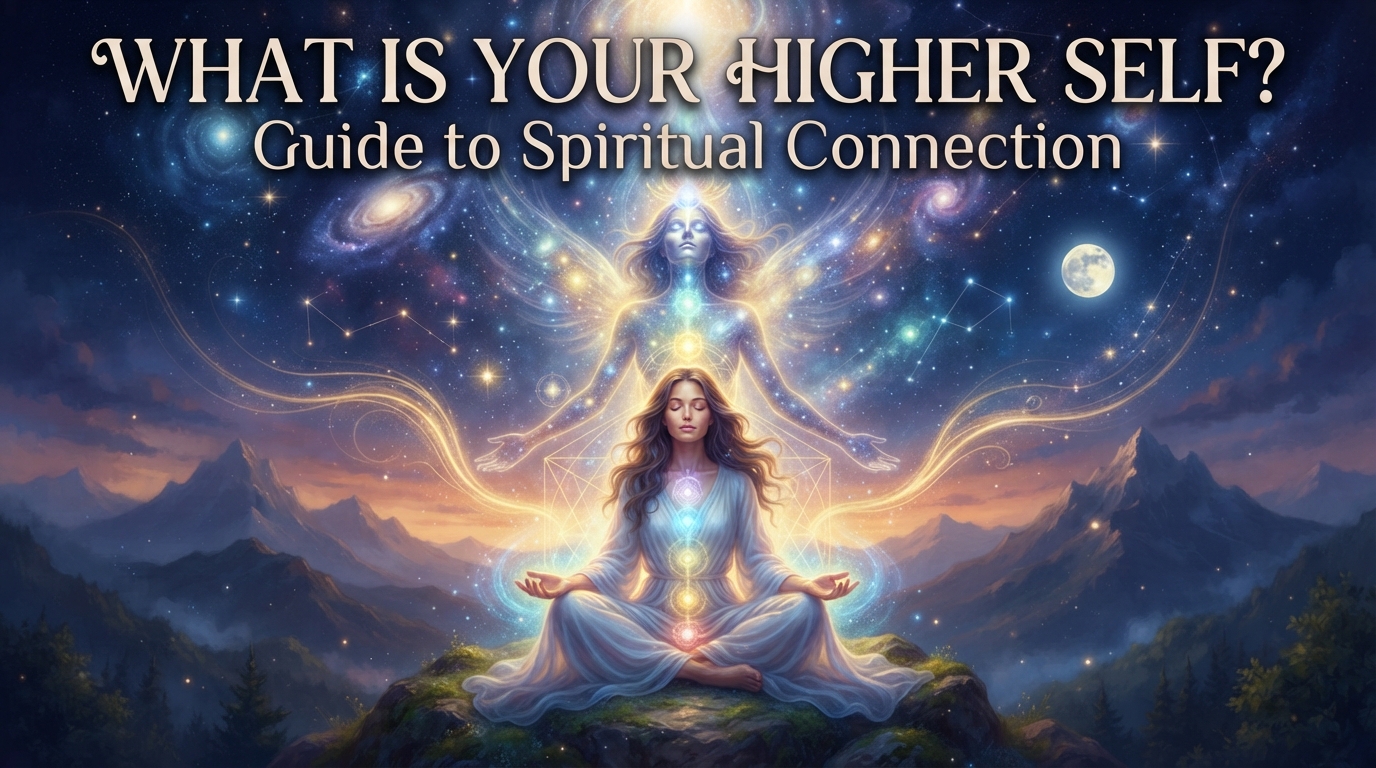
The Higher Self Decoded: A Complete Guide to Inner Wisdom, Life Purpose, and Living in Alignment
Introduction: What Is the Higher Self?
Have you ever experienced a quiet feeling that seems to come from somewhere deeper than your ordinary thoughts? Perhaps you suddenly knew that a certain decision was right, felt drawn toward a new direction, or discovered an unexpected sense of clarity during a moment of silence.
Many spiritual traditions describe this deeper source of awareness as the Higher Self.
The Higher Self can be understood as the wisest and most authentic aspect of who you are—the part of you that sees beyond temporary fears, habits, and social expectations. Rather than being a separate being, it is often described as a deeper level of consciousness connected to your values, intuition, inner wisdom, and sense of purpose.

The idea of the Higher Self is especially appealing when life feels confusing or disconnected. Instead of constantly searching for answers outside yourself, this perspective encourages you to become quiet enough to recognize the wisdom that may already exist within you.
In this guide, we will explore what the Higher Self means, how it differs from the ego and spiritual guides, and practical ways to strengthen your connection with your inner wisdom.
1. What Is the Higher Self? Understanding the Different Levels of Consciousness
The concept of the Higher Self can be interpreted in different ways depending on one’s spiritual or philosophical beliefs. Some people see it as an aspect of the soul, while others understand it as a symbol of expanded awareness and deeper self-knowledge.
For a practical approach, it can be helpful to explore the concept on three interconnected levels.

The Personal Higher Self
The personal Higher Self represents your deepest inner wisdom and your most authentic sense of direction.
It is the part of you that can recognize what truly matters beneath temporary emotions, fear, pressure, or the desire to please others. It may appear through intuition, strong inner feelings, moments of clarity, or a persistent sense that a particular path is meaningful to you.
For example, you may know that a certain relationship, career path, or lifestyle no longer feels right even when you cannot immediately explain why.
This does not mean every instinct is automatically correct. Intuition can be influenced by past experiences, fears, and expectations. The important practice is learning to observe your inner responses rather than immediately acting on them.
Over time, self-awareness can help you distinguish between anxiety, impulse, and genuine inner guidance.
The Collective Higher Self
The idea of a Collective Higher Self expands awareness beyond the individual.
Human beings are deeply interconnected through families, communities, cultures, and shared experiences. Our choices affect other people, just as their choices affect us.
From a spiritual perspective, collective consciousness can be understood as a shared field of awareness. From a psychological perspective, it can simply represent our recognition that personal growth and social responsibility are connected.
When you develop greater compassion, patience, and awareness, the benefits are rarely limited to yourself. Your behavior influences the people around you and can contribute to healthier relationships and communities.
In this sense, connecting with your inner wisdom also means becoming more aware of your place within something larger than yourself.
The Cosmic Higher Self
The Cosmic Higher Self represents the broadest interpretation of the concept.
In many spiritual traditions, it refers to a universal consciousness or divine source connecting all existence. The experience associated with this idea is often described as a sense of oneness, interconnectedness, peace, or belonging.
Whether you interpret this spiritually or symbolically, the concept can encourage a shift in perspective. Instead of viewing yourself as an isolated individual, you begin to recognize your relationship with nature, other people, and the larger world.
This broader perspective can sometimes create a powerful sense of humility and inner peace.
2. How to Connect With Your Higher Self
Connecting with your Higher Self does not have to involve complicated rituals or extraordinary experiences. In many cases, it begins with something much simpler: slowing down and paying attention.

Meditation and Silence
Modern life is filled with information, notifications, conversations, and constant stimulation. When the mind is continuously occupied, subtle feelings and intuitive insights can be difficult to notice.
Meditation creates space for observation.
You do not need to empty your mind completely. Instead, sit quietly, focus on your breathing, and allow thoughts to appear and disappear without immediately following them.
With regular practice, you may become better at recognizing the difference between a fearful thought and a calm inner knowing.
Even five to ten minutes of quiet reflection each day can become a valuable starting point.
Journaling as a Conversation With Yourself
Journaling is another practical way to explore your inner world.
Rather than simply recording what happened during the day, try using your journal to ask meaningful questions:
- What am I truly feeling right now?
- What am I avoiding?
- What do I need to let go of?
- What matters most to me at this stage of my life?
- What would I choose if I were not afraid of failure?
- What is one small step I can take next?
Do not worry about producing perfect answers. Write freely and allow your thoughts to develop naturally.
Sometimes, the most useful insights appear only after you stop trying to find the “right” answer.
Learning to Listen to Your Intuition
Intuition is often described as the language of the Higher Self.
It can appear as a subtle feeling, an immediate sense of recognition, or an unexpected insight that seems to arrive without conscious reasoning.
However, intuition should not be confused with every strong emotion.
Fear can feel intuitive. Anxiety can feel like a warning. Impulsive desire can feel like certainty.
One useful approach is to observe your intuitive impressions before acting on them. Start with relatively small decisions and keep track of what you sensed, what you chose, and what happened afterward.
This creates an opportunity to learn how your own intuition actually works.
Spending Time in Nature
Nature can provide a powerful environment for reconnecting with yourself.
A walk through a forest, time beside the ocean, gardening, or simply sitting outside without your phone can interrupt the constant stimulation of everyday life.
Nature does not demand that you perform, achieve, or explain yourself. That change of environment can make it easier to notice your thoughts and emotions without becoming overwhelmed by them.
For many people, this simple practice creates the mental space necessary for reflection and inner clarity.
3. The Higher Self vs. Guardian Spirits: What’s the Difference?
The Higher Self is sometimes confused with guardian angels, spirit guides, or other spiritual beings. Although these concepts can overlap in spiritual traditions, they represent different ideas.

The Higher Self: Inner Wisdom
The Higher Self is generally understood as an aspect of your own deeper consciousness.
It does not exist separately from you. Instead, it represents a broader perspective of yourself—one that is less influenced by temporary fear, social expectations, and habitual patterns.
From this perspective, connecting with the Higher Self means developing a stronger relationship with your own inner wisdom.
Guardian Spirits: External Spiritual Guides
Guardian spirits or guardian angels are traditionally understood as spiritual beings that exist independently of the individual.
Different cultures and traditions describe them in different ways. Some people view them as protective beings, ancestral guides, angels, or other benevolent spiritual presences.
Beliefs about their existence are deeply personal and cannot be established as objective fact. Nevertheless, many people find the idea meaningful because it provides a symbolic or spiritual framework for guidance, protection, and hope.
Can They Work Together?
Within spiritual traditions that accept both concepts, the Higher Self and spiritual guides are often viewed as complementary.
The Higher Self represents internal wisdom and self-awareness, while guardian spirits are seen as sources of external spiritual guidance.
Whether you understand these ideas literally or symbolically, the practical lesson is similar: cultivate awareness, remain open to meaningful experiences, and avoid surrendering your personal judgment.
A healthy spiritual practice should ultimately help you become more grounded, conscious, and capable of making your own decisions.
4. What Happens When You Live in Alignment With Your Higher Self?
Living in alignment does not mean that life suddenly becomes perfect. Difficulties, uncertainty, and unexpected events are still part of being human.
The difference is often found in how you respond to them.

Greater Awareness of Synchronicity
Synchronicity refers to meaningful coincidences that seem personally significant.
You might think about an old friend and unexpectedly hear from them, encounter a book that addresses a question you have been exploring, or discover an opportunity that seems closely connected to a goal you recently identified.
Some people interpret these experiences as signs from the universe or their Higher Self. Others see them as the natural result of increased attention and pattern recognition.
Either way, paying attention to meaningful coincidences can encourage reflection and help you notice possibilities that you might otherwise overlook.
Stronger Intuition and Creativity
When you become less overwhelmed by fear and mental noise, creative ideas can emerge more naturally.
Artists, writers, entrepreneurs, and other creative people often describe moments when ideas seem to arrive unexpectedly. Practices such as meditation, journaling, walking, and quiet reflection can create the mental space in which these insights become easier to recognize.
The goal is not to force inspiration but to create conditions in which it can emerge.
A Clearer Sense of Purpose
One of the most meaningful benefits of inner alignment can be a clearer understanding of what matters to you.
Purpose does not necessarily mean discovering one grand mission that determines the rest of your life. It can be much more practical.
Your purpose may involve how you treat people, the work you choose to pursue, the relationships you nurture, or the kind of person you want to become.
As you become more aware of your values, decisions can become easier because you have a clearer internal reference point.
Greater Inner Peace
Perhaps the most important change is not external at all.
When you stop trying to control every outcome and begin accepting what you can and cannot influence, life can feel less like a constant struggle.
Inner peace does not mean never experiencing fear, sadness, or uncertainty. Instead, it means learning that these emotions can exist without completely controlling your decisions.
This is where the idea of the Higher Self becomes especially practical: it encourages you to step back, observe your experience, and choose your response with greater awareness.
Conclusion: Your Higher Self as a Path to Deeper Self-Knowledge
The Higher Self can be understood as a spiritual reality, a deeper level of consciousness, or a powerful metaphor for our capacity for wisdom and self-awareness.
Regardless of how you interpret it, the underlying practice is valuable: slow down, listen inwardly, question automatic patterns, and become more conscious of what truly matters to you.
Meditation can create silence. Journaling can reveal hidden thoughts. Time in nature can restore perspective. Developing intuition can help you recognize subtle emotional and psychological signals.
None of these practices requires you to abandon reason or ordinary life. Instead, they can complement practical thinking by helping you understand yourself more deeply.
Your Higher Self does not have to be something distant or mysterious. It can begin with a simple question:
What do I already know deep down, but have not yet taken the time to hear?
Sometimes, the journey toward greater purpose and inner peace begins not by searching for another answer, but by becoming quiet enough to recognize the wisdom within yourself.