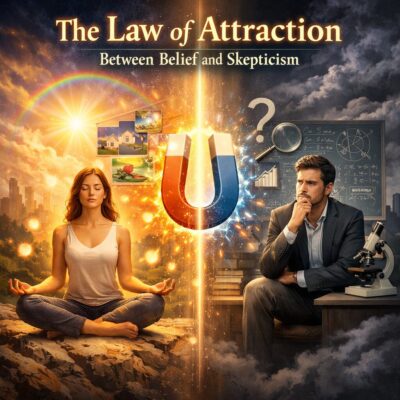
What Is the Law of Attraction, Really?

At its core, the Law of Attraction is built on a simple but powerful idea: like attracts like. The concept suggests that everything—thoughts, emotions, even circumstances—vibrates at a certain frequency, and similar frequencies naturally draw each other in.
This is why you often hear phrases like “thoughts become reality” or “your mindset shapes your life.” According to this view, what you consistently think and feel doesn’t just stay in your head—it subtly influences what shows up in your world.
A Philosophy with Mysterious Roots

Supporters often trace these ideas back to ancient traditions, sometimes pointing to texts associated with early Egyptian spirituality or later interpretations like the Kybalion. Over time, these concepts were repackaged into modern success philosophy, blending mysticism with self-help.
However, the historical claims are often vague or debated. While the narrative of ancient wisdom is appealing, it’s not always clear how much of it is grounded in fact versus reinterpretation. In many ways, the modern version of the Law of Attraction feels less like a direct inheritance and more like a reimagining of older philosophical ideas.
Mindset, Emotion, and the Limits of Control

A common theme in Law of Attraction teachings is the importance of maintaining a positive, excited, or “abundant” mindset. The idea is that if you truly embody the feeling of already having what you want—especially wealth or success—you’ll naturally attract it.
But there’s a complication: our subconscious isn’t fully under our control. Thoughts arise unexpectedly, emotions fluctuate, and people often find themselves reacting rather than consciously choosing every feeling.
There’s also a shared understanding that while you might influence your own internal state, you can’t directly control other people. This creates a tension in the theory—how much of reality can really be shaped from within?
Belief vs. Skepticism

This is where the biggest divide appears.
On one side, believers see the Law of Attraction as a meaningful framework for personal growth. Even if it’s not scientifically proven, they argue that focusing on positive thinking and intention can still lead to better outcomes.
On the other side, critics point out the lack of empirical evidence. Compared to psychology—which relies on research and measurable data—the Law of Attraction is often seen as unproven at best, misleading at worst.
Skepticism also grows when the concept is tied to expensive seminars or products. For some, this raises red flags, making it feel less like a philosophy and more like a business model.
Still, defenders push back: if it doesn’t resonate with you, simply ignore it. From this perspective, success or failure is personal—if it didn’t work, maybe it just wasn’t applied effectively.
Conclusion
The Law of Attraction sits in an interesting space between philosophy, self-help, and belief. It offers an appealing message—that your inner world shapes your outer reality—but also raises valid questions about evidence, control, and responsibility.
Whether you see it as a useful mindset tool or an unproven idea may ultimately depend less on the theory itself, and more on what you’re looking for: certainty, or possibility.